Get Full Government Meeting Transcripts, Videos, & Alerts Forever!
Get email alerts on the Legacy Funding topic
No spam. Unsubscribe anytime.
Senate advances legacy appropriations bill after contentious floor amendments; transparency and repeat grants spar over priorities
Summary
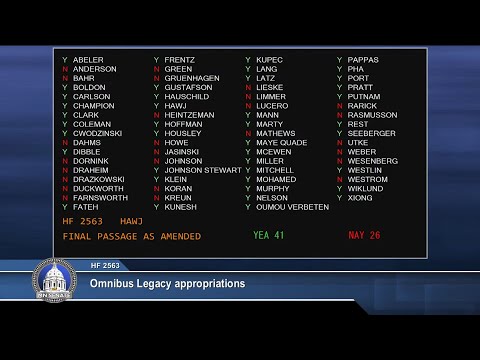
The Senate passed House File 25‑63 (legacy appropriations) after debate over amendments on grant priorities, repeat grantees and reporting. Several transparency and reporting amendments failed; the bill passed 41–26.
The Minnesota Senate passed the legacy appropriations bill (House File 25‑63) on May 12 after floor debate over how legacy funds are allocated and whether repeat grantees should be restricted. The final vote on the bill was 41–26.
Floor discussion centered on the distribution of funds across the four legacy accounts (outdoor heritage, clean water, parks and trails, and arts and cultural heritage), transparency for grant recipients, and how often organizations may receive legacy grants. Senator Herr offered a delete‑all substitute (A23) that included a set of changes and expanded grants for specified commemorations; the A23 amendment was adopted on a recorded roll call.
Senator Green repeatedly pressed amendments aimed at increasing reporting and limiting repeat awards to the largest recurring grantees. Several of those amendments (A24, A25, A29) were defeated on roll calls. Senator Green framed the proposals as accountability measures; opponents including the bill sponsor said the administering agencies and existing processes provide necessary safeguards and preferred to refine reporting in committee or the summer interim.
Other floor actions included a friendly amendment from Senator Pratt (A34) to give priority to previously unfunded groups in a particular commemoration appropriation; Pratt's amendment was accepted as a friendly amendment. Senator Abler offered an amendment to add funding for a rapid local response to an emergent spongy‑moth infestation; he later withdrew the amendment after discussion with the committee chair. Senator Lucero offered A55, proposing recipient eligibility checks related to immigration status; that amendment failed on a roll call.
Proponents of stronger reporting argued legacy funds are substantial and require public accountability; opponents said the bills include statutory and administrative safeguards and that some programs require multi‑year funding and continuity.
Why it matters: The legacy funds support conservation, clean water, parks and arts projects statewide. Floor votes affect which projects are prioritized and can change the administrative guidance sent to grant recipients.
Next steps: With Senate passage the bill will proceed to final steps (enrollment and reconciliation with the House if required). Sponsors flagged intentions for follow‑up oversight and possible statutory refinements during the interim.
Quoted from the floor: "Sunsetting this new low to moderate income community solar program is both premature and will slow down the growth of solar power generation in Minnesota," — Senator McEwen (in related energy debate earlier); on legacy appropriations, Senator Green said, "Eventually, we're going to have to dig into this."
Ending: The bill cleared the Senate with several transparency proposals defeated and others accepted; lawmakers said they will continue to press changes during committee work and interim oversight.