Get Full Government Meeting Transcripts, Videos, & Alerts Forever!
Get email alerts on the Cvso Funding topic
No spam. Unsubscribe anytime.
Lawmakers and veterans officers urge increased state funding for county veteran service officers
Summary
County veteran service officers told a joint Senate–Assembly hearing in Sacramento that modest state investments expand access to federal benefits, reduce homelessness and suicide risk, and counter predatory for‑profit claim agents.
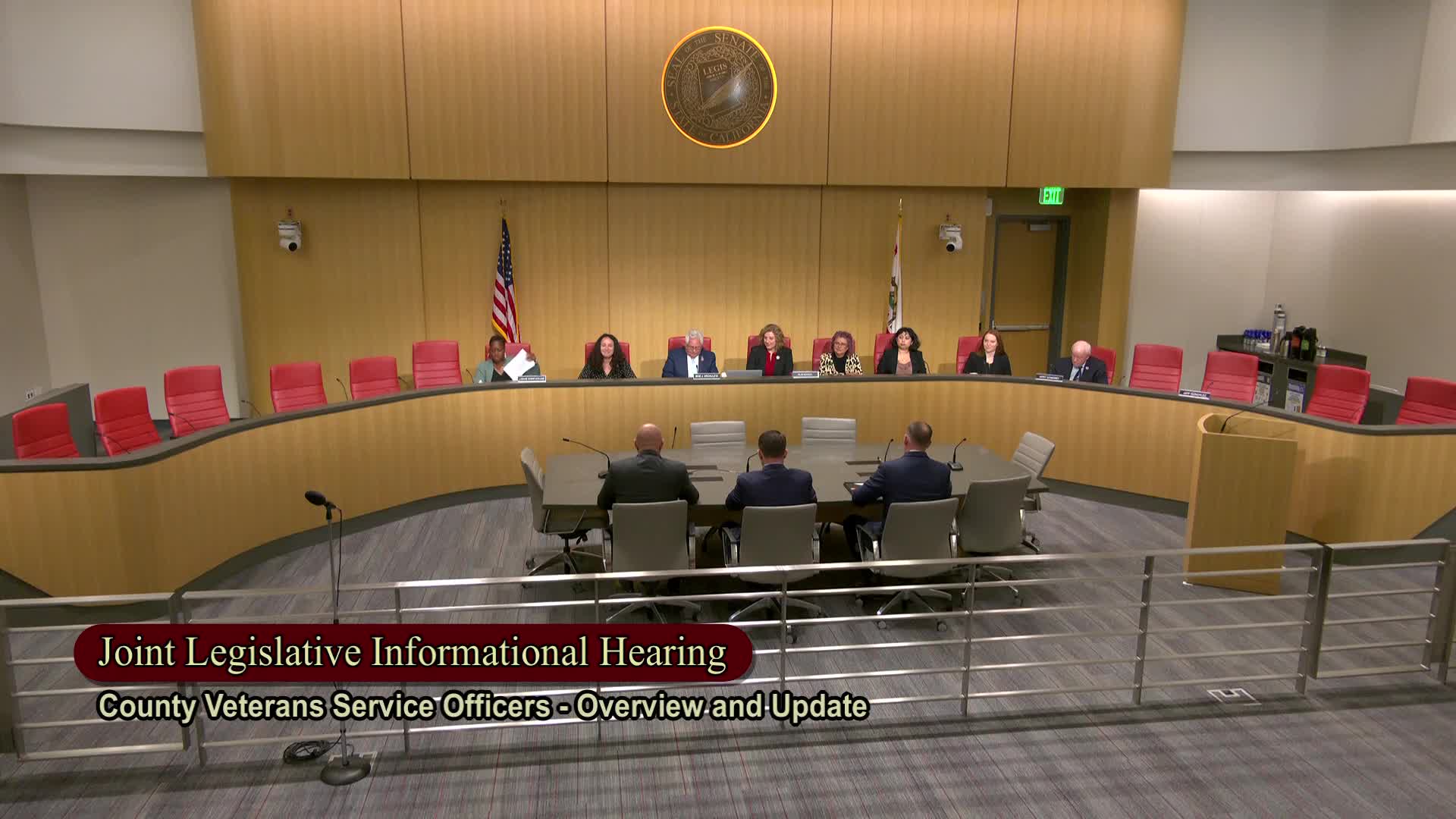
At a joint informational hearing of the Senate and Assembly Committees on Military and Veteran Affairs in Sacramento, county veteran service officers urged state lawmakers to increase funding for County Veteran Service Officers (CVSOs), saying modest state investments generate large returns in federal benefits and local stability.
David West, president of the California Association of County Veterans Service Officers (CACVSO), told the committees that CVSOs are “the first point of contact for veterans, their spouses, and their family members” and that counties’ offices build “lifelong relationships with veterans, advocating for them across decades.”
The request centered on expanding the state subvention that supports CVSO operations. West and other witnesses provided detailed figures: the state currently provides about $11,000,000 in annual general‑fund subvention; the Medi‑Cal Cost Avoidance Program supplies about $838,000; and the Veterans Services Office Fund provides about $554,000. West said CalVet’s proposed 2025 budget totals about $565,000,000, with roughly $421,000,000 dedicated to veterans homes. By contrast, West said the CVSO allocation translates to about $7.86 per veteran per year when spread across the roughly 1,400,000 veterans CVSOs serve.
That, witnesses argued, understates CVSOs’ return on investment. Placer County CVSO Richard Johnson and others cited statewide figures showing CVSOs filed roughly 12% of claims submitted to the U.S. Department of Veterans Affairs in the past year, securing hundreds of millions in new federal benefits. Jim Zenner, Los Angeles County Director of Military and Veteran Affairs, described local programs that pair county resources with CVSO services and said county investments had helped the county reduce veteran homelessness and improve service outcomes.
West and others also framed the funding request as a public‑protection measure. They told legislators that underresourced CVSO offices leave veterans vulnerable to unaccredited commercial consultants who charge fees for work CVSOs provide for free. “We are not standing still,” West said, and asked the Legislature “to meet the commitment that was set forth in the California Military and Veterans Code of the legislature’s intent to fund 50% of County Veterans Services operation budget.”
CalVet Deputy Secretary Roberto Herrera described the accreditation and training pipeline that supports CVSOs and said improved staffing increases the quality and speed of claims. Herrera said California‑power‑of‑attorney claims average about 135 days to decision, compared with higher averages elsewhere, and pointed to ongoing CalVet district‑office review and appeals work as quality controls.
Why it matters: witnesses tied funding to measurable outcomes — more accredited representatives, cleaner initial claims, faster processing, and higher rates of benefits awards — which in turn produce recurring federal benefits and local economic activity. Lawmakers on the panel asked staff and witnesses for data to quantify the return on investment and discussed an updated budget ask to increase the state subvention above $11,000,000.
Prognosis and next steps: witnesses described ongoing efforts — CACVSO mentorship and fellowship programs, CalVet training academies, county pilot programs — and asked lawmakers to consider increasing the state subvention and to support related policy changes. No formal votes or legislative actions were taken at the hearing.