Get Full Government Meeting Transcripts, Videos, & Alerts Forever!
Get email alerts on the School Facilities topic
No spam. Unsubscribe anytime.
Wake County Public Schools outlines $3 billion, seven-year capital plan and life-cycle needs
Summary
Wake County Public Schools staff presented their FY2026–FY2032 capital improvement program update, described the program components (new schools, additions/renovations, program requirements), and said life-cycle backlog is between $600M–$700M with life-cycle spending planned to rise to roughly $46M in FY26.
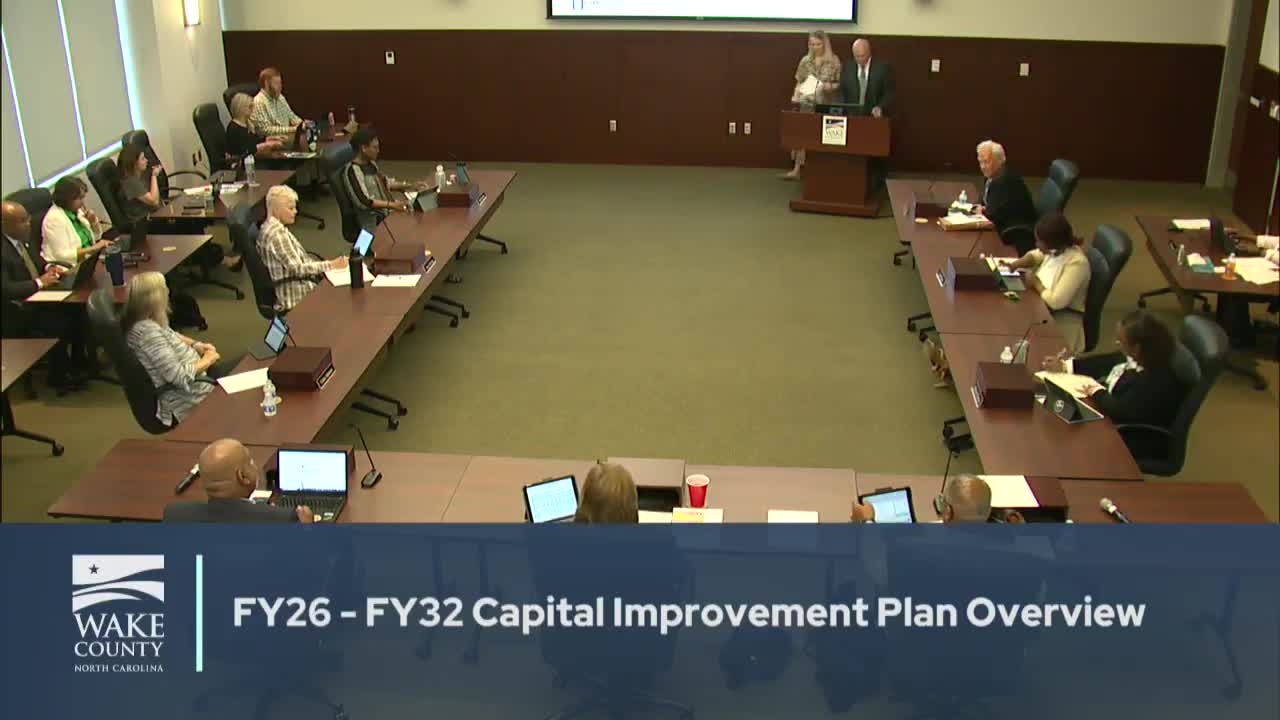
Wake County Public Schools staff updated the Wake County Board of Commissioners on the district’s FY2026–FY2032 capital improvement program during the May 12 work session, describing three primary categories — new schools, additions and renovations, and program requirements — and answering commissioners’ questions about HVAC work, life-cycle backlog and staffing.
Mark Strickland, chief facilities and operations officer for Wake County Public Schools, said the seven-year CIP “is about $670,000,000” for new schools and that the district’s total seven-year plan for capital is “almost $3,000,000,000.” He told commissioners the new-schools list has not changed substantially from the prior year but that the district is exploring levers such as student reassignment and year-round calendars to maximize use of new capacity.
On existing schools, Strickland said the district uses a rubric that considers age, condition, program square footage, environmental issues (lead paint, asbestos), workload and how projects advance district diversity goals. He said the life-cycle backlog is “somewhere between 6 and $700,000,000” and that life-cycle spending has risen from about $20 million a few years ago to scheduled levels near $46 million in fiscal 2026, with roughly half of annual life-cycle funds directed to HVAC projects.
Commissioners pressed on operational detail. A commissioner asked whether life-cycle work covers full HVAC replacement; Strickland said replacing chillers alone can cost “anywhere from 2 to 3 or $4,000,000,” and that full projects often include pumps, air handlers, fire alarms and lighting. He said the district is adding life-cycle staff positions (two new positions approved) because current life-cycle staff are at capacity; he estimated about nine people in the life-cycle department and said additional positions are being advertised.
Strickland described how educator input is incorporated: program requirements for new facilities are developed with educators (science, art and other departments) before construction, and campus-level visioning sessions include school staff, students and the public once a school is identified for work. He said the district maintains work-order and environmental data that factor into prioritization and that many documents and committee materials are public via the facilities committee and school board meetings.
No formal board votes occurred on school projects during the session. Commissioners asked staff to provide additional documentation on life-cycle work, recent HVAC replacements and maintenance schedules; Strickland agreed to share the PowerPoint and follow-up information with county staff for distribution to commissioners.