Lifetime Citizen Portal Access — AI Briefings, Alerts & Unlimited Follows
Boca Raton CRA backs 3-month autonomous shuttle pilot in Meisner Park, staff to amend contract
Loading...
Summary
City staff proposed a 3-month, $90,405 pilot of an 8-seat Level 4 autonomous shuttle in a 0.5-mile Meisner Park loop; commissioners supported starting small while pressing to accelerate expansion to busier downtown routes and obtain federal approvals.
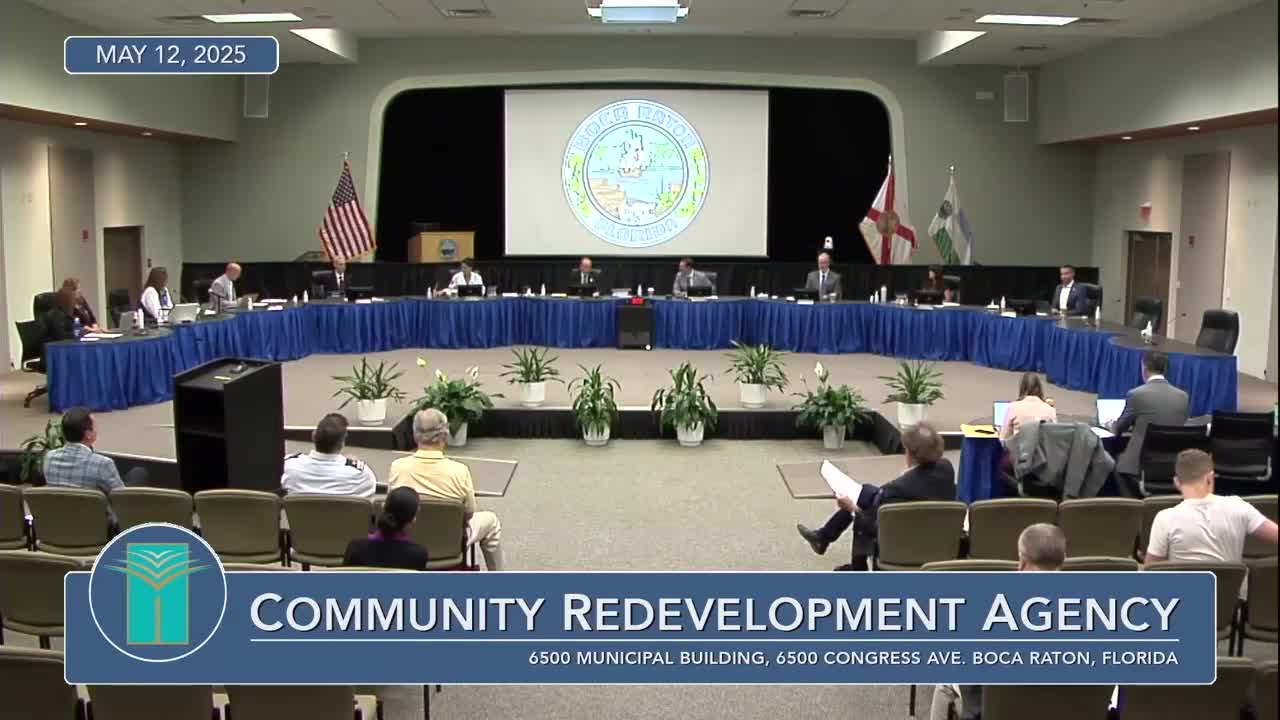
The Community Redevelopment Agency of Boca Raton on May 12 reviewed a proposal to run a three-month autonomous shuttle pilot in Meisner Park and directed staff to incorporate the service into the existing Circuit contract and pursue necessary approvals.
Zach Beard, Public Works and Engineering Director, told the CRA the pilot would use an eight-seat Level 4 autonomous shuttle on a roughly 0.5-mile loop in Meisner Park with four to six designated stops. Staff presented March 2025 Boca Connect ridership data (2,030 trips, 3,131 passengers) as background and said the pilot is intended to complement the city’s on-demand Boca Connect service and to generate operational data for future expansion.
Beard said the initial proposal is a three-month pilot priced at $90,405 that would be offered under a Circuit contract amendment and would include vendor responsibilities such as vehicle registration, insurance and installation of a charging station in Meisner Park. He noted federal approvals would be required for broader use and that the vendor recommends starting small and scaling. “It would be possible to get down to Sanborn Square,” Beard said when asked about route alternatives, and staff said they would evaluate alternatives that connect Meisner Park to Royal Palm Plaza and across Palmetto Park Road.
Representatives of the proposed vendor, including a speaker identified as Mr. Braun from the vendor’s operations team, described recent launches in other Florida cities and a remote operations center that can take over a vehicle if needed. Braun said the West Palm Beach pilot launched April 16, 2025, on a 0.9-mile loop with six stops and reported about 113 rides per week with one vehicle operating limited hours. He said the vendor provides the software and remote monitoring and noted advertising inside vehicles is feasible and did not appear to conflict with the city’s sign code.
Staff and vendor described technical and operational limits: the shuttle’s reported top operating speed is 25 miles per hour (the presentation contained a typo indicating kilometers per hour), the vehicle requires a safety passenger under current federal practice, charging cycles include about 55 minutes to continue operations, and future teleoperations could lower staff needs if federal rules change. Beard said the pilot would provide “a massive amount of information” on trip starts, ends and heat maps showing concentration of downtown trips.
Commissioners pressed staff on timing, routing and scale. Mayor Singer and Commissioner Nocles (identified in the transcript as Ms. Nockelson) asked how quickly the city could move to phase 2 and 3 — operating on public streets beyond the internal loop — with estimates from staff ranging from roughly eight months to a year for implementation of expanded routes and regulatory and design work. Commissioner Drucker urged a more accelerated approach, noting other municipalities moved faster and asking staff and legal to identify any policy or permitting changes needed to speed expansion.
There was no formal vote to authorize full deployment; instead the CRA gave staff direction to proceed with the pilot planning, to prepare amendments to the Circuit contract to include the vendor’s service, and to work with legal on permitting, insurance and related approvals. Several commissioners said they preferred a short pilot (three months) to gather data and then quickly apply to the U.S. Department of Transportation and the National Highway Traffic Safety Administration for approvals required for expanded operations.
Staff listed operational parameters they would seek to finalize: days/hours of operation, whether the pilot should be seven days a week or four days a week for nine hours, details of the charging and storage sites, signage and how the vehicle’s presence would be shown in the Circuit app. Beard said staff would return with any amended proposals and additional cost scenarios.
The discussion emphasized the pilot’s limited scope as a data-collection step, not a full service rollout. Commissioners expressed support for beginning the pilot while simultaneously pursuing faster approvals and route extensions to connect Meisner Park to higher-demand downtown stops.