Get Full Government Meeting Transcripts, Videos, & Alerts Forever!
Get email alerts on the Youth Safety topic
No spam. Unsubscribe anytime.
Lone Star Justice Alliance presents youth safety strategic plan and public dashboard developed with National League of Cities
Summary
Lone Star Justice Alliance described a youth safety strategic plan created as part of an NLC reimagining community safety grant cohort; the plan centers ecosystem building, leadership/mentorship, education and youth justice and is accompanied by a public data dashboard combining arrest, school discipline and 311 data.
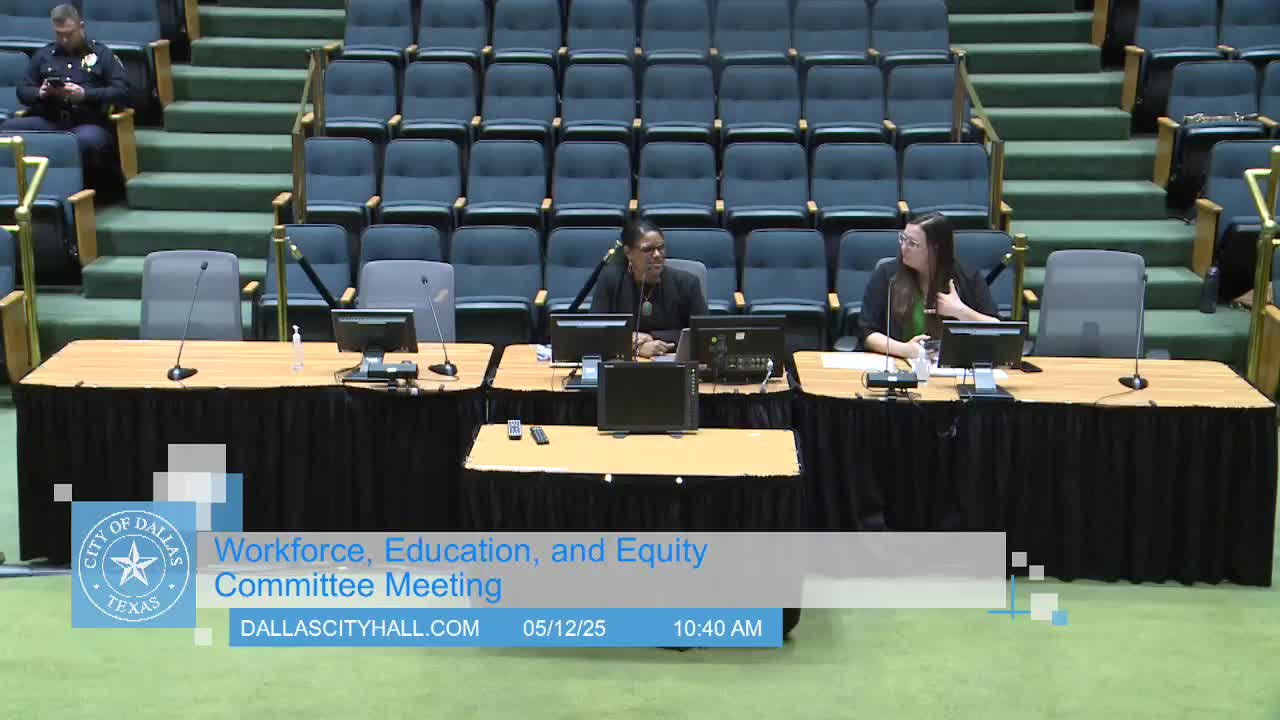
Lone Star Justice Alliance briefed the Workforce Education and Equity Committee on May 12 on a youth safety strategic plan and public data dashboard created under a National League of Cities (NLC) municipal reimagining community safety grant.
Ulysses (Ulysse) Reeves Waters, chief innovations officer for Lone Star Justice Alliance, told the committee the organization used youth surveys, “vibe sessions” (youth focus groups) and community convenings to inform the plan and that the NLC cohort included Baltimore, Dallas, Jackson, Philadelphia and St. Louis. Waters said the Alliance centers adolescent brain development and the social determinants of health in its approach.
Why it matters: the plan and the dashboard are intended to help community organizations and city departments target prevention and intervention services by linking school disciplinary data, Dallas Police Department arrest data, Dallas County juvenile department data and 311 service calls at neighborhood and school levels. Waters said those datasets allow local stakeholders to identify patterns and deploy services where risk is concentrated.
Key findings and priorities cited by Lone Star Justice Alliance included high needs for housing (68 percent of surveyed youth), transportation (48 percent), food access (41 percent) and mental health supports (24 percent). Waters said those needs are closely tied to behavior and justice involvement and noted a program recidivism rate of about 10 percent for Lone Star’s participants compared with Texas juvenile justice department figures cited at roughly 73.7 percent.
The strategic plan’s four cornerstones highlighted in the presentation are: (1) ecosystem building and infrastructure to create referral pathways and coordinate resources, (2) leadership development and mentorship, (3) education that creates safe, supportive school environments and community supports, and (4) youth justice strategies emphasizing diversion and reduced reliance on detention.
Data tools: Waters described a public-facing dashboard developed under the grant that allows users to view arrests, calls for service, juvenile court referrals and school disciplinary incidents by school or neighborhood, with multi-year trends. Waters invited committee members and staff to review the dashboard via a QR link provided in the presentation.
Council reaction: Committee members praised the scope of the work and urged continued city support, data sharing and collaboration with community groups. Several council members stressed the need for programs to address underlying social needs that drive risk behaviors.
Ending: Waters said the Alliance will continue to convene partners and refine metrics and that the dashboard is intended to make local patterns visible so funders and service providers can align resources more effectively.