Get Full Government Meeting Transcripts, Videos, & Alerts Forever!
Get email alerts on the Opioid Funding Allocation topic
No spam. Unsubscribe anytime.
Fayette County opioid commission to hold special meeting to finalize recommendations after Kroger settlement payment
Summary
Members of a Fayette County commission voted to call a special meeting next month to finalize a single set of recommendations to the mayor on how to spend roughly $7.3 million in opioid litigation funds, including a new Kroger settlement payment of $197,316.03, commissioners said.
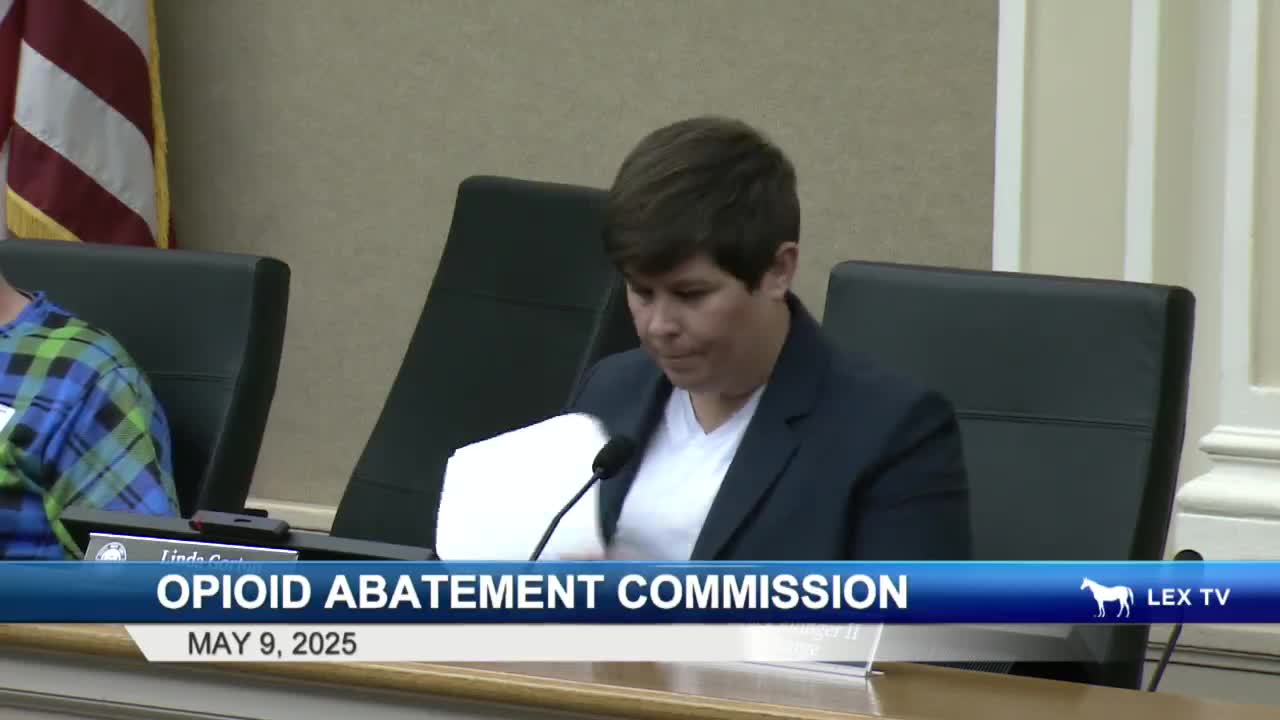
Members of the Fayette County Opioid Commission voted to call a special meeting in the coming month to finalize recommendations to the mayor for dispersing opioid litigation funds, commissioners said during a regular meeting.
Connie Neal, who delivered the commission's executive-board report, said the commission recently was awarded $197,316.03 from the Kroger settlement and expects a similar disbursement next year. "To date, Fayette County has received $7,304,541.28 in opioid litigation funds," Neal said during the meeting.
The commission's work groups previously submitted an initial set of recommendations to the mayor, but commission members said the mayor asked for clarifications and conveyed a new understanding: the recommendations the commission submits now are likely to be the primary set that guides spending for several years. Carmen, the commission staff liaison who met with the mayor, said the mayor appeared to expect a more complete, near-final package rather than a set of incremental recommendations.
Commission members discussed options to structure spending. Presenters and commissioners described three broad pathways included in a draft packet: (1) a larger-grant process (an RFP-style mechanism) to fund multi-year or higher-dollar programs; (2) a funding stream targeted to jail-based programs and services for people identified with substance use disorders while incarcerated; and (3) expanded infrastructure and resources for substance use disorder (SUD) services countywide. Commissioners also discussed continuing a separate mini-grant program alongside any larger grant process.
Several commissioners urged caution and broader outreach before finalizing recommendations. One member said the commission had been told earlier that this would be an ongoing process; with the mayor's clarification, members said they now felt they needed time to collect additional presentations and input and to avoid making a one-off decision that would guide several years of spending.
Carmen said she would email several proposed dates early next week to schedule a special, public meeting in the coming month when the full commission and work groups could meet together. The commission voted to call the special meeting; all commissioners present voted in favor.
Commissioners discussed logistics for the special meeting: convening the full commission together (with possible breakout sessions by work group), providing attendees with a packet of prior presentations and minutes, and ensuring the meeting is noticed publicly. Commissioners also noted that some funding decisions could require specific parameters so that staff and the mayor's office could evaluate whether submitted projects fit the commission's priorities.
No formal spending decisions were made at the meeting. The commission instructed staff to set the special meeting, gather prior presentations and minutes for review, and continue work-group discussion in advance of the reconvening.