Get Full Government Meeting Transcripts, Videos, & Alerts Forever!
Assembly passes FY26 budget package after hours of debate over schools, discovery law, mask rule and electric buses
Summary
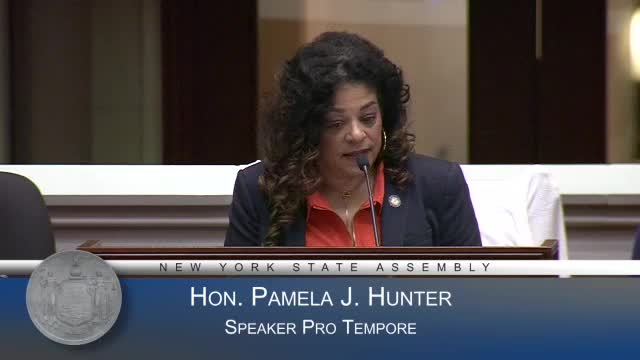
The New York State Assembly approved a package of bills on Feb. 3 that implements major pieces of the enacted FY26 budget, passing education, revenue and capital measures after extended floor debate over school funding, discovery law changes, a new concealment offense and a pause on the zero‑emission bus mandate.
The New York State Assembly approved a package of bills on Feb. 3 that implements major pieces of the enacted state budget for fiscal year 2025–26, voting to advance education/labor/family assistance, revenue and capital measures after extended debate over school funding, changes to discovery law, a new offense tied to concealment of identity during crimes and a pause on the 2027 zero-emission school bus mandate.
The three measures advanced on voice and recorded votes: the education/labor/family-assistance implementing bill (Assembly No. 3006-C) passed 109–40, the revenue bill (Assembly No. 3009-C) passed 103–46, and the capital projects bill (Assembly No. 3004-D) passed 107–42.
The package funds and changes in the enacted budget are extensive. The Assembly's on‑floor discussion included a detailed fiscal summary offered to members: the enacted plan totals roughly $254.3 billion on an all‑funds basis, with a $163.5 billion state operating fund and $126.6 billion in the General Fund. The Assembly debate flagged major line items that members emphasized, including a one‑time $8 billion payment to reduce the Unemployment Insurance trust fund debt, multi‑billion dollar increases in school aid and human services, and significant capital authorizations.
Education and school spending
Members spent long periods on changes to school aid, student services and mandates. The enacted school‑aid total discussed on the floor included a foundation aid component of roughly $26.4 billion for the coming school year, with the overall education cost figure referenced in debate at about $37.6 billion. Lawmakers described several technical and policy changes to the foundation aid formula: the enacted budget replaces the census poverty measure with a set of alternatives, adopts the executive's state‑share ratio increases with small exceptions, raises the Westchester regional cost index and increases the weighting for English language learners from 0.50 to 0.53.
Assembly members also discussed targeted education items included in the package: an increase to BOCES aidable salary caps phased in beginning in 2026–27 (to a maximum of $60,000, with a three‑year phase in), no immediate change to Universal Pre‑K (UPK) reimbursement rates this year, a requirement that sellers of zero‑emission buses provide…
Already have an account? Log in
Subscribe to keep reading
Unlock the rest of this article — and every article on Citizen Portal.
- Unlimited articles
- AI-powered breakdowns of topics, speakers, decisions, and budgets
- Instant alerts when your location has a new meeting
- Follow topics and more locations
- 1,000 AI Insights / month, plus AI Chat