HFSC warns national grant delays and outlines local proposals to address drug-case backlog
Loading...
Summary
Houston Forensic Science Center leaders told the board that a recent Department of Justice rescission of grant funding could delay Debbie Smith Act awards nationwide and that HFSC has a congressional community-funded proposal to study and triage about 70,000 misdemeanor drug cases in HPD storage.
HFSC President and CEO Dr. Peter Stout updated the board on federal grant developments and Texas bills that could affect laboratory workload and funding.
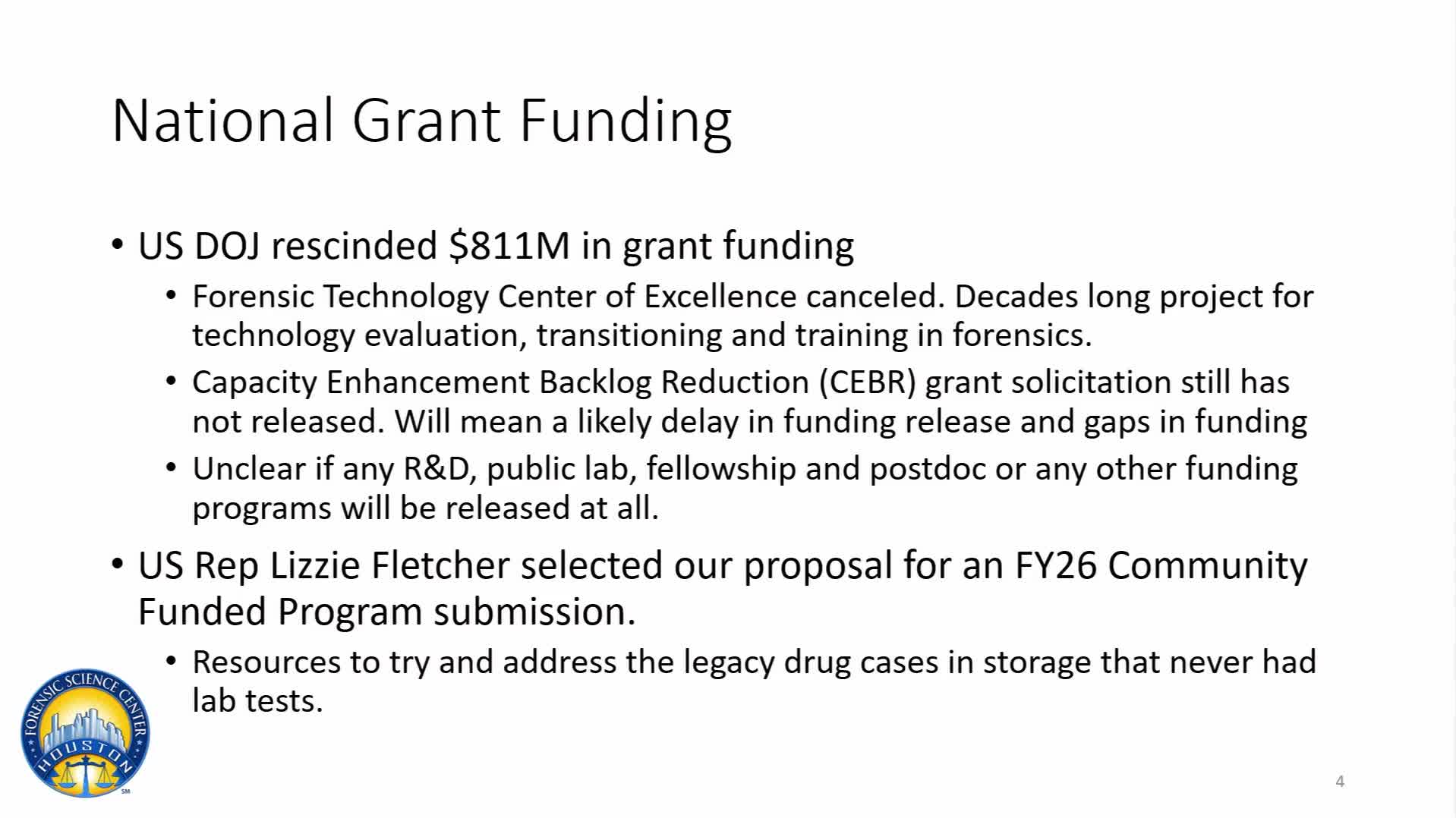
Stout said the U.S. Department of Justice rescinded nearly $1 billion in grant funding in a recent action; while most rescinded funds did not directly target forensics, HFSC cited cancellation of the Forensic Technology Center of Excellence — a roughly $12 million National Institute of Justice project — as a material loss for forensic training and technology transfer nationwide. That program’s functions include technology evaluation and a federally mandated forensic laboratory needs assessment under the Justice for All Act, Stout said.
Immediate concern centers on capacity‑enhancement and backlog‑reduction grants (often associated with the Debbie Smith Act). Stout said the solicitation for the current funding cycle had not been released on its usual schedule, and laboratories nationwide that budget personnel on those awards may face gaps by December of this year; he said awards — if released now — often take about a year from solicitation to funding release. HFSC staff told the board they have contingency planning in place and that some state offices may provide short‑term help if federal funds are delayed.
Local proposal to triage 70,000 misdemeanor drug cases
HFSC described a separate, community-funded project selected for FY‑26 that would examine a backlog of about 70,000 misdemeanor drug cases in Houston Police Department storage. Stout said many of the cases originated from field‑test results; studies suggest a 3–5% false‑positive rate for those kits, which means the backlog might include roughly 2,100–3,500 cases where defendants pleaded based on a field test that later laboratory testing would not confirm. The HFSC proposal would test a subset of cases to develop indicators for triaging cases so that scarce testing funds are used where they are most needed.
Stout noted practical limits: many of the 70,000 items date back 20–30 years and materials may have degraded, and full brute‑force testing of the entire inventory could cost an estimated $10–15 million. HFSC said the project would seek to identify low‑risk cases and higher‑priority cases to make targeted use of limited resources.
State legislative developments
Stout also briefed the board on Texas legislation that could change lab workload or funding: SB 1620 and HB 5293 (forensic analyst apprenticeship program), SB 1660 (toxicology evidence retention, particularly DWI blood tubes), and HB 1280 (waivers for evidence preservation at adjudication points). He said SB 1620 had advanced out of committee and could create an apprenticeship pipeline if passed. On hemp/THC regulation, Stout summarized competing Senate and House approaches to SB 3: the Senate v. near‑total cannabinoid ban would simplify forensic testing thresholds, while the House substitute favors a regulatory framework and dedicates 25% of licensing fees to forensic labs — although Stout cautioned that fee revenues may not materialize in practice.
Why it matters: grants and law changes shape forensic lab staffing and what tests the lab is equipped to perform. Stout said HFSC had added roughly $2.5 million to its biology budget for the current year to shift work in‑house and reduce outsourcing; he forecast signoffs for additional analysts (two new seized‑drugs analysts now signed off for casework, four DNA analysts signed off in August 2025, and three more in early 2026) that will reduce backlog over time.
Ending
Stout told the board HFSC will continue contingency planning for federal grant delays, pursue local funding or community‑funded projects where appropriate, and monitor state legislation that could alter the lab’s analytical responsibilities.