Get Full Government Meeting Transcripts, Videos, & Alerts Forever!
Get email alerts on the Environment Budget Sf2077 topic
No spam. Unsubscribe anytime.
Minnesota conference committee reviews Senate File 2077 differences; agencies urge operating adjustments
Summary
Members of the Minnesota Legislature’s conference committee on environment and natural resources met May 9 in St. Paul to compare House and Senate versions of Senate File 2077 and to hear agency testimony on budget and policy differences affecting the MPCA, DNR, Board of Water and Soil Resources and Minnesota Zoo.
Members of the Minnesota Legislature conference committee on the environment and natural resources budget met May 9 in St. Paul to compare House and Senate positions on Senate File 2077 and to hear agency testimony on key budget and policy differences.
The committee’s discussion centered on competing general‑fund targets and agency operating adjustments, fee increases tied to groundwater and aquatic invasive species (AIS) programs, a proposal to allow seizure and forfeiture of abandoned watercraft, a Senate proposal for a sustainable foraging task force and a disagreement over the closed landfill investment fund (CLIF) appropriation.
The Senate presented a general‑fund target that nets to a minus $1,000,000 change in fiscal 2026‑27 and a plus $2,000,000 tails position. The House presented a minus $10,000,000 target for the biennium. Nonpartisan staff walked members line‑by‑line through a spreadsheet of change items showing where the chambers differ on spending, fee changes and statutory language.
Key budget and policy items discussed
- Minnesota Pollution Control Agency (MPCA): Nonpartisan staff described a set of operating adjustments and program shifts. The Senate would add permitting capacity tied to five new FTEs in fiscal 2026‑27 and three in the tails, funded in part from the general fund and in part from environmental and remediation funds. The Senate also proposes a $6.5 million one‑time appropriation to the closed landfill investment fund for fiscal 2026‑27; the House would instead extend the existing statutory appropriation for CLIF for four years.
- Department of Natural Resources (DNR): The Senate package includes operating adjustments rolled into one line item and several fee increases (groundwater and AIS surcharges) intended to replace certain general‑fund reductions and support services. The Senate shows an AIS boat fee increase estimated in the spreadsheet to generate about $6.45 million in the first biennium and $8.6 million in the tails; a groundwater fee increase is shown to generate roughly $3.0 million in the first biennium and $5.8 million in the tails. The Senate also includes one‑time grants for ATV and off‑highway motorcycle trails and an extension of prior appropriations for certain boat‑launch and land‑transfer projects.
- Policy proposals: The Senate bill contains language authorizing seizure and forfeiture of abandoned watercraft and related civil and criminal penalties, increases the AIS surcharge, sets field‑citation authority and fines for certain MPCA information requirements, requires outreach to Minnesotans of diverse backgrounds, reduces certain game and fish license fees for disabled veterans, and creates a Minnesota sustainable foraging task force with a temporary moratorium on related rulemaking until July 1, 2027. The House and Senate differ on several of these provisions and on the CLIF statutory treatment.
Agency testimony
Katrina Kessler, commissioner of the Minnesota Pollution Control Agency, told the committee the MPCA appreciates technical and noncontroversial items included in both chambers’ positions and emphasized the importance of passing operating adjustments to preserve current service levels and advance permitting reform. "I appreciate that noncontroversial or technical budget items were included in both the house and senate," Kessler said.
Bob Meyer, assistant commissioner of the Department of Natural Resources (speaking for Commissioner Sarah Strommen), urged inclusion of the DNR’s operating adjustment and said fee increases included in the Senate bill (groundwater and AIS) address service needs. "Keeping pace with inflation is essential to maintain DNR services such as park operations, forest management, conservation work, and timely permitting processes," Meyer said. He also flagged concerns about the foraging task force language, saying the draft would give a majority voice to consumptive users and would restrict the DNR’s ability to set harvest limits without supporting data.
Andrea Fish, assistant director of the Board of Water and Soil Resources, asked the committee to consider the Senate operating adjustment for that agency and noted that changes to prior appropriations for easement funding could affect the agency’s ability to leverage federal conservation funds.
John Frawley, executive director of the Minnesota Zoo, described the zoo’s funding model and said the governor’s recommended reductions would create a roughly $6 million shortfall over the biennium. Frawley said the zoo derives about one‑third of its funding from the state and two‑thirds from earned revenue and asked lawmakers to consider a $1.3 million per‑year increase to avoid layoffs. "Approximately one third of our funding comes from the state, and the rest, two thirds of it is revenue we have to earn ourselves," Frawley said.
Next steps
Nonpartisan staff will continue to reconcile line items and policy language. Committee chairs said the conference negotiations could be brief or prolonged and that a subsequent meeting date would be determined when members of the other body are available. The committee did not take formal votes at this session; staff and agency witnesses were directed to continue technical work and shared document review.
Why this matters
Senate File 2077 combines budget and policy provisions affecting multiple environment and natural resources agencies and includes fee and statutory changes that affect how programs are funded and operated. The conference committee’s choices on operating adjustments, fee authority and statutory language will determine service levels for permitting, invasive species control and land management and will influence agency ability to leverage federal and non‑state resources.
Details and numbers from the conference spreadsheet (as presented to the committee)
- Senate general‑fund net change shown: +$736,000 in fiscal 2026‑27 on the PCA line items (netting with other agency adjustments to reach the chamber target described by staff).
- House general‑fund target: a minus $10,000,000 reduction achieved through specified reductions to DNR, PCA and Board of Water and Soil Resources appropriations.
- PCA permitting proposal: five new FTEs in 2026‑27 and three in the tails (paid in part from the general fund and in part from environmental funds).
- Closed Landfill Investment Fund: Senate one‑time appropriation $6,500,000 for fiscal 2026‑27; House would extend the statutory appropriation instead of a one‑time appropriation.
- DNR fee measures in the Senate spreadsheet: AIS boat surcharge ≈ $6.45 million (first biennium), groundwater fee ≈ $3.0 million (first biennium).
Speakers
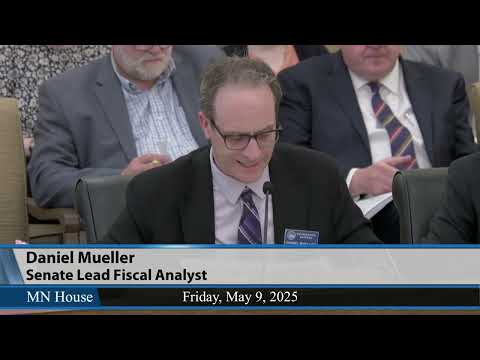
- K. (chair) — Chair, conference committee (identified on record as calling the meeting to order). First referenced at timecode 00:02. - Fong He — Senator, chair (Senate). First referenced at timecode 00:50. - Josh Heintzeman — Representative and co‑chair. First referenced at timecode 02:45. - Dan Mueller — Senate fiscal staff (nonpartisan). First referenced at timecode 06:05. - Brad Hegmeier — House fiscal staff (nonpartisan). First referenced at timecode 07:08. - Ben Stanley — Senate nonpartisan counsel. First referenced at timecode 31:25. - Katrina Kessler — Commissioner, Minnesota Pollution Control Agency. First referenced at timecode 38:29. - Bob Meyer — Assistant commissioner, Department of Natural Resources (speaking for Commissioner Sarah Strommen). First referenced at timecode 40:45. - Andrea Fish — Assistant director, Board of Water and Soil Resources. First referenced at timecode 46:09. - John Frawley — Executive director, Minnesota Zoo. First referenced at timecode 48:01.
Authorities
- {"type":"other","name":"Senate File 2077 (environment and natural resources omnibus)","referenced_by":["sf2077-conference-summary-2025-05-09"]} - {"type":"other","name":"Closed Landfill Investment Fund (CLIF)","referenced_by":["sf2077-conference-summary-2025-05-09"]} - {"type":"other","name":"Environmental Fund","referenced_by":["sf2077-conference-summary-2025-05-09"]} - {"type":"other","name":"Remediation Fund","referenced_by":["sf2077-conference-summary-2025-05-09"]} - {"type":"other","name":"Game and Fish Fund","referenced_by":["sf2077-conference-summary-2025-05-09"]} - {"type":"other","name":"Environment and Natural Resources Trust Fund (LCCMR recommendations)","referenced_by":["sf2077-conference-summary-2025-05-09"]}
Actions: []
discussion_decision:{"discussion_points":["Line‑by‑line budget differences between House and Senate for PCA, DNR, BWSR, MN Zoo and other agencies","Senate proposals for fee increases (AIS and groundwater) and PCA permitting FTEs","Senate policy provisions: abandoned watercraft seizure and forfeiture, field citations and fines for MPCA information failures, disabled veteran license fee reductions, foraging task force and moratorium on foraging rulemaking","House approach to CLIF (extend statutory appropriation) vs Senate approach (one‑time appropriation)","Minnesota Zoo’s budget shortfall and request to avoid layoffs"],"directions":["Nonpartisan fiscal and policy staff to continue reconciliation of spreadsheet line items and to support technical follow up","Agencies to provide materials and clarifications requested by committee members (as stated by staff and witnesses)"],"decisions":[]}