Get Full Government Meeting Transcripts, Videos, & Alerts Forever!
Get email alerts on the Higher Education Funding And Policy topic
No spam. Unsubscribe anytime.
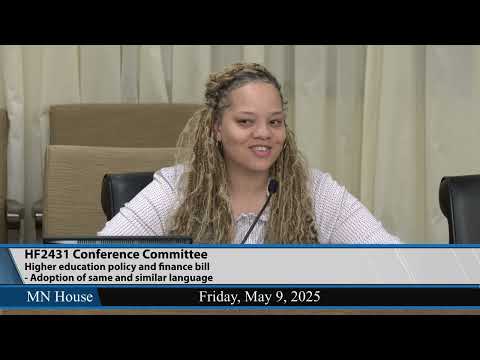
Higher education conference committee adopts same‑and‑similar language; debates grants, direct admissions, Narcan and fraud response
Summary
Members adopted same‑and‑similar statutory language across multiple higher education bills and discussed distribution of emergency and hunger‑relief grants, a statewide direct‑admissions rollout, a requirement to stock opioid antagonists in residence halls, and formation of a working group on "go student" enrollment fraud.
The Minnesota Legislature's higher education conference committee adopted same‑and‑similar statutory language for a series of higher education provisions and discussed policy differences on emergency student grants, hunger‑relief funding, scaling direct admissions, on‑campus naloxone access and a working group on online enrollment fraud.
Committee chairs and members spent the meeting moving sections of the side‑by‑side higher education bills into agreement. Many sections were adopted by voice vote after brief explanation by committee leaders and agency staff. The panel also heard testimony from Office of Higher Education (OHE) staff, system representatives and student and higher‑education advocates on the practical effects of several policy choices.
Why it matters: The actions and policy directions discussed will change how some student supports are delivered and tracked — including where emergency and hunger‑relief dollars flow, how high schools nationwide receive direct admissions support and whether public institutions must proactively stock opioid antagonists in campus residence halls. Some provisions also add reporting or working groups intended to improve transparency or combat fraud.
Most notable items discussed and outcomes
- Emergency grants and hunger‑relief funding: Both the senate and house side proposed directing emergency postsecondary assistance and hunger‑relief appropriations directly to the University of Minnesota and Minnesota State rather than routing all funds through OHE. The senate language adds expanded reporting requirements for OHE and institutions on how award dollars are distributed and used; committee members described the reporting as intended to increase legislative transparency. OHE staff said the additional reporting is administratively feasible. Testimony from University and Minnesota State representatives emphasized that direct appropriations can reduce administrative overhead and speed distribution to students. OHE estimates the direct‑admissions expansion and reporting work will require additional staff resources; university and system speakers described program needs and student demand. Representative testimony summarized the reporting items as including: distribution among institutions; how students apply and institutions select awardees; number of students receiving awards; common needs addressed; and average time from request to disbursement.
- Direct admissions scaling: Members discussed a provision requiring public and charter high schools to participate in the direct admissions program by the 2029–30 school year to scale a program OHE said has increased FAFSA completion and fall college enrollment where implemented. OHE Assistant Commissioner Wendy Robinson told the committee the agency expanded to 82 high schools in the current year with roughly 31,000 eligible students participating and expects next‑year participation to grow toward 250 schools. Robinson said new or small schools need support at start‑up — she estimated roughly 40 staff hours for a school to implement in year one and about 20 hours in subsequent years — and that the appropriation in the senate bill (listed at $500,000 per biennium) is intended to support agency staffing, vendor work and limited support to new schools.
- Opioid antagonist (naloxone/Narcan) in residence halls: The committee discussed senate language requiring public colleges and universities to stock two doses of an opioid antagonist in each residential building. Students and student senates testified in support, describing variation across campuses in naloxone access. The committee reviewed a fiscal estimate for systems: Minnesota State’s estimated cost was $77,000 in 2026–27 and $52,000 in 2028–29; the University of Minnesota’s estimate was about $80,000 in 2026–27 and $28,000 in 2028–29. Chairs said the provision had support but noted budget constraints in some vehicles and that the measure is narrower than earlier drafts (limited to residential buildings rather than every campus building).
- Dual training, private/out‑of‑state and private career school language: The committee moved amendments clarifying how accreditation language applies in dual training grant sections and corrected language to avoid unintentionally excluding training providers. Nikki Oliver, director of government relations and community engagement at OHE, said the A12 amendment removes an unintended expansion of the term “accredited” so that the statute would not eliminate eligibility for many training programs; the amendment was adopted and the underlying sections were approved. The A14 amendment removed certain fees for applicants seeking limited licenses only to access dual training grants or WIOA‑eligible training provider lists; members said the change was intended to avoid making participation cost‑prohibitive.
- College financing literacy and disclosure of postgraduation outcomes: The committee discussed a bipartisan proposal requiring OHE, after stakeholder consultation, to develop a standardized financial aid offer form for institutions and to require institutions to disclose postgraduate employment and earnings information on public pages. OHE staff said drafting and stakeholder convening will be the bulk of OHE’s work; a fiscal note estimated OHE costs (the fiscal note in the hearing estimated OHE costs at roughly $229,000 in 2026–27 and $274,000 in 2028–29, with additional smaller costs to Minnesota State and the University of Minnesota). Members and advocates said standardized offers and clearer postgraduate outcome data help students compare net costs and likely outcomes across institutions.
- "Go student" / enrollment fraud working group: The committee heard from Minnesota State faculty representatives about a fraud pattern where false students are enrolled in online courses to generate financial‑aid disbursements that are then diverted. Testimony described detection at multiple two‑year institutions, the use of stolen identities and rapid extraction of overpayment funds. The committee discussed creating a working group to develop statewide practices and policies to detect and address the problem; the senate provision would establish that working group and specified that participation would not carry additional compensation (the fiscal note for compensation was withdrawn).
Votes at a glance (voice votes where recorded)
- Multiple "same and similar" sections were adopted by voice vote across R31–R73 and other enumerated sections; motions were seconded and carried by aye voice votes throughout the session. Committee chairs moved and members concurred on items including: a cybersecurity addition for a doctoral degree in the MN state program (R31–32); North Star Promise definitions and eligibility changes (R52–54); removal of an OHE determination requirement for out‑of‑state institution eligibility (R54); changes to data disclosure elements for self‑loans (R54–55); amended dual training accreditation language (R56–57, A12 adopted); private and out‑of‑state postsecondary changes and the private career school amendments (R58–73, A14 adopted); and the identified language of multiple sections as amended. (Individual roll‑call tallies were not recorded in the transcript; outcomes are recorded as motions carried.)
What the committee did not do
The committee set aside some detailed policy differences for a later hearing (notably state grant parameter changes and certain misconduct policy discussions) and indicated chairs will take the gavel in a future meeting with subject‑matter experts present.
Sources and attribution
Statements and explanations in this summary are attributed to committee chairs and to agency and system staff who testified at the hearing, including Nikki Oliver (director of government relations and community engagement, Minnesota Office of Higher Education), Dennis Olsen (commissioner, Minnesota Office of Higher Education), Wendy Robinson (assistant commissioner, Office of Higher Education), Colleen McDonald (Boynton Health basic needs lead, University of Minnesota), Michelle Trumpy (director of public health, University of Minnesota), Molly Lloyds (policy director, LeadMN), Paul Sirkrenick (introduced himself as president of the "bridal college council"), student advocates from Students United and Ed Allies, and Mark Grant (government relations, Minnesota State College Faculty). Direct short quotations are taken from those speakers as recorded in the committee transcript.
Ending
Committee members scheduled follow‑up hearings to take up detailed grant‑parameter and policy disagreements with additional agency subject‑matter staff present and adjourned to reconvene with further deliberations.