Get Full Government Meeting Transcripts, Videos, & Alerts Forever!
Get email alerts on the Special Education topic
No spam. Unsubscribe anytime.
USVI lawmakers press agencies on special-education backlog, staffing and funding
Summary
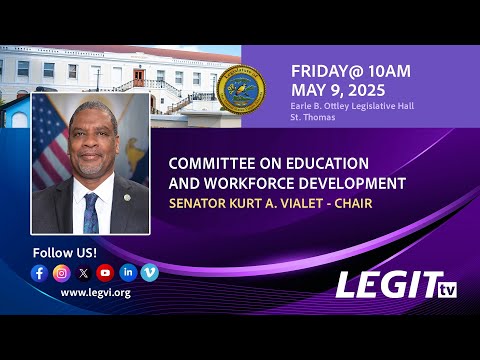
St. Thomas, U.S. Virgin Islands — Lawmakers at a May 9 Committee on Education and Workforce Development hearing pressed territorial agencies and private providers for immediate fixes to a territory‑wide backlog of special‑education evaluations, rising contractor costs and persistent shortages of school psychologists, speech‑language pathologists and related service providers.
St. Thomas, U.S. Virgin Islands — Lawmakers at a May 9 Committee on Education and Workforce Development hearing pressed territorial agencies and private providers for immediate fixes to a territory‑wide backlog of special‑education evaluations, rising contractor costs and persistent shortages of school psychologists, speech‑language pathologists and related service providers.
Commissioner Dion Wells Hedrington of the Virgin Islands Department of Education told the committee the state office and the two district offices face “limited funding, shortages of specialized staff such as school psychologists, speech and language pathologists, and special education teachers,” and infrastructure challenges that impede on‑time delivery of federally required services. “Education is not just a pathway to opportunity. It is a foundation,” he said in testimony to the 36th Legislature’s committee.
Why this matters: federal law (the Individuals with Disabilities Education Act, IDEA) and Section 504 of the Rehabilitation Act require timely evaluation, Individualized Education Programs (IEPs) and related services for children with disabilities. Witnesses told senators that long evaluation waits, unpaid vendor invoices and insufficient staffing are delaying required services, risking students’ short‑ and long‑term academic progress and exposing the territory to enforcement action tied to a court‑ordered consent decree.
What agencies reported
Department of Education: The department outlined a multi‑factor problem. District officials said a combination of hurricanes, COVID‑19 disruptions, leadership turnover and a national shortage of school psychologists produced long evaluation queues — the St. Croix district reported roughly 250 pending evaluations (a mix of initial and re‑evaluations) and St. Thomas reported about 180 pending re‑evaluations plus about 80 new referrals. The department said it has run summer accelerated evaluation programs and is contracting outside providers to reduce the backlog.
The department also told senators it shifted dozens of positions from federal to local payroll after federal funding priorities changed. Commissioner Hedrington said 41 employees were moved to the local budget, increasing personnel costs by about $2.7 million and creating a local shortfall; the department said it remains short about $1.7 million in personnel and roughly $3.6 million in purchased services for the current year.
University of the Virgin Islands and training pipeline: UVI leaders said the university is expanding local training to build a “grow‑your‑own” pipeline. UVI Dean Karen H. Brown and UVI Center for Excellence programs described a specialist degree in school psychology funded in part with ARP (American Rescue Plan) money; five candidates are enrolled and expected to complete the program in 2026 and have agreed to work in the territory after graduation. UVI also described assistive‑technology and continuing‑education programs and recommended a dedicated legislative appropriation for disability student services at the university.
Department of Labor: Jean Ford, assistant commissioner, summarized workforce supports under WIOA and said the territory’s workforce system records show a small share of applicants self‑identify as disabled. The department described co‑location and referral work with Vocational Rehabilitation and said roughly 42 individuals who identified as disabled used workforce services in the last 12 months (data captured in the territory’s electronic workforce system).
Disability Rights Center: Kishma B. Francis, staff attorney and parent‑training director for the Disability Rights Center of the Virgin Islands (DRCVI), told the committee that parents report multiple barriers: long waits for evaluations (complaints about three‑year wait times were cited), inconsistent access to assistive technology, intermittent availability of translated materials, and disparities between the territory’s share of students served under IDEA (about 9% of students) and national averages (roughly 15%). She urged clearer, faster evaluation pathways and better community outreach to reduce stigma.
Private and nonprofit providers: Coral Reef Academy, Orange Tree Staffing and JS Therapies described how private providers are filling gaps and the limits of that approach.
- Coral Reef Academy (K–12 specialized school for autism and related needs) said it serves 33 students across St. Croix and St. Thomas; 11 of those students are VIDE‑funded and the rest attend privately. Coral Reef asked the Legislature and VIDE to expand contracts and to support classroom development so students can transition back to district schools after progress.
- Orange Tree Staffing (recruiter/contractor) reported 38 active contractors in the territory and said it filled dozens of vacancies but still faces openings for SLPs and a bilingual school psychologist. Orange Tree urged earlier, funded purchase orders and reliable payment schedules so contractors can recruit and relocate staff before the school year starts.
- JS Therapies (pediatric therapy clinic) said it provided about 20,000 therapy visits in 2024, serves roughly 500 children on the two main islands and that about 40 percent of its caseload is children with autism or likely to be diagnosed on the spectrum. JS Therapies and other providers asked for reduced administrative barriers in the territory’s Medicaid‑like Medical Assistance Program (MAP) so families can access therapy faster.
Common themes and numeric details
- Backlog: St. Croix ~250 pending evaluations (district estimate); St. Thomas ~180 reevaluations + ~80 initial referrals. - Staffing: Department estimate: territory needs dozens more special‑education teachers and paraprofessionals; districts reported acute shortages of school psychologists and therapists. - Budgets: IDEA grants have averaged about $8.5 million annually; witnesses said the formula tied to child counts led to a drop in the state award (a figure cited in testimony: $7.3 million for a recent grant year). The department reported spending about $6.9 million on contracted services this year and moving 41 staff to local payroll (about $2.7 million). Contractor hourly rates for therapy/assessment work were described as rising from about $50/hour to roughly $90/hour. - Private‑sector activity: Orange Tree said it had 38 contractors active in the territory; JS Therapies said it performed roughly 20,000 visits in 2024 and has seen 20–40 new referrals monthly; Coral Reef said it has 33 students (21 on St. Croix, 5 on St. Thomas) with 26 students diagnosed with autism across its enrollment.
Barriers vendors and families cited
- Payment and procurement timing: Contractors said late funded purchase orders and unpaid invoices (contractors reported territory receivables that in testimony were characterized as “over $1 million” in arrears to some vendors) make it difficult to confirm placements and retain staff. Staffing firms asked for funded purchase orders before April or May so they can secure housing and travel plans for candidates. - Credentialing: Senators and witnesses discussed licensing or certification rules that limit the candidate pool. The USVI Board of Psychology’s requirement for national certification (NCSP) was described as a recruitment constraint; witnesses asked the board or legislature to clarify reciprocity and consider narrower, school‑based licensing options for psychologists who will practice only within schools. - MAP and claims workflow: Private therapists described a complex referral and authorization process for the territory’s Medical Assistance Program that delays children’ s initial visits; providers urged simplifying authorization, lengthening reauthorization windows and improving the electronic claims path between MAP, providers and Department of Finance. - Physical space and sensory rooms: District staff and providers described schools with limited dedicated space; providers recommended occupational‑therapy input for sensory rooms and a maintenance follow‑up for already‑purchased equipment. Senator requests at the hearing included a follow‑up with the Bureau of School Maintenance and Construction about installation delays at Yvonne Miller Balsky Elementary.
Recommendations and requests reported to the committee
Witnesses and senators offered many short‑ and long‑term recommendations: expand local training and “grow‑your‑own” pipelines (UVI school‑psychology and special‑education tracks), contract formally for speech‑language pathology assistants (SLPAs) to extend SLP capacity, simplify MAP authorizations for children under 5, provide earlier funded purchase orders so staffing firms can recruit, and revisit credentialing or testing rules for school psychologists when the credential is only required for practice inside schools.
At the hearing close, the clerk read a set of committee follow‑ups requested by senators: the Department of Education was asked to provide the cost estimate for this summer’s special‑education testing blitz; senators requested a status update on the sensory room installation at Yvonne Miller Balsky; Senator DeGraff asked for a copy of the Nadine Jones consent decree referenced in testimony; and committee members asked staff to consider whether mainstream classroom teachers should receive stipends and whether recent legislation limiting retired teachers’ rehire requires amendment to help summer staffing.
What lawmakers said and next steps
Senators pressed for faster solutions. Several members urged the administration to secure earlier purchase‑order guarantees so contractors can confirm placements and families can receive consistent services. Committee chair Senator Kurt A. Vialle and colleagues ordered follow‑up materials and set the record for a continuing oversight dialogue.
“After the backlog is dealt with, we would have a better projection of what is needed,” Commissioner Hedrington told the panel, summarizing the department’s near‑term view. Senator comments at the hearing repeatedly framed the issue as urgent: delays in early identification and evaluation can compound into lifelong educational and economic costs.
The committee did not take formal votes at the hearing. Lawmakers requested documented follow‑ups and told staff to return with timelines and cost estimates for summer testing, procurement status and a copy of the consent decree referenced by witnesses. The committee also signaled interest in legislative or regulatory changes on credentialing, procurement timing and allowance for school‑based SLP assistants.
Editors’ note: This article summarizes testimony and numeric estimates given at a public committee hearing on May 9, 2025 in St. Thomas. Quotations and counts in this story come from witness testimony to the Committee on Education and Workforce Development; where testimony provided multiple figures or evolving counts, the article reports the figures as stated by witnesses during the hearing.