Get Full Government Meeting Transcripts, Videos, & Alerts Forever!
Get email alerts on the Energy topic
No spam. Unsubscribe anytime.
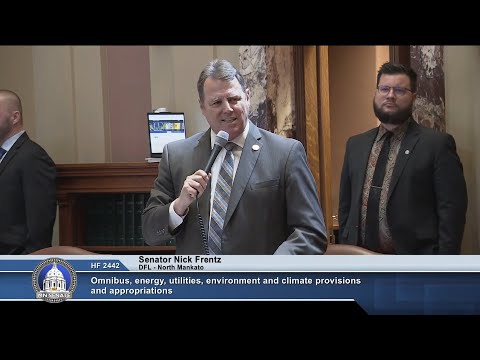
Senate debates HF2442 energy omnibus; rejects bipartisan amendment, approves wood‑waste change and tables bill
Summary
On May 9 in St. Paul the Minnesota Senate debated House File 2442, the energy omnibus, voted down a large bipartisan amendment, adopted a measure treating wood waste used for energy as carbon‑neutral, and voted to lay the bill on the table after further floor amendments failed.
ST. PAUL, Minn. — The Minnesota Senate on May 9 debated House File 2442, the energy omnibus measure, during a lengthy floor session that ended with the chamber rejecting a large bipartisan amendment, approving an amendment classifying certain wood waste as carbon‑neutral and then voting to lay the bill on the table.
The bill, presented on the floor as the energy omnibus, contains both budget and policy elements. The bill sponsor told senators the package included a required biennial budget reduction of $4,000,000 largely achieved by reducing weatherization funding, while preserving the governor’s requested operating increases for the Department of Commerce and the Public Utilities Commission, including information‑technology requests. "This is a basic cut target. We had to cut $4,000,000 from the energy biennium budget," the sponsor said.
Why this matters: committee supporters and opponents said the changes affect household energy costs and long‑term clean‑energy goals. The bill’s fiscal provisions include funds from the Renewable Development Account (RDA) for projects named on the floor — a green hydrogen project in St. Cloud, microgrid research at the University of Saint Thomas, a geothermal project at the Como Zoo, an anaerobic digester provision, and funding for an "Energy Alley" program for clean‑energy businesses. The bill also includes an increase in the Petro Fund and a policy provision to sunset Minnesota’s community solar garden program in 2030.
Floor debate focused on policy left out of the compromise, the allocation of budget reductions, and whether to fold committee‑level bipartisan agreements into the floor bill. "If you want to vote for a bipartisan energy bill, then this is the bill to vote for," said Senator Matthew Matthews when offering an amendment (A15) that the sponsor and its proponents said would restore many provisions that had been removed before the bill moved to finance. The chamber rejected the A15 amendment on a roll call, 32‑35.
Other floor amendments included a bid to lift the statutory cap on hydropower capacity. Senator Richard Gruenhagen urged support of that amendment as a carbon‑free, baseload option and cited testimony he said showed roughly "36% of Minnesotans can't pay or are struggling to pay their energy bills right now." That hydro cap amendment (A8) failed on a roll call, 33‑34.
A different amendment from Senator Farnsworth (A9) — which defines certain wood waste used for energy as carbon‑free/carbon‑neutral for purposes of the bill — passed on a roll call, 33‑32. Farnsworth and supporters argued that using timber harvest residue for energy reduces more potent greenhouse gas emissions from decomposition and can provide local economic and wildfire‑risk benefits.
After additional procedural motions and debate, Senate leaders secured a vote to lay House File 2442 on the table; that motion prevailed 34‑33. Following the vote the Senate recessed to the call of the president.
Discussion versus decisions: floor debate included substantive policy arguments and fiscal rationale (discussion), roll‑call votes on amendments that either failed or were adopted (formal actions), and a final procedural motion to table the bill (formal action). Multiple senators urged prioritizing the state budget as the reason to limit policy changes in a budget bill while others pushed to restore the committee's bipartisan policy language.
Votes at a glance: - A15 (Matthews) — motion to replace the energy policy article with the committee version that included net metering, B100, repeal of the hydro cap and other committee compromises. Outcome: Not adopted, vote 32 yes, 35 no. - A8 (Gruenhagen) — motion to lift the existing cap on hydropower (remove a statutory cap stated on the floor as 100 megawatts). Outcome: Not adopted, vote 33 yes, 34 no. - A9 (Farnsworth) — motion to define wood waste used for energy as carbon‑free/carbon‑neutral in the bill. Outcome: Adopted, vote 33 yes, 32 no. - Motion to lay HF2442 on the table (by Senator Murphy) — Outcome: Adopted, vote 34 yes, 33 no.
What remained in the bill as discussed on the floor: a $4 million biennial reduction taken largely from weatherization funds; funding for Department of Commerce and PUC operating and IT increases; RDA project allocations for several named projects; increased Petro Fund; and a policy sunset of the Minnesota community solar garden program in 2030. Senators on both sides repeatedly framed the disagreement around whether policy should be added to a budget vehicle or handled separately.
The floor debate included repeated requests for roll calls and several appeals to bipartisanship. Senate activity ended with the bill tabled; the transcript records the votes and the recess to the call of the president.