Get Full Government Meeting Transcripts, Videos, & Alerts Forever!
Get email alerts on the Baby Dj Law topic
No spam. Unsubscribe anytime.
After infant’s death, Harrison County discussion turns to a proposed "Baby DJ" law to involve police when CPS cannot be reached
Summary
A recent infant fatality in Harrison County prompted community members and officials to press for clearer practice and a proposed law to require law enforcement notification or alerts when CPS cannot locate an at-risk child, and hospital–CPS communication improvements.
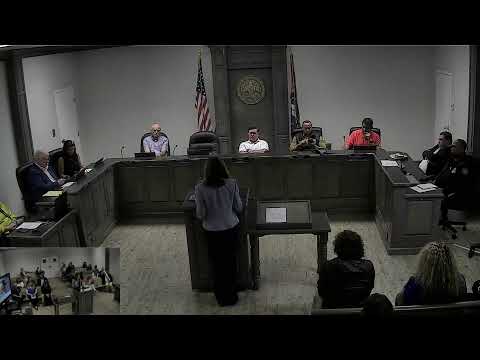
Community members and county officials used a Harrison County supervisors’ workshop to press for clearer local practice and a proposed state policy after an infant’s death that residents and the county’s Blue Ribbon Committee identified as a catalyst for action.
Rebecca Powers, a Blue Ribbon Committee participant who spoke at the workshop, described the case and urged a statutory change. Powers said the child known in public discussion as "baby DJ" was released from a hospital despite later test results indicating the infant had fentanyl exposure at birth, and that the child later died with multiple fractures. "He went back home again to the meth addict and to the abuse," Powers said, summarizing the sequence that the committee reviewed.
Powers and others urged a legislative measure — referred to in the meeting as a local proposal, “Baby DJ’s Law” — that would require law-enforcement involvement or an alert (an APB-style search) when hospitals or providers cannot reach CPS and they believe a child is at immediate risk. Powers said the Blue Ribbon Committee has discussed such a law and that it would create a formal alternative route when CPS cannot be reached quickly.
Andrea Sanders, commissioner of the Mississippi Department of Child Protection Services, acknowledged the case and described operational changes made locally since the death: weekly staffing with NICU teams, steps to improve hospital-to-CPS contact and renewed collaboration with local law enforcement. Sanders said hospital staff now have a direct CPS contact for the coast and that her office is willing to “sit down at the table and review” legislative or practice proposals such as the Baby DJ law. "It is the hardest part of the work that we do," Sanders said of responding to child fatalities.
County supervisors and law-enforcement leaders at the meeting emphasized that police want to be called in serious cases and that hospitals can and should call law enforcement in addition to or if they cannot reach CPS when they suspect criminal conduct or immediate danger. Panelists agreed that HIPAA does not prohibit notifying law enforcement about suspected child abuse; the transcript discussion emphasized operational uncertainty rather than a legal bar.
The Blue Ribbon Committee and county leaders said they will pursue clearer local operational rules and will discuss possible state-level legislation with the commissioner and legislators. No formal county policy or vote was taken at the workshop; the session was used to share information and to begin drafting collaborative responses.