Get Full Government Meeting Transcripts, Videos, & Alerts Forever!
Get email alerts on the Parking Study topic
No spam. Unsubscribe anytime.
Commission begins work on scoped parking RFQ: first phase to focus on inventory and analysis
Summary
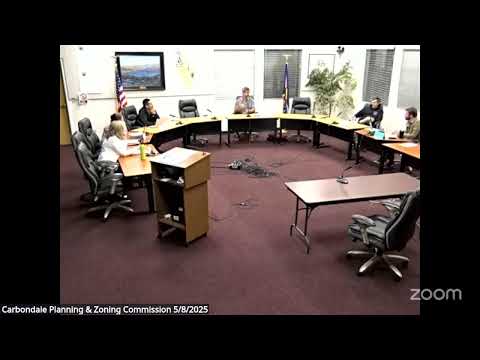
Carbondale's Planning and Zoning Commission discussed a two-phase approach to a parking study RFQ, agreeing the first phase should prioritize a high-level inventory and analysis of existing parking (on- and off-street) and recommend whether additional, more costly utilization studies or engagement should follow.
Carbondale's Planning and Zoning Commission on May 8 discussed the scope of a proposed parking study and directed staff to refine a two-phase approach: an initial, limited RFQ focused on inventory and analysis, followed later by a more robust, engagement-driven study if warranted.
Jared (staff member) told the commission the Board of Trustees had been receptive to a two-part process: a limited, lower-cost RFQ for inventory and code review to establish a baseline; and a second, larger effort that would include public engagement and potential policy options. Jared said staff aims to have funds in the 2026 budget to hire a consultant after completing the first-phase work.
Commissioners agreed the first phase should include an overview and inventory of current parking resources, a zoning/code analysis, and a concise report that would inform later public engagement. Commissioners discussed the practical limits of the first phase: detailed utilization counts (weekday/weekend, event peaks, seasonal differences) and traffic studies increase cost and time and could be included as add-ons or part of phase two.
Several commissioners suggested the RFQ ask candidates to demonstrate experience with mountain towns and to provide comparisons with peer towns (for example, matrix summaries of how Carbondale's parking metrics relate to similarly sized mountain communities). Commissioners also raised the value of a visual representation or heat map showing parking capacity and pressure points.
On data collection, commissioners and staff discussed alternatives to full boots-on-the-ground counts for every lot: targeted short audits, use of automated counters for a representative sample of locations, or third-party data tools (for example, anonymized mobile-location datasets) to estimate peak demand. Commissioners noted the trade-off between cost and the precision of utilization data.
Jared said staff will collect budget guidance and return with a revised draft RFQ and timeline. Commissioners asked staff to categorize RFQ deliverables as "required" versus "preferred" so proposals can be evaluated against a realistic budget.