Get Full Government Meeting Transcripts, Videos, & Alerts Forever!
Get email alerts on the Growth Management topic
No spam. Unsubscribe anytime.
Lexington staff unveil draft preservation and growth-management program; public input planned May 22
Summary
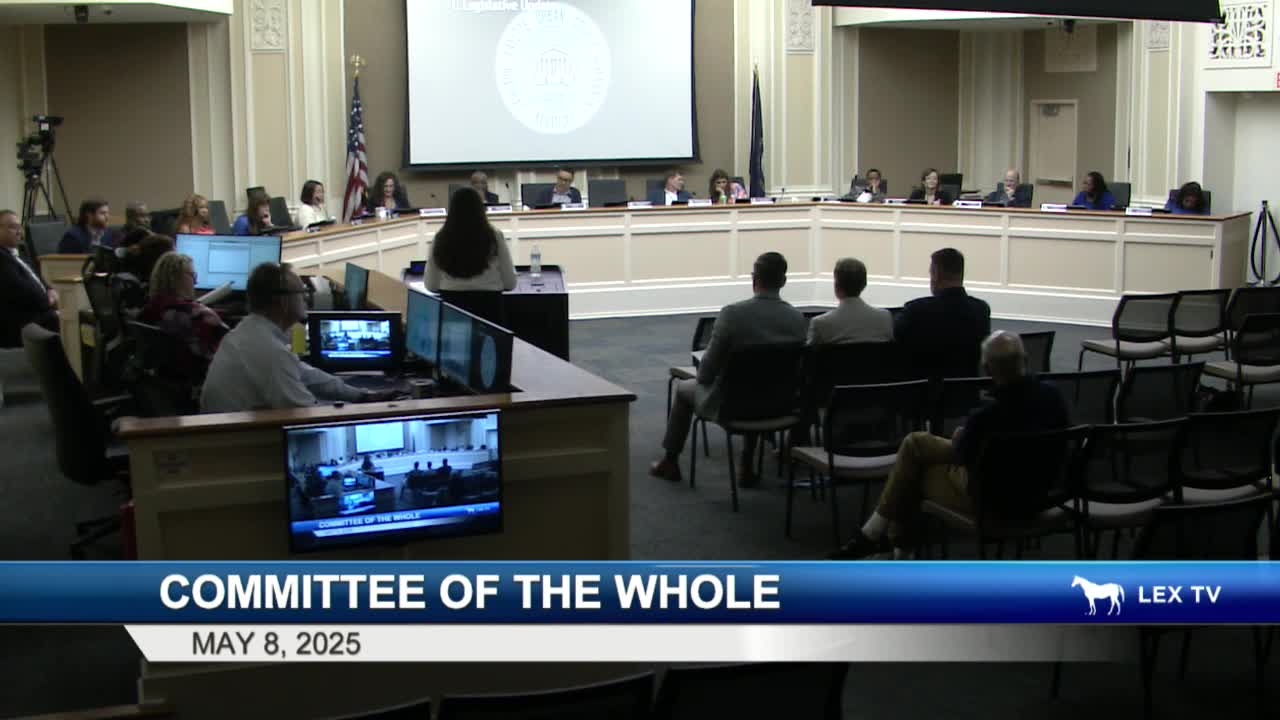
City planning staff presented a draft preservation and growth-management program to Lexington’s Committee of the Whole on May 8 that would use a five‑year off‑cycle growth-trends report with a 20‑year horizon to guide urban service area and policy decisions.
Hal Bailey, manager of long-range planning, and deputy director Chris Taylor presented a draft framework of Lexington’s preservation and growth management program at the Committee of the Whole on May 8, describing a process to evaluate whether the city needs additional acreage for residential, commercial or industrial uses and how to handle expansion of the urban service area.
The program, Bailey said, would run on a staggered cycle separate from the five-year comprehensive-plan update: a growth-trends report (performed off-cycle) would use current data to project needs over a 20-year horizon and would be publicly vetted. "This data would form the basis of a growth trends report, which would be done off cycle 2 years following the statutory requirement of the comprehensive plan," Bailey said. If the report showed no additional acreage was needed, the process would pause until the next cycle.
If the analysis identified a need for land, the planning commission would craft recommendations for the Urban County Council that could include policy changes, regulatory changes or adjustments to the urban service area. Bailey described options for a special “economic development” exception: the council could, by supermajority, initiate a targeted process for a transformative project outside the current urban service area but would still require master planning and public review before rezoning or service changes.
Under the draft, a subcommittee would review vacant land inventory and could recommend removing long‑undeveloped peripheral parcels from the urban service area while adding acreage to meet need elsewhere. Bailey said the process would include a 60‑day application window for property owners to submit proposals and master-plan review similar to the 2023 urban growth process.
Council members sought specifics. Councilmember Savigny asked which data sources the city would use; Bailey said planners plan to combine Census and Bureau of Labor statistics with permitting and local data and to partner with universities to reduce perceived bias. On the question of what constitutes "vacant" or "underutilized" acreage, Bailey said the inventory would exclude land in active principal uses (for example, downtown surface parking lots in active use would not be treated as vacant) and would focus on parcels not functioning for their primary zoned purpose.
Several members pressed whether the special-need exception could be used to recruit large economic-development projects. Bailey said the process is intended to create a formal path for such opportunities but would raise the bar compared with ad-hoc rezones by requiring master planning and higher council thresholds. "We are proposing this as having some sort of formalized process... this allows us to work that in while also upping the bar ensuring that we are talking about a super majority and having master planning associated," he said.
The draft timeline Bailey described would take roughly two years from initial growth-trend findings to completion of master planning and any urban service area modification; the city expects additional public outreach, with a drop-in engagement session scheduled for May 22 at the Lexington Senior Center and a planned GGP committee discussion on July 1. A fuller draft of recommended changes aimed at council review is expected by the September 9 special GGP public forum.
Bailey and staff said more technical metrics and locational requirements (the precise screening criteria for which parcels could be considered) remain to be defined and will be developed with public input. Several council members urged staff to produce clear, shareable data sets early so successive councils and the public can evaluate the method and results rather than having the work shelved until the next council cycle.
The vice mayor closed the session by encouraging councilmembers and residents to attend the May 22 public event and to continue dialogue with planning staff as the draft is refined.