Get Full Government Meeting Transcripts, Videos, & Alerts Forever!
Get email alerts on the State Legislation topic
No spam. Unsubscribe anytime.
Kentucky League of Cities summarizes 2025 session: preemption defense, firefighter schedule flexibility, pension health boost
Summary
Gracie Kelly of the Kentucky League of Cities briefed Lexington’s Committee of the Whole on bills from the 2025 Kentucky General Assembly, highlighting defensive work against preemption, enactment of 10 KLC initiatives and measures affecting firefighters, municipal audits and retiree health subsidies.
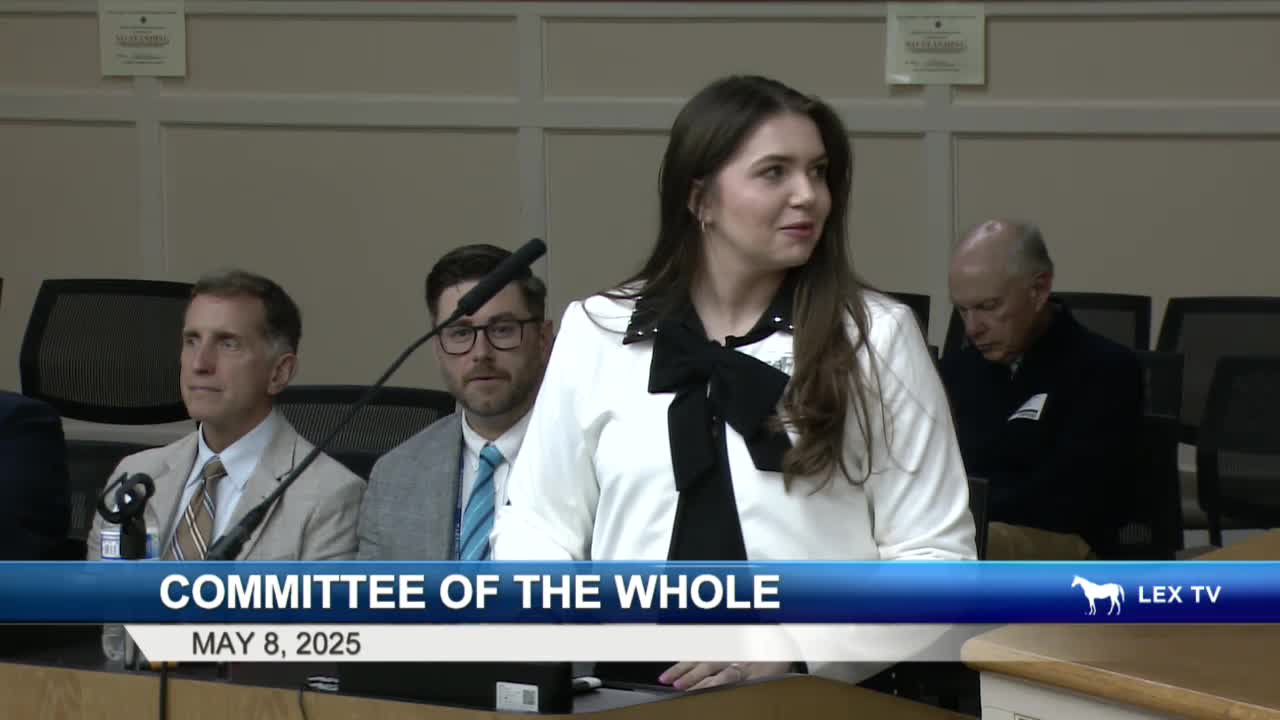
Gracie Kelly, director of government affairs for the Kentucky League of Cities, told the Lexington Urban County Council’s Committee of the Whole on May 8 that the 2025 legislative session required heavy “defensive work” by local governments amid repeated preemption proposals and rapid bill activity.
Kelly said the 30-day session produced more than 1,000 filed bills and 148 enacted measures; 10 were KLC initiatives that the League’s board had prioritized. “It may not seem like a lot, but that's actually really substantial,” she said, describing KLC’s role in drafting, finding sponsors and shepherding those initiatives.
The update highlighted several enacted measures or developments the League tracked that could affect Lexington and other cities. Kelly described House Bill 30 as codifying a court of appeals decision to protect ordinary raises and bona fide promotions from triggering pension-spiking penalties. She said House Bill 131 lets some jurisdictions adopt alternative firefighter schedules (examples Kelly gave include 48-on/96-off and 1-3-2-3 national models), a change intended to give cities flexibility for recruitment and retention while not superseding collective bargaining.
Kelly also summarized planning-and-zoning training changes in House Bill 321 that extend the initial orientation deadline for appointed planning commissioners from 120 days to one year and lengthen continuing education windows from two years to four years; she said one hour of the orientation and continuing education must focus on housing. Other measures she flagged included House Bill 369 (authorizing local accrual schedules for a 15-day annual leave granted to officers upon hire), House Bill 437 (removing arrest authority for ABC administrators and investigators unless they are peace officer–certified) and an open‑records change in House Bill 520 that adjusted how law-enforcement investigations may be withheld from disclosure.
On retirement benefits, Kelly described Senate Bill 10 as raising the CERS retiree health insurance subsidy for members under 65: nonhazardous retirees who meet a career threshold (27 years, as Kelly stated) would receive $40 per month per year of service and hazardous retirees $50 per month per year of service, increases Kelly said were actuarially manageable for employer contributions.
Kelly said Senate Bill 237 clarified statewide standards for waiving certain physical-agility tests for officers recently employed in another state and authorized a 40-hour online training pathway for part-time telecommunicators. She also noted Senate Bill 25 included KLC priorities such as allowing industrial revenue bonds to be used for multifamily housing developments of 48 units or more and permitting local fire appeals boards where local processes are available.
On matters that did not pass, Kelly warned the committee that a centralized collection proposal for occupational taxes (House Bill 253) did not receive a hearing but remained a likely interim topic; she described KLC opposing mandated state collection of local occupational taxes. She said short-term-rental legislation and other preemption proposals also remain active concerns for local governments.
Council members asked several follow-up questions: Councilmember Lynch pressed for rationale behind extending training timelines under HB 321; Kelly said the change was intended to help smaller cities that struggle to recruit volunteers who can meet the shorter deadlines. Councilmember Curtis and others asked whether any measures singled out Lexington; Kelly said most KLC initiatives are board-driven and she deferred to Lexington’s paid lobbyists on bills specifically tailored to Lexington, but she confirmed the KLC board had considered and in some cases voted on bills that affected consolidated local governments.
Kelly concluded by offering to follow up with councilmembers and with questions about bills that required more detail. "I'm happy to answer those," she said, and the vice mayor thanked her and her team for the briefing.
The presentation lasted within the allotted time and preceded a separate staff presentation on Lexington’s preservation and growth management program.