Get Full Government Meeting Transcripts, Videos, & Alerts Forever!
Get email alerts on the Tax Policy topic
No spam. Unsubscribe anytime.
Finance committee hears memo showing scenarios where residential tax burden could rise sharply; staff urge caution
Summary
City staff presented modeling of FY26–29 tax and valuation scenarios that show a possible shift of property-tax burden from commercial to residential properties and a rapid drawdown of excess levy capacity, prompting calls for a cautious approach and a proposed $5 million federal stabilization fund.
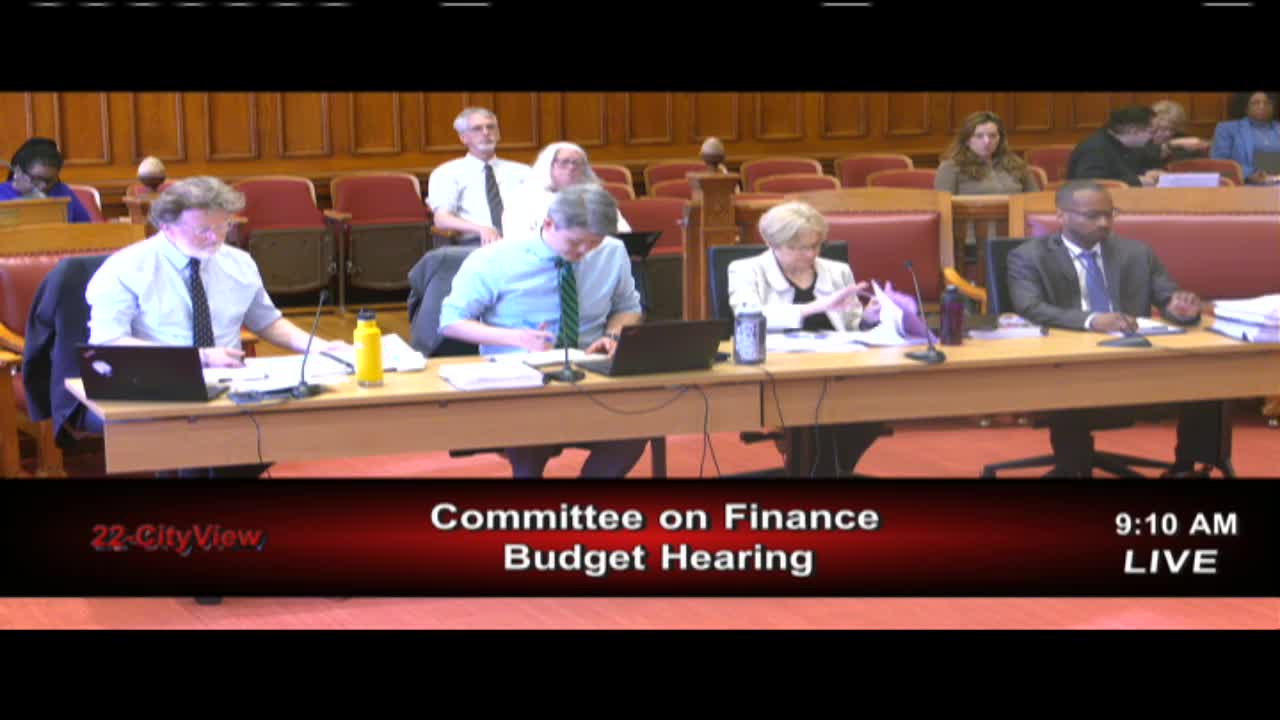
City staff told the Cambridge Finance Committee on May 8 that a set of modeled scenarios shows emerging risks to the city's property-tax base and long-term fiscal flexibility. Assistant City Manager (ACM) Spinner and Budget Director Jennings presented a memo requested by the council that traced how continued declines in commercial values or faster budget growth could push greater tax increases onto homeowners over the next several years.
The memo said the FY26 budget as submitted reflects a 7.9% levy increase and that each 1% of levy growth raises roughly $6.8 million. Staff modeled a "moderate" scenario in which residential bills could rise about 12% in a year when commercial values decline moderately, and a more pessimistic scenario in which residential bills could climb nearly 15% in a single year because of steep commercial value declines. Cumulatively, staff showed that residential property tax bills could grow by roughly 43% in a moderate scenario and nearly 70% in the worst-case scenario through FY29.
"We're particularly concerned about the possibility of a shift in burden from the commercial class to residential taxpayers," ACM Spinner said. "Two things create that pressure: declining commercial valuations and continued reliance on the levy for operating needs." Budget Director Jennings added that Cambridge's commercial real estate market has shown higher vacancies and lower valuations in recent months, particularly in office and lab space.
Why it matters: staff emphasized that the city's excess levy capacity functions as a financial buffer. Under a moderate budget-growth plan (a tax-levy cap at or below 8% in FY26 and lower targets thereafter), staff showed excess levy capacity declining from roughly $189 million at the start of the period to about $138 million by 2029. Under a higher-growth scenario the cushion could fall to roughly $69 million by 2029.
Staff recommendation and next steps: to respond to near-term federal funding uncertainty, staff proposed a $5 million federal funding stabilization reserve in FY26. Councilors asked for more detail on household impacts, and several members said they would consider whether targeted use of free cash or modest tax adjustments could preserve essential services. ACM Spinner and the Budget Director said a multi-year plan and a formal roadmap for ERP and staffing efficiencies would be brought forward to limit long-term levy pressure.
"A lot of this comes down to choices about near-term services versus preserving long-term capacity," Spinner told the committee. "We want the council's partnership to balance short-term community priorities while protecting the city's financial flexibility." Ending: Staff said the October tax vote will rely on property values as of January 1, 2025, and that year-over-year shifts in values will determine the final distribution of levy burden between classes.