Get Full Government Meeting Transcripts, Videos, & Alerts Forever!
Get email alerts on the Waste Management topic
No spam. Unsubscribe anytime.
Planning board approves trash compactor at Shops of Parkland with conditions
Summary
The City of Parkland Planning and Zoning Board approved a site-plan amendment to install a locked trash compactor at the Shops of Parkland, imposing conditions on pickup times and directing staff to pursue stronger enforcement for repeat code violations.
The City of Parkland Planning and Zoning Board on May 8 approved a site-plan amendment to add a secured trash compactor at the Shops of Parkland, a 13,000-square-foot outparcel on a 20.8-acre parcel near State Road 7 and Hillsborough Boulevard. The motion passed 5-2 after board members asked for conditions on pickup schedules and stronger enforcement for repeated violations.
Board staff said the compactor is intended to reduce ongoing trash overflows at the retail outparcel, which houses seven tenants (five food-and-beverage operators). Planning Department staff member Caitlin Forbes said the compactor is “being proposed to help clean up some of those existing code violations” by consolidating trash and reducing the number of collection truck visits.
Board members were focused on operational details and site impacts. Staff and the applicant said the site currently manages roughly 13 combined trash- and recycling-collection trips per week; the applicant estimated the compactor would reduce trash pickups from about seven times weekly to once weekly and could lower recycling trips from six to three, bringing total weekly visits down from roughly 13 to about four. The compactor would occupy one existing parking space (the site requires 66 spaces and currently has 69) and be enclosed behind an approximately 8-foot masonry wall with hedges and two palm trees for screening.
Several board members raised concerns about traffic and circulation at the adjacent gas station and BJ’s access drive, potential odor, maintenance and enforcement, and whether the landlord would reliably manage pickup times. Joel Kaplan and others suggested alternative placements and additional design elements (e.g., floor drains/grease-trap connections, a chute-style inlet, or different orientation) to reduce sight-line and circulation conflicts. Staff said earlier iterations placed the unit on the north side of the building but county easements and vehicle-turning analyses prompted the current south-corner location.
Applicant representative Liz Summerstein described the existing trash configuration: two enclosed dumpster areas each with a 4-yard trash and 4-yard recycling bin (16 yards total), plus an unenclosed 8-yard dumpster the tenant added to manage overflow. She said the compactor will increase on-site trash capacity while substantially reducing collection frequency and visible overflow, and that gates will be locked and the compactor has interlocks so it cannot operate unless doors are closed. Consultant Julian Bobolev and staff said the city and applicant are working to specify pickup windows to avoid peak circulation times.
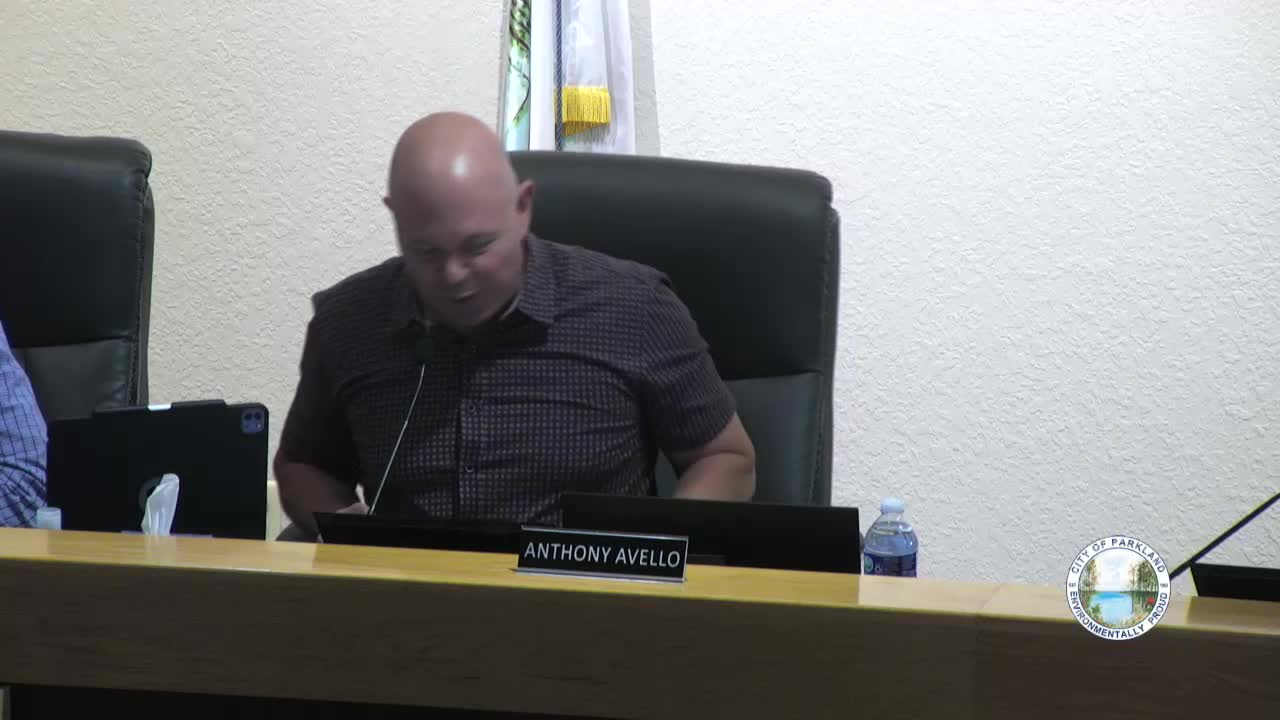
The board added conditions as part of the approval. The motion, made and read into the record, approved Resolution 2025-024 for the Shops of Parkland trash compactor “with the condition of the applicant working out the pickup schedule with the planning department and also a code enforcement, violation penalty work for repeat offenses.” Alex Laszewick moved the motion and Vice Chair Anthony Avelo seconded it. The vote record was: Jordana Goldstein — yes; Alex Laszewick — yes; Joel Kaplan — no; Todd Rogers — yes; Derek Bigsby — yes; Vice Chair Anthony Avelo — yes; Chair Marie Zweig — no. The motion passed 5-2.
Staff noted existing city remedies: commercial property maintenance standards, the city nuisance ordinance addressing offensive or obnoxious odors, and the code-enforcement process through the special magistrate, which can impose daily fines and stiffer penalties on repeat violations. Board members asked staff and the city attorney to ensure enforcement language and any “teeth” for repeated noncompliance are clear in the condition of approval.
Board discussion also covered operational safeguards and site details staff will pursue before the commission hearing: locking gates, whether cameras or sanitation/sanitizing options are available on the compactor unit, pickup time windows, and possible additional recycling capacity in existing enclosures. Staff said they will continue coordinating with engineering, code enforcement, and the applicant; the board reserved the option to revisit the solution if it does not resolve the ongoing problems.
The board recorded several practical clarifications on the record: the proposed compactor will fit within the existing footprint while removing one parking space; existing trash bins in two enclosures will have their trash bins removed and may be replaced with additional recycling bins; the compactor is proposed to be collected by a private hauler (not the current mixed providers), which allows the city and applicant more leverage to limit pickup windows; and some site constraints (including a sanitary-sewer easement) prevented placement at the previously considered north location.
The approval instructs staff to finalize pickup-time conditions and to include language addressing repeat code violations before the item advances to the city commission.