Get Full Government Meeting Transcripts, Videos, & Alerts Forever!
Get email alerts on the Calworks Budget topic
No spam. Unsubscribe anytime.
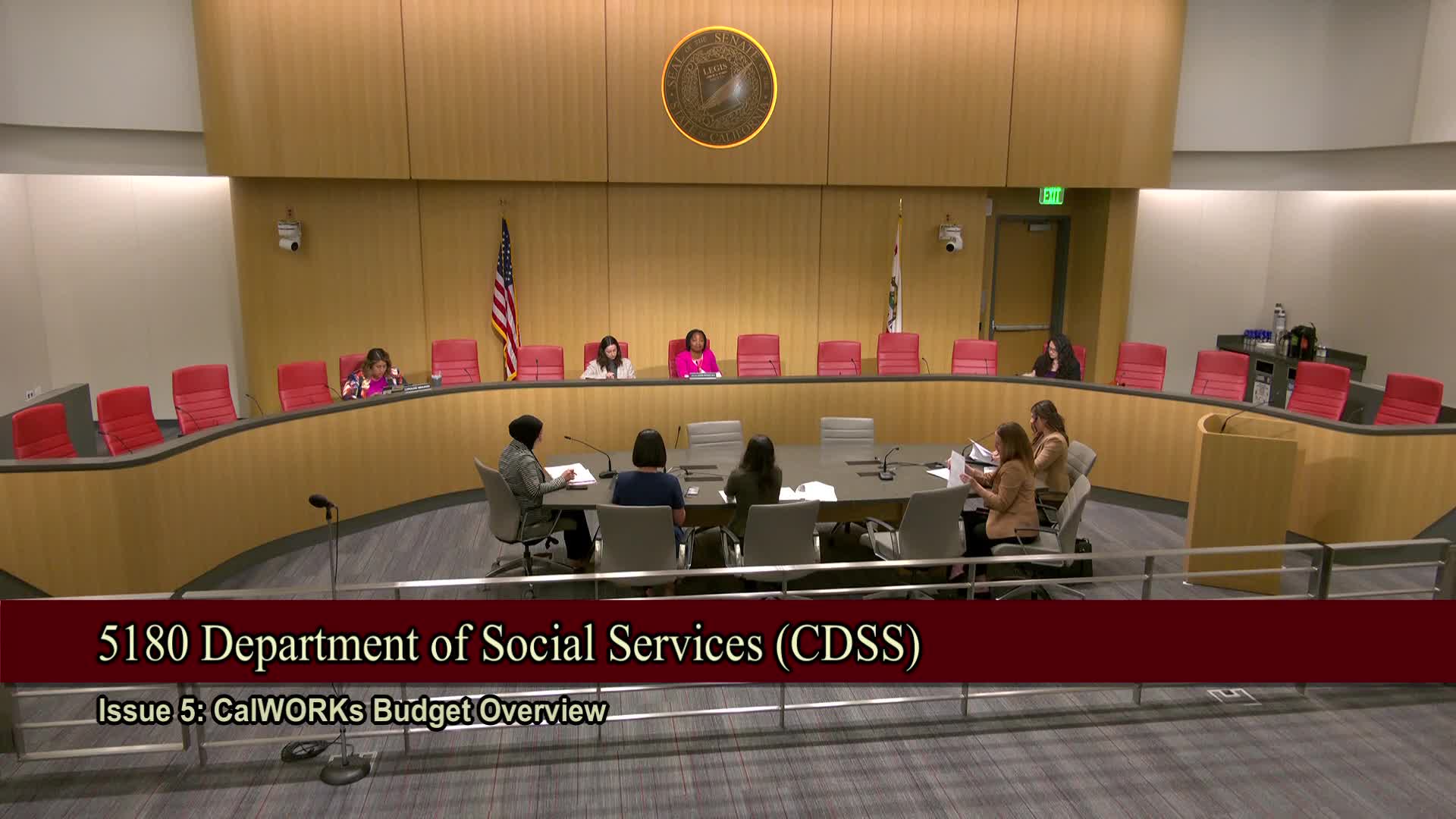
Senate subcommittee reviews CalWORKs budget, single‑allocation concerns and "Reimagine CalWORKs" proposals
Summary
CDSS staff told the subcommittee the governor's budget holds single‑allocation funding at the 2024‑25 level while projecting modest caseload increases; LAO and county representatives raised concerns about whether county eligibility administration is sufficiently funded and urged oversight and potential methodology updates.
Officials from the California Department of Social Services presented an overview of CalWORKs (California’s TANF‑funded welfare‑to‑work program) and budget assumptions to the Senate Budget Subcommittee 3, describing program priorities, projected caseloads and a series of policy options intended to reduce administrative burden and center family engagement.
Jennifer Troia, speaking for CDSS, said the governor’s January budget proposal included approximately $6.4 billion in total CalWORKs funds for the budget year and projected a caseload of about 360,000 families in 2024–25 and roughly 362,000 in 2025–26. Troia described a range of services funded through CalWORKs — childcare, employment services, family stabilization, home visiting and subsidized employment — and noted the administration’s focus on combining quick employment placement with supports that address barriers such as housing instability, education deficits and behavioral health needs.
Single allocation and county administration: CDSS told the committee that counties receive a single allocation (a block grant) to administer eligibility, employment services and a related intensive case‑management program. The governor’s budget holds single‑allocation funding at $1.7 billion in 2024–25 and proposes $1.6 billion in 2025–26, a reduction that CDSS said reflects changes in projected employment‑services caseload and is intended to hold counties harmless for prior commitments. The Legislative Analyst’s Office told the committee it continues to review whether the eligibility‑administration component of the single allocation is sufficient. LAO staff said updating the eligibility administration methodology could require roughly $200,000,000 in additional funding based on their reassessment.
"No‑cost" and low‑cost options: CDSS summarized a report prepared under Assembly Bill 161 that presents multiple policy options to center family engagement, reduce administrative burden and support local implementation. Troia described one example — eliminating sanctions during a client’s first 90 days of engagement — and said the department estimated the first‑year grant cost at about $1.9 million with ongoing costs of $1.7 million, offset in part by county administrative efficiencies.
County and advocate input: Kelly Brooks of the County Welfare Directors Association urged adoption of a $245,000,000 proposal championed by Senator Caballero to update and make counties whole for single‑allocation underfunding. LAO and Department of Finance representatives said they will continue to monitor expenditures and caseloads through the May revision and noted that county implementation differences can create varied local impacts for services such as stage‑based childcare within CalWORKs.
Legislative oversight and next steps: LAO representatives said the governor’s budget maintains previously enacted multi‑year reductions in some CalWORKs components and that the legislature could use oversight and the May revision window to consider low‑ or no‑cost reforms and methodology updates. CDSS said it will continue to refine data dashboards and county partnerships to measure participation gaps and program reach as the state moves toward implementing the options in the AB 161 report.