Get Full Government Meeting Transcripts, Videos, & Alerts Forever!
Get email alerts on the Food Assistance topic
No spam. Unsubscribe anytime.
Senate subcommittee told federal funding cuts threaten California food-assistance programs
Summary
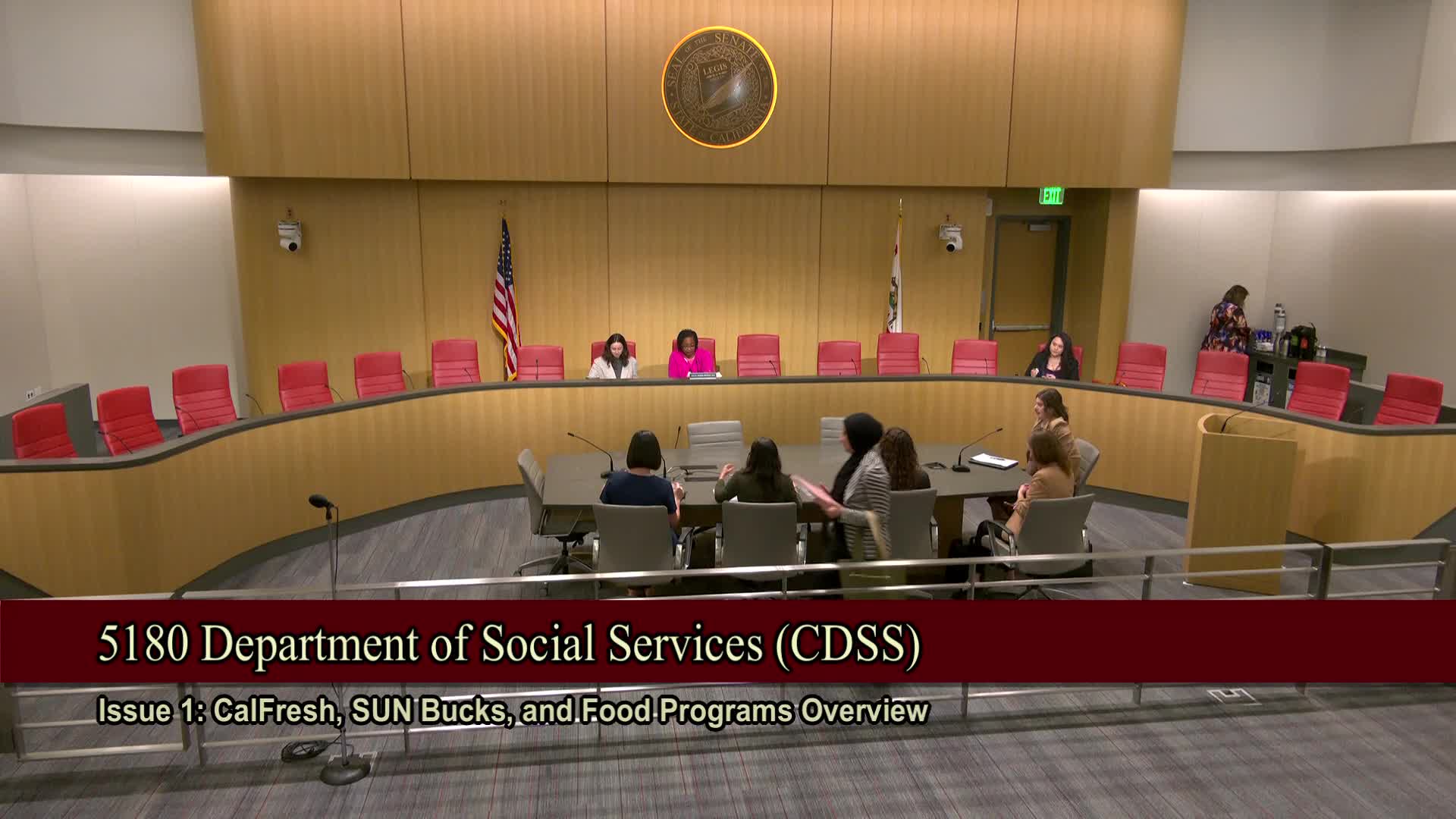
At a hearing of the California State Senate Budget Subcommittee 3, Department of Social Services officials warned that recent USDA decisions terminating several grant streams threaten programs that buy and distribute locally produced food and other emergency food supports that reach millions of Californians.
At a hearing of the California State Senate Budget Subcommittee 3, officials from the California Department of Social Services (CDSS) told legislators that recent federal decisions and the ending of several USDA funding streams are reducing resources for statewide food‑assistance programs that reach millions of Californians.
Jennifer Troia, speaking on behalf of the Department of Social Services, said CalFresh (the state name for the federal Supplemental Nutrition Assistance Program) remains the state’s largest food and nutrition program but that other affiliated programs have faced abrupt federal changes. "We were awarded a total of $88,000,000 via 2 grama, LFPA and LFPA plus that were anticipated to be available through June of 2026," Troia said, and later added that a planned third round of LFPA funding (LFPA '25) was terminated on March 7, 2025, canceling approximately $47,300,000 the department expected to receive.
Why this matters: the Local Food Purchase Assistance (LFPA) and related grants enabled California to buy locally produced food for food banks, supporting socially disadvantaged farmers and local distributors. CDSS told the committee those grants had been fully committed to partners including the California Association of Food Banks, the California Department of Food and Agriculture and regional food bank collaboratives.
CDSS staff also described other recent federal changes affecting emergency food resources. The department said it had previously received a Commodity Credit Corporation (CCC) augmentation to the federal emergency food program (TFAP) but that the USDA notified states on April 2, 2025, that that CCC augmentation was terminated. CDSS estimated the value of canceled TFAP food for California would be about $60,000,000, but said exact values were not provided by USDA. "There's clearly a high level of uncertainty related to changes that the new federal administration or Congress may pursue," Troia said.
SunBUCs/Summer EBT: CDSS described the newly implemented summer EBT program, referred to at the hearing as SunBUCs (Summer EBT). CDSS said the program provides eligible school‑age children $120 per child for groceries during the summer, tied to free and reduced‑price meal eligibility and automatic for children who participate in CalFresh and Medi‑Cal. The department reported issuing about $672,000,000 to roughly 5.6 million children in summer 2024 and said the 2025 plan was approved by the federal government on April 9, 2025. Troia said cards were scheduled to begin arriving in early June 2025.
Disaster CalFresh and emergency food reserves: CDSS explained how disaster CalFresh operations work after a presidential declaration that triggers individual assistance. In response to recent Los Angeles wildfires and related outages, CDSS said it had issued more than $17,000,000 in replacement benefits to over 127,000 households across 13 counties. The department also described an emergency food bank reserve that can be replenished with up to $1,000,000 and gave an example of an emergency contract to deliver 25,000 food boxes and truckloads of bottled water to local food banks within days of the fires.
Food‑bank perspective: Becky Silva, government relations director for the California Association of Food Banks, told the committee that food banks are already facing a “perfect storm” of elevated demand and disappearing federal and state funds. "One in four people are paying for groceries with a credit card and are taking on debt to buy food," Silva said. She urged the legislature to sustain Cal Food funding at $60,000,000 annually and warned that without replacement LFPA and TFAP funds food banks and local producers would face severe strain.
Budget context and appeals: Troia said California included $3.9 billion in total funds and $1.3 billion in General Fund for CalFresh and nutrition programs in the governor’s January budget proposal. CDSS said it had submitted an appeal to USDA on April 4 asking the agency to reverse the LFPA termination but had not received a response as of the hearing.
Discussion and next steps: Legislative Analyst Office staff reported they will continue to monitor caseloads, the SunBUCs rollout, and federal decisions. Committee members asked CDSS and the Department of Finance about contingency planning; both agencies said they were monitoring developments and that the state’s ability to backfill lost federal funds would be constrained by the state’s fiscal position.
Looking ahead: CDSS said it will continue outreach to food banks and growers, press USDA on appeals, and monitor the practical impacts of the terminated federal grants. Food‑bank and community witnesses urged the committee to consider state funding actions now to prevent service interruptions.