Get Full Government Meeting Transcripts, Videos, & Alerts Forever!
Get email alerts on the Mining Reclamation Bonds topic
No spam. Unsubscribe anytime.
State reclamation staff explain how Colorado sets mine reclamation bonds, show software behind estimates
Summary
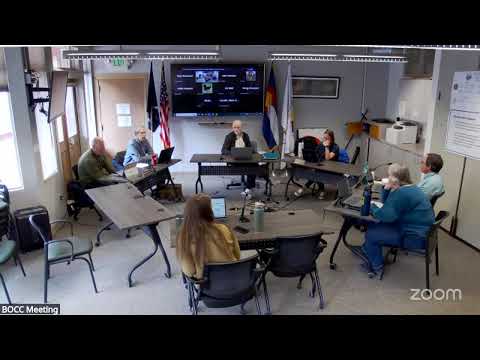
Officials from Colorado's Division of Reclamation, Mining and Safety gave San Miguel County planning commissioners a technical briefing on how reclamation bonds are calculated, demonstrated the SIRSES estimating software and described monitoring of financial warranties.
Representatives from the Colorado Division of Reclamation, Mining and Safety (DRMS) told the San Miguel County Planning Commission on May 8 that the agency uses a standardized, data-driven process to calculate reclamation bonds and to monitor financial warranties for mines in the county.
DRMS environmental protection specialist Amy Yadell demonstrated the agency's cost-estimating software (SIRSES/CIRCE) and said the division's approach is designed to produce an amount that will cover the cost to complete reclamation by a third party if an operator forfeits a bond. "We simply could not trust the operators to tell us how much they think that their bond should be," Yadell said, describing why the division uses the software and a set of nationally-sourced cost data.
The briefing explained why the division's bond amounts are often higher than operator estimates. Yadell said a DRMS bond must include direct reclamation costs (equipment hours, haul distances and material volumes) plus indirect costs the state would incur if it must contract and manage reclamation work. Those indirect costs include contractor overhead and profit, insurance and performance bonds, a superintendent, administrative and contract-management fees, and a contingency allowance for uncertainty.
Yadell demonstrated how SIRSES assembles tasks (for example, dozing, hauling and seeding), applies productivity and correction factors drawn from the CAT handbook and other industry sources, then rolls up a complete estimate. She said DRMS updates much of the database annually (equipment and contractor rates, for example) and surveys seed and material vendors every three to four years to keep revegetation costs current. Yadell described SIRSES as a transparency and audit tool: the system prints a task-by-task PDF that shows quantities, equipment and the source of unit costs.
Russ Means, representing Colorado Dreams (a DRMS outreach/consulting partner who introduced the presenters), and Sarah Stevenson-Ben, DRMS's financial warranty specialist, also spoke. Stevenson-Ben described how the division accepts and audits financial warranties (cash, certified letters of credit, corporate sureties, CDs) and that DRMS annually audits banks and sureties to ensure instruments remain in force. "We will use the words financial warranty and bond kind of interchangeably," she said, and explained DRMS sends operators a notice and typically allows 60 days to correct shortfalls after a surety increase or other change.
DRMS staff gave county-specific context: Yadell said San Miguel County currently has 15 active mine permits, five county pits used by road and bridge, and roughly $1.8 million in reclamation bonds held for sites in the county. Over the past 25 years, DRMS staff said three new permits were approved (all construction materials permits), and the division reported 88 sites that achieved final reclamation or termination statewide in the time period referenced.
Commissioners asked about how DRMS treats off-site impacts such as fugitive dust and water quality. DRMS staff said air-quality and many off-site nuisance issues are handled by the Colorado Department of Public Health and Environment (CDPHE) or by county authorities. Yadell said DRMS's statutory jurisdiction is focused on reclamation, erosion control and on-site erosion protection; she noted DRMS will coordinate with CDPHE and local agencies when off-site impacts appear to be an issue.
DRMS staff also described interagency coordination: they cited memoranda of understanding with the Bureau of Land Management and U.S. Forest Service (DRMS typically serves as the primary financial warranty holder under those MOUs) and said the Department of Energy is the primary bond holder for certain DOE-licensed uranium work, with DRMS holding a statutory $100 bond on those lands.
Why this matters: county staff and commissioners are updating local mining regulations and asked DRMS for technical input. DRMS said it would continue to provide technical comments and clarified that the bond calculation method is intended to produce a reliable, defensible dollar amount that the state can use to pay contractors and complete reclamation if an operator fails to do so.
Ending: DRMS staff encouraged local jurisdictions to request their county-assigned environmental protection specialist for site-specific questions and said the division is working on a web-based version of SIRSES that could be shared with operators and partner agencies once funding and publication arrangements are finalized.