Get Full Government Meeting Transcripts, Videos, & Alerts Forever!
Get email alerts on the Corrections topic
No spam. Unsubscribe anytime.
Assembly budget bill allows 18‑year‑old hires, out‑of‑state corrections workers and mandates body‑worn cameras; members warn of staffing, safety risks
Summary
The Assembly advanced a budget implementation bill that includes multiple provisions affecting the state prison system: it authorizes the Department of Corrections to recruit 18‑ to 20‑year‑olds for corrections officer positions while facilities remain below a staffing threshold, allows out‑of‑state hires, requires body‑worn cameras and gives the governor authority to close up to three prisons.
The Assembly advanced a budget implementation bill that includes multiple provisions affecting the state prison system: it authorizes the Department of Corrections and Community Supervision (DOCS) to recruit 18‑ to 20‑year‑olds for corrections officer positions while facilities remain below a defined staffing threshold; allows DOCS to hire applicants who live outside New York; requires DOCS to deploy body‑worn cameras for officers and certain designated staff; and gives the governor expedited authority to close up to three correctional facilities with notice. The bill passed the floor later in the day as part of the body’s budget votes.
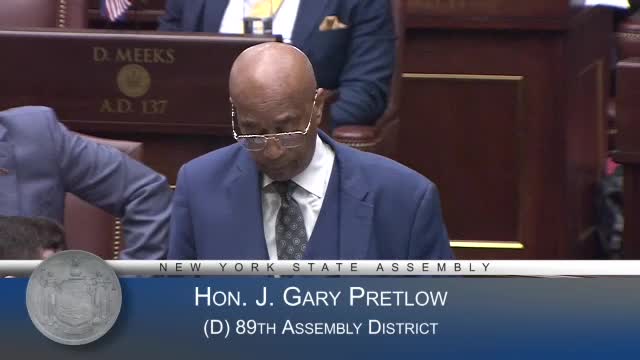
Supporters framed the changes as emergency measures to fill a reported shortfall of correction officers. “Right now, we’re approximately 4,000 CEOs short,” said Chairman Pratlow during floor debate, describing the recruitment provisions as a way to increase on‑duty headcount and shift experienced officers from noncontact duties back to front‑line posts. Pratlow and other sponsors said younger hires would receive academy training and that any 18‑ to 20‑year‑old assigned to work in a secure custody area would be supervised; they also emphasized the recruits would not be placed in roles carrying firearms inside facilities.
Opponents and rank‑and‑file members raised repeated objections to the plan. Lawmakers asked how DOCS will ensure sufficient supervision and training for the younger recruits and whether long‑term retention and morale effects had been modeled. Representative questions focused on whether out‑of‑state hires would receive the same benefits and whether hiring outside New York would undercut local recruitment. “Wouldn’t we be better served giving them better benefits, paying our corrections officers more, and making the prison safe for them to work in instead of hiring people outside of the state?” Representative Durstow asked during debate.
On body‑worn cameras, the bill requires DOCS to provide cameras for correction officers, security supervisors and designated civilian staff and grants the corrections commissioner authority to identify additional staff who must wear cameras. Sponsors said the cameras will be turned on during interactions and that supervisors should enforce compliance. “If an officer is seen without the camera that affixes to one’s chest, it would be obvious that they’re not in compliance with the regulation,” Pratlow said. Several lawmakers pushed for clarity on camera policies covering privacy (bathroom/restroom use), training on device operation, how footage will be stored and who will have access; the text directs DOCS to set implementation rules.
The bill also includes a provision authorizing the governor to close up to three correctional facilities before March 31 of the next year, with a 90‑day notice window. Several members from upstate and rural districts framed that authority as disruptive for communities that rely on prisons as employers and asked for a longer lead time and more transparency. “A 90‑day notice is nothing. This is extremely disruptive to families, to the careers of the individuals themselves, to our whole entire infrastructure,” a representative from a district with a state prison said on the floor.
Several other prison policy items raised during debate are not part of this budget bill, including changes to discovery law and certain retirement or “death‑benefit” fixes for corrections officers. Sponsors said some of those items remain the subject of further negotiation or standalone bills. Lawmakers also debated whether the bill’s measures are short‑term stopgaps versus structural reforms to improve recruitment, safety and working conditions.
What happens next: the budget implementation package that includes these DOCS provisions moved through the chamber’s vote cycle as part of the Assembly’s budget bills. Implementation details, including specific DOCS regulations on camera use, supervision standards for younger staff and any hiring rules for out‑of‑state employees, will be determined in agency guidance and the corrections commissioner’s directives if the measure is enacted.
Ending note: Lawmakers across the floor emphasized both the urgency of correcting staffing gaps and the need for stronger, long‑term reforms that address working conditions, pay, benefits and safety to stabilize staffing without repeatedly resorting to temporary fixes.