Get Full Government Meeting Transcripts, Videos, & Alerts Forever!
Get email alerts on the Criminal Law Self Defense topic
No spam. Unsubscribe anytime.
Utah Supreme Court Hears Arguments on Self-Defense Instruction and 911-Call Evidence in Hunt Appeal
Summary
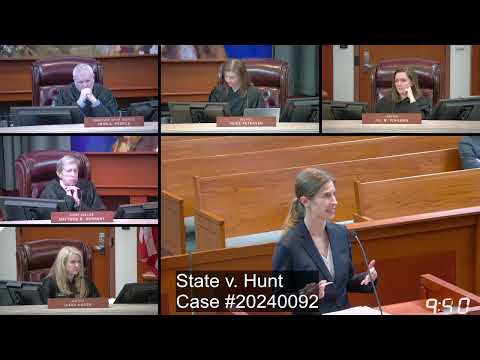
Utah Supreme Court oral argument: Natalie Skabin, counsel for appellant Mr. Hunt, told the court the trial judge erred by refusing to give an instruction clarifying that a defendant need not face an actual danger to establish self defense and that a reasonable mistake of fact can satisfy the statute.
Utah Supreme Court oral argument: Natalie Skabin, counsel for appellant Mr. Hunt, told the court the trial judge erred by refusing to give an instruction clarifying that a defendant need not face an actual danger to establish self defense and that a reasonable mistake of fact can satisfy the statute.
Skabin argued the statutory phrase "reasonably believes that force is necessary" is not explicit that a reasonable mistake can suffice and that the requested instruction would have clarified that point for the jury. Skabin cited earlier decisions and told the court that "the statute and the instruction ... stated that force is justified only if the individual reasonably believes that force is necessary to prevent death or serious bodily injury, and that just leaves kind of fuzzy the question of whether someone can reasonably believe force is necessary in the moment when hindsight reveals that there was no actual danger." She urged the court to treat the district court's refusal as an abuse of discretion where the statute and the facts supported the clarification.
State counsel Connor Nelson told the justices there was no reasonable likelihood of a different outcome even if the requested instruction had been given. Nelson argued the instructions actually provided the jury the reasonableness framework and that the evidence showed the defendant was the aggressor who escalated the encounter into a deadly shooting. "Defendant could not claim any form of self defense here because he was the aggressor and he unreasonably escalated this encounter into a deadly shooting," Nelson said, arguing the jury was adequately instructed on "reasonable belief" and that the denial of the extra instruction did not prejudice the defense.
The court pressed both sides repeatedly about the standard of review for refused jury instructions—whether the issue should be reviewed for abuse of discretion or for correctness when an instruction is necessary to avoid confusion. Counsel and the justices discussed cases the parties relied on, including Turner, Starks, and a concurrence in State v. Lee, as well as a court of appeals decision (Devon) that the defense said recognizes the same concept. The state pointed to Meeks v. Pang and related decisions stating that when an instruction correctly states the law, the trial court has latitude in precise wording.
The second main issue argued was the admission of a 911-call recording and whether defense counsel performed deficiently by not objecting or pursuing pretrial exclusion. Nelson said only about four to four-and-a-half minutes of a roughly five-and-a-half-minute call were played at trial and that the recording had probative value beyond emotion—bearing on movements at the scene, whether CPR was provided and witness credibility. "Based on the exhibit in the record and where it was cut off, I estimate the entire call played was about 4, 4 and a half minutes," Nelson said.
Defense counsel argued the emotional nature of the audio could unfairly arouse the jury's sympathy and that a reasonable defense attorney should have objected or sought a pretrial ruling rather than allow the entire segment to play. The justices questioned whether there was any sound strategic reason not to object and probed counsel about what prejudice, if any, flowed from the admission.
Throughout argument the court asked several times whether any misstatements in the district court's oral reasoning would matter if the ultimate decision to deny the instruction was correct. Counsel for both sides acknowledged the court could affirm on alternative grounds, but disagreed about whether the district court showed any legal misunderstanding that would narrow appellate deference.
After extended questioning on both issues, the court took the matter under advisement. No ruling was announced at argument.
The record shows the dispute focused on (1) whether the trial court should have instructed the jury explicitly that an apparent danger or a reasonable factual mistake can satisfy "reasonable belief" under Utah's self-defense framework, (2) whether the wording offered by defense counsel was duplicative or confusing compared with instructions already given, (3) whether defense counsel rendered deficient performance by not objecting to the 911 recording, and (4) which standard of appellate review governs a trial court's refusal to give a requested instruction.