Get Full Government Meeting Transcripts, Videos, & Alerts Forever!
Get email alerts on the Criminal Justice Courts topic
No spam. Unsubscribe anytime.
Utah Supreme Court weighs standard of review in State v. Wilcox; case turns on video, timing and statute
Summary
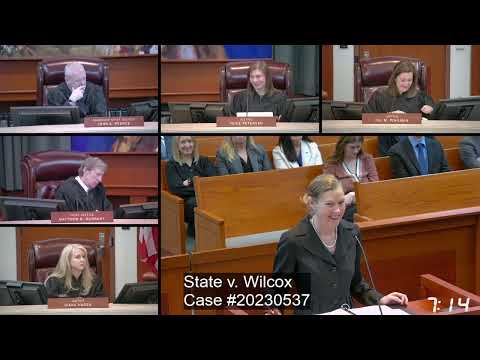
The Utah Supreme Court heard argument in State v. Wilcox on whether appellate courts should review district-court pretrial justification rulings de novo or with deference, and whether a district court erred by dismissing an aggravated child abuse charge after finding the defendant justified in defending others.
The Utah Supreme Court heard argument in State v. Wilcox on whether appellate courts should review a district court's determination under the state's pretrial justification statute with de novo review or with greater deference, and whether the district court erred in dismissing an aggravated child abuse charge against a tennis coach who restrained a player after a slap.
The state, represented by Lindsay Wheeler, told the court the case presents two issues on appeal: the proper standard of review for the second step of the pretrial justification statute and whether the district court wrongly dismissed the aggravated child abuse and communication device charges. Wheeler said the court should give little deference to the district court's ultimate legal conclusions so the law on imminence, necessity and proportionality is uniform across districts. "The strangulation statute ... it's any impediment of the neck that restricts breathing," Wheeler said while arguing the video evidence and photographs supported reversal.
Why it matters: the court's choice of standard will affect how future pretrial justification hearings are reviewed statewide. Under the statute the defendant must first produce sufficient evidence to raise the defense; if that threshold is met the state must then disprove justification by clear and convincing evidence. How an appellate court reviews the district court's factfinding and the mixed legal questions determines how final those pretrial rulings will be.
Argumenters and justices debated three review approaches. The state urged a more lawlike (correctness) review for the mixed questions applying statutory terms such as "imminence" and "proportionality," drawing analogies to Fourth Amendment suppression rulings. Defense counsel Anne Tala Ferrell argued parts of the inquiry should be treated as factual and reviewed with greater deference, particularly the question whether the state met its clear-and-convincing burden; she urged the court to parse the inquiry into factual (subjective) components and legal (objective) components and apply different review standards accordingly. "Gwen testified ... she 'snapped' and she 'burst,'" Ferrell told the court while summarizing testimony the district judge credited.
The facts underlying the statutory question were the focus of several justices' questions. The contested episode began when a player slapped Coach Wilcox on a tennis court; the coach responded by restraining the player and the two went to the ground. Counsel and justices discussed the timing and scope of the contact: participants and the parties' filings describe the sequence from slap to ground as very brief (counsel said approximately four seconds from slap to the ground and roughly 24 seconds for the larger sequence). The district court found the coach was not justified in using force to defend herself but concluded the coach was justified in defending others and dismissed the aggravated child abuse charge; the state seeks reversal of that dismissal.
Evidence and credibility were contested. The state emphasized slowed video and still screenshots and photographs of marks on the player's neck to argue the district court's findings were clearly erroneous. The defense and several justices pressed that the trial judge had the advantage of observing witnesses and their demeanor, and the district court credited testimony that the coach's arms were at the base of the player's neck or collarbone rather than a chokehold and that the player was able to push the coach's arms off while on the ground. Counsel acknowledged the parties provided screenshots but the district judge and the parties relied on the full video at the hearing.
On legal framing, justices repeatedly probed whether the court should treat the ultimate question''whether the state disproved justification by clear and convincing evidence''as analogous to a sufficiency-of-the-evidence review, to the mixed-question analyses in cases such as Randolph and Levin, or to correctness review for uniform guidance. Several justices proposed parsing each element into a subjective factual component (e.g., whether the defendant actually believed a threat existed) and an objective legal component (e.g., whether that belief was reasonable), with different standards applied to each.
No decision was announced. The court took the case under advisement at the end of argument.
The record: the court of appeals certified the question to the Utah Supreme Court. The district court held an evidentiary hearing at which the defendant went first and the state presented cross-examination and its own witnesses; the district court made explicit credibility findings and considered video evidence. The parties contested whether the district court's factual findings and legal conclusions should be reviewed for clear error, sufficiency or correctness on appeal.
Looking ahead: a ruling that adopts a correctness standard for the mixed legal questions would give the Supreme Court greater authority to shape uniform doctrine on imminence, necessity and proportionality in pretrial justification hearings. A ruling that applies more deferential review on the sufficiency or factlike components would preserve broader discretion for trial judges who saw witnesses and viewed the evidence in real time.
(Additional details from argument: the state told the court it is not challenging the district court's prima facie finding that the defendant produced sufficient evidence to raise the defense; the state is contesting only the second-step finding that the state did not disprove justification by clear and convincing evidence. The district court dismissed an associated communication device charge, which the defense conceded it would not press further on appeal.)