Get Full Government Meeting Transcripts, Videos, & Alerts Forever!
Get email alerts on the Foreclosure Sales topic
No spam. Unsubscribe anytime.
Utah Supreme Court weighs whether waivers and delay bar challenge to bulk foreclosure sales
Summary
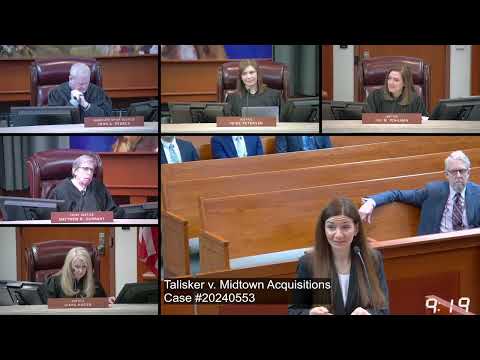
The Utah Supreme Court heard argument in Talisker v. Midtown Acquisitions over claims that lenders and a court‑appointed receiver colluded to chill bidding and sell foreclosed property in bulk, depriving Talisker of a fair market sale, counsel for Talisker said.
The Utah Supreme Court heard argument in Talisker v. Midtown Acquisitions over claims that lenders and a court‑appointed receiver colluded to chill bidding and sell foreclosed property in bulk, depriving Talisker of a fair market sale, counsel for Talisker said.
Talisker attorney Artis Vamanakis told the court the case involves “one of the largest judicial foreclosures in Utah’s history” and alleges misconduct kept secret under a purported common‑interest agreement that deferred an interested purchaser and produced a low credit bid. Vamanakis argued the amended complaint alleges “gross inadequacy of price” and unfairness sufficient under Piper v. Bond and other equitable principles to warrant relief, and that Rule 60(d) permits an independent action to obtain that relief after the sale.
The state’s respondent counsel, Matthew Lawley, representing Midtown Acquisitions and co‑defendant Wells Fargo, answered that the plaintiffs’ own documents contain broad waivers and repayment guarantees that bar the requested relief and that the complaint seeks to vacate or substantially reduce a long‑standing deficiency judgment. Lawley said the repeated, specific waivers and the defendants’ lawful credit bid foreclose the remedy Talisker seeks, calling the petition’s relief “the epitome of unfairness” to the creditors if granted.
A central dispute at argument was how to read the parties’ waivers. The parties’ loan agreements contain a general “any and all” waiver phrase alongside more specific waiver language, and the justices probed whether the general language is sufficient to surrender the particular obligation in Utah Rule of Civil Procedure 69 that property “shall be sold in such parcels as are likely to bring the highest price.” Vamanakis said many documents expressly waived specific rights (for example, the redemption period) but did not expressly waive the Rule 69 ‘‘highest price’’ duty; he urged the court to read the loan package as a whole and to require a clear, intentional waiver of that right. Lawley countered that commercial settlement and loan documents commonly waive future rights and that the contractual language here expressly permits beneficiaries to sell collateral “as a whole or in separate parcels” and to credit‑bid at the beneficiary’s “sole and absolute discretion.”
The parties also disputed the proper procedural vehicle and timing for relief. Talisker relies on Rule 60(d) and on the common‑law framework articulated in Piper v. Bond to argue an independent equitable remedy is available where the sale price was grossly inadequate and unfairness occurred. Defense counsel urged that challenges to sheriff’s sales are normally brought in the underlying foreclosure proceeding and that relief from a sheriff’s sale — not alteration of a confessed deficiency judgment — is the ordinary remedy. Lawley emphasized timeliness defenses, noting the sales and credit bids occurred years earlier and arguing that Talisker waited nearly a decade before filing, raising laches and statute‑of‑limitations concerns.
Counsel for Talisker said key factual information became available only after a trial court order that produced documents previously protected by a claimed common‑interest privilege, including evidence of an interested purchaser (identified in briefing as Park City Municipal Corporation) and lender valuations showing higher fair‑market values. Talisker argued those later disclosures mean it could not have reasonably brought a timely sale challenge immediately after the auction.
The justices pressed both sides on practical remedies. Several questions explored whether the appropriate remedy would be to set aside the sheriff’s sale or to seek a reduction or credit against an existing deficiency judgment, how redemption periods interact with potential relief, and whether courts may craft partial or prospective equitable remedies when property has since passed to bona fide purchasers.
No ruling was issued from the bench. After argument the court said it would take the case under advisement and adjourned.
The issues the Supreme Court must resolve include (1) whether the repeated waivers in the loan and settlement documents amount to a clear, intentional waiver of the Rule 69 duty to sell in parcels likely to bring the highest price, (2) whether an independent action under Rule 60(d) or common law (Piper) can furnish relief years after a sheriff’s sale, and (3) what remedies are legally and practically available where properties were resold or conveyed to third parties after a contested foreclosure sale.
If the court finds waiver dispositive, Talisker’s ability to obtain equitable relief will be limited; if it finds waiver inapplicable or ambiguous, the court will confront novel questions about timeliness, laches, and tailoring remedies when third‑party purchasers are involved.