Get Full Government Meeting Transcripts, Videos, & Alerts Forever!
Get email alerts on the Public Safety topic
No spam. Unsubscribe anytime.
Oro Valley council delays police pay decision after wide public support for higher wages; asks staff for side‑by‑side cost comparisons
Summary
After more than two hours of public comment and presentations from union and management negotiators, the Oro Valley Town Council voted to table action on a proposed public‑safety memorandum of understanding and requested a side‑by‑side comparison of the rival proposals to return to the council in two weeks.
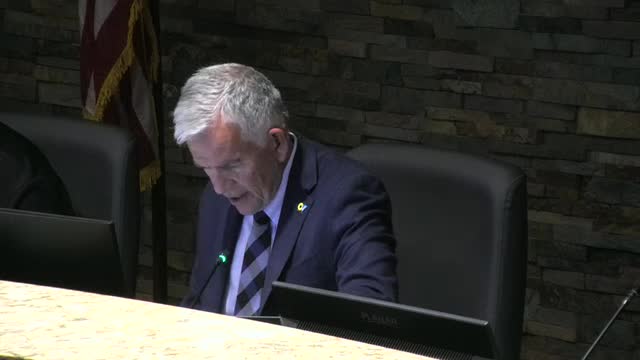
The Oro Valley Town Council on May 7 delayed a decision on a proposed memorandum of understanding (MOU) covering police salaries and benefits after lengthy public comment and competing presentations from town negotiators and representatives of the Oro Valley Police Officers Association and the Fraternal Order of Police.
The council voted 6–0 to table the item to a date certain two weeks after the meeting and directed staff to return with a direct, side‑by‑side comparison of the competing proposals so council members could review costs and pension impacts before taking final action.
Why it matters: Council members and town staff said they want to preserve the town’s high level of public safety while ensuring any agreement is fiscally sustainable. Speakers from labor groups, local business leaders and dozens of Oro Valley residents urged the council to approve a competitive pay package, saying recruitment and retention of experienced officers is a critical local issue.
During public comment more than two dozen residents, many with family ties to Oro Valley officers or with previous careers in law enforcement, described the department as the town’s primary asset and urged the council to approve the unions’ proposals or a comparable plan. "Give the cops what they want," said realtor and resident Lisa Bayless, summarizing a common theme from speakers who tied public safety to property values and local quality of life. Several union leaders and outside law‑enforcement advocates warned that other agencies with higher pay—particularly the Arizona Department of Public Safety and neighboring municipal departments—had already drawn officers away from Oro Valley.
Union presentations: Kelsey Durbin, speaking for the Public Safety Negotiation Committee (a joint committee of the Oro Valley Police Officers Association and FOP Lodge 53), outlined a timeline of bargaining that began with a union proposal in November 2024 and said talks became stalled after management revised its offer in late April. Durbin said the union provided a proposal on April 21 that was “within a quarter of a percent” of the town’s then‑best offer and that management later withdrew earlier progress and proposed a so‑called "bridge plan" that the unions said would compress pay and risk losing experienced personnel. The committee provided comparisons showing starting pay, mid‑career and top‑of‑scale pay versus Marana, Tucson and the Arizona Department of Public Safety.
Town management presentation: Town negotiator Vltava (presenting for management) described the town’s counterproposal and warned that the union’s April proposal would produce a significantly larger one‑time pension liability. Vltava said management’s analysis found the union package could add roughly $7.8 million in pension spike exposure while the town’s current proposal would produce a lower one‑time pension effect and a smaller two‑year cost. Town staff emphasized the need to balance competitiveness with long‑term fiscal sustainability.
Union leadership and police command: Christopher Knapp, president of the Oro Valley Police Officers Association, and Jeff Douglas, OVPD sergeant and OVPOA vice president, said morale and retention are at risk; Knapp told councilors there was a real possibility “more than 30 officers will begin looking to leave our agency” if pay did not become competitive. Police Chief Danny Sharp, who has led the department for more than 20 years, urged councilors to remember the town’s long‑standing commitment to public safety and said Oro Valley historically competed for the “best and the brightest.”
Public safety consequences: Chief Sharp and council members discussed concrete operational impacts should the department lose a significant number of officers. Sharp said losing a sizable portion of patrol would force the department to reassign staff from support functions (including school resource officers) to patrol, reducing other services. Durbin and others said internal surveys showed a substantial portion of officers were considering leaving because of pay and benefit concerns.
Council action and next steps: After debate, Mayor Joseph C. Winfield proposed a resolution that would have approved a management offer with several amendments (including one‑time bonuses for certain steps and a change to the sergeant pay scale). Councilmember Joan Nicholson offered a substitute motion to adopt an April 14 proposal that negotiators had discussed earlier in the process and to adopt negotiating guidelines requiring transparency and the ability for unions to communicate with council and media. The substitute motion was amended to ask staff to prepare a side‑by‑side comparison of the April 14 package and the management proposal and to return the item to council in two weeks for further action. The motion to table and return with comparative documentation passed 6–0.
What was not decided: Council did not approve a final MOU on May 7. No changes to pay or benefits were implemented. The council directed staff to provide the comparative cost and pension information requested, and members said they wanted printed copies of the union materials and management analyses in advance of the next meeting.
Quotes: “Give the cops what they want,” resident Lisa Bayless told the council. Kelsey Durbin, representing the unions, said negotiators were "within a quarter of a percent" of management before a later proposal reversed prior progress. Christopher Knapp, president of OVPOA, warned that failing to become competitive could lead to an exodus of officers.
Ending: Council members and negotiators agreed to continue bargaining but gave themselves and staff a two‑week window to present clearer, comparable fiscal analyses. The item will return to a future council meeting for a final vote after the side‑by‑side documents are placed in the public record.