Get Full Government Meeting Transcripts, Videos, & Alerts Forever!
Get email alerts on the Housing Permitting Utilities topic
No spam. Unsubscribe anytime.
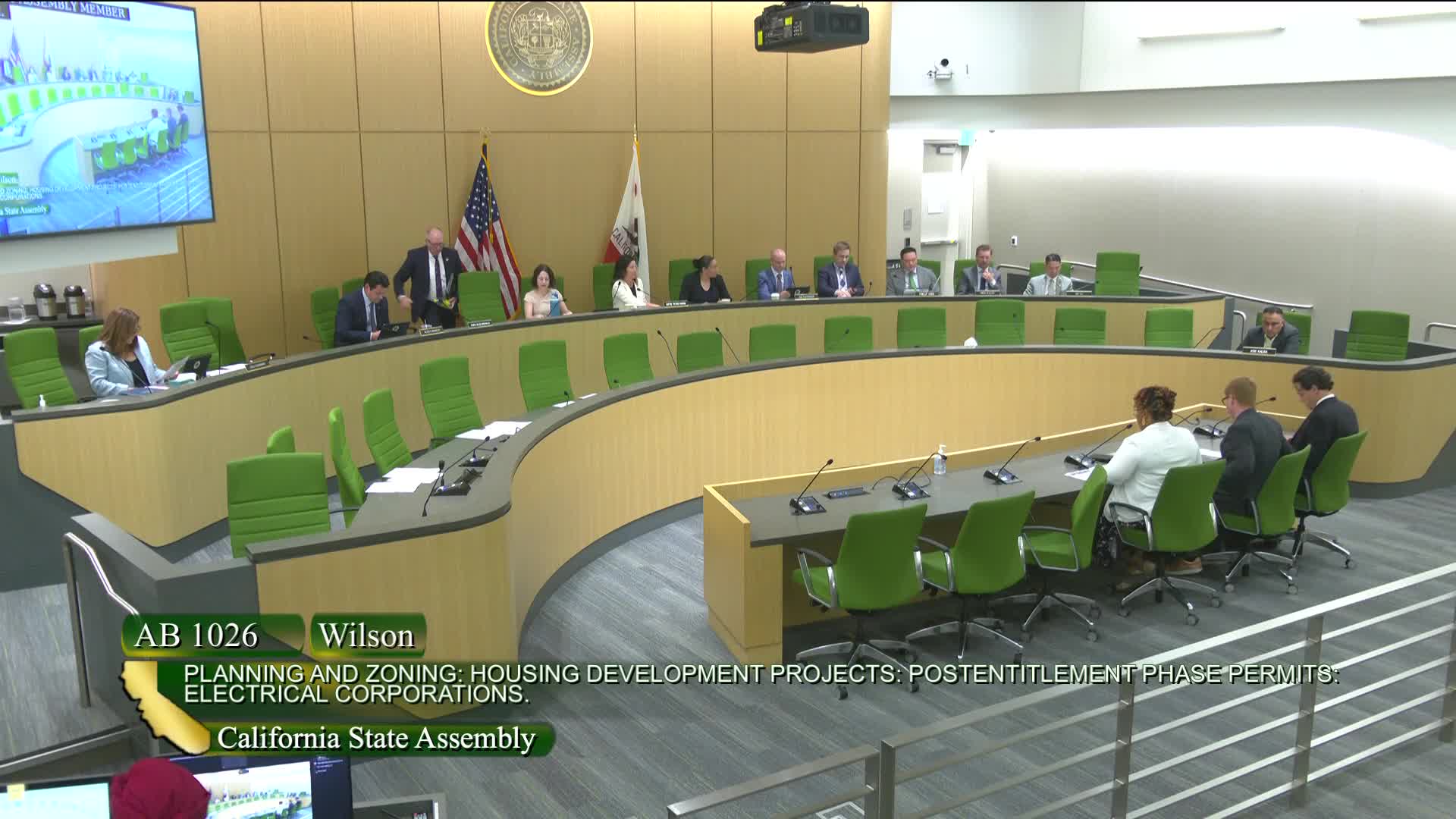
Assembly committee advances AB 1026 to set timelines, information requirements for utility energization applications
Summary
The Assembly Committee on Utilities and Energy voted to send AB 1026 to the floor as amended after testimony from housing advocates and investor‑owned utilities about delays in post‑entitlement utility approvals that can stall housing projects.
The California Assembly Committee on Utilities and Energy voted to send AB 1026 to the Assembly floor as amended after testimony from housing advocates, affordable‑housing developers and investor‑owned utilities. The bill, introduced by Assemblymember Wilson, would require electric corporations to publish the information needed to approve or deny post‑entitlement “energization” applications, adopt consistent timelines for reviews and limit last‑minute changes to application requirements.
Supporters told the committee that unpredictable utility connection processes can hold approved housing projects up for months or years. Corey Smith, executive director of the Housing Action Coalition, said AB 1026 “brings parity to investor‑owned utilities” by applying standards akin to those already required of cities and counties. Kevin Ketchum, housing development director at Mission Housing, told the committee a transformer approval in San Francisco delayed rehabilitation of an affordable property by a year; another transit‑oriented 31‑unit project was delayed about two years, he said, while developers redesigned to avoid utility delays.
Investor‑owned utilities urged caution. Brandon Ebeck of Pacific Gas and Electric Co. said PG&E supports clearer roles between local governments and utilities but opposed aspects of the bill as drafted, including what he called an unrealistic 10‑day timeline in a proposed amendment. Ebeck said the end‑to‑end average process takes roughly 330 days and that utilities are responsible for about 50 of those days; he identified other frequent causes of delay — Caltrans permits, easement acquisition and conflicts between local and utility technical requirements.
Catherine Borg of Southern California Edison told the committee the California Public Utilities Commission’s ongoing energization rulemaking (the Energization OIR) and the CPUC’s September 2024 decisions had created a framework of timelines; she said further changes by statute could hinder the rulemaking’s work and that the CPUC process should be allowed to continue to refine timelines. SCE, like PG&E, said it is working to improve internal processes and assign business representatives to cases within 10 days under the phase‑1 rules established by the CPUC.
Assemblymember Wilson said the bill seeks consistent, statewide expectations so developers and local governments know what information will be required when energization applications are submitted. She told the committee she would accept committee amendments and acknowledged ongoing discussions with utilities and sponsors.
The committee approved the measure “do pass as amended to the floor” by recorded vote, and the secretary recorded the vote as 15‑0. The committee left the roll open for absent members to add themselves before final publication.
Why it matters: California housing developers frequently cite utility connection uncertainty as a cause of delay and cost escalation. AB 1026 would create a statutory set of information and timing standards for investor‑owned utilities’ post‑entitlement energization reviews, aligning those reviews with other permitting timelines advocates say have reduced delays.
What the bill does (as described at the hearing): AB 1026 would (1) require electric corporations to publish the information necessary to make an energization determination, (2) establish timelines for intake and substantive review, (3) require timely responses and limit last‑minute changes to application requirements, and (4) align review timelines with CPUC processes already underway. The author and sponsors said the bill uses the term “energization application” to describe the post‑entitlement utility processes developers call permits.
Dissent and caveats: PG&E and SCE supported the bill’s goals but opposed aspects of the proposed amendments and urged reliance on the CPUC’s Energization OIR. Utilities warned that statutory deadlines that don’t account for third‑party permits, easements or transmission work risk shifting costs or creating unworkable timelines. Supporters countered with developer examples of long delays and urged consistency across IOUs.
Next steps: AB 1026 will move to the Assembly floor for further consideration following the committee’s do‑pass vote.