Get Full Government Meeting Transcripts, Videos, & Alerts Forever!
Get email alerts on the Education Budget topic
No spam. Unsubscribe anytime.
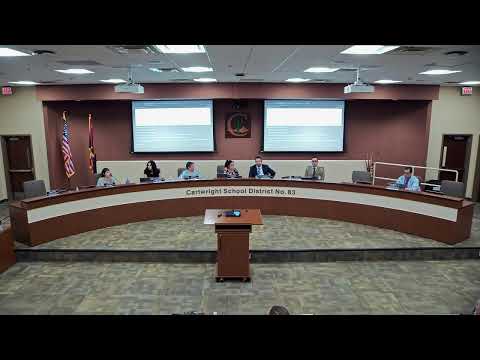
Cartwright board approves May budget revision after public hearing, members warn of long-term shortfalls
Summary
The Cartwright Elementary School District governing board approved its May 2024–25 budget revision after a public hearing and discussion in which district staff said one-time revenue and carryover are masking structural budget pressure that will require multi‑million‑dollar expenditure reductions.
The Cartwright Elementary School District governing board voted on and approved the district’s May budget revision after a public hearing in which the district’s business manager, board members and parents discussed the district’s carryover, funding sources and the need for future cuts.
The revision increases the district’s reported budget capacity for the maintenance and operations (M&O) fund to about $118.1 million and reflects an approximately $4.1 million gain in the district’s revenue control limit tied to higher weighted average daily membership, the district’s business manager told the board during the presentation.
The budget revision matters because it shows the district has more budget capacity on paper this year but is using reserves to cover current expenditures. That mismatch, administrators said, creates a multi‑year sustainability problem that will require expenditure reductions or other adjustments.
Dr. Esbridge, who presented the May revision, told the board the M&O fund is the district’s largest operating fund and that “of the maintenance and operations fund, close to 80% is used for salary and benefits.” He said the revision reflects both a weighted ADM increase of about 485 (which he said equates to roughly $4.1 million) and an actual enrollment increase of about 50 students compared with the adopted budget. He added the district remains down roughly 350 students compared with the previous year.
The presenter said the revision shows an expected carry forward into 2025–26 of about $6.6 million after accounting for current expenditures (about $84.5 million as of April 29), encumbrances (about $25.5 million) and other anticipated expenditures (about $1.5 million). He warned, “our expenditures are currently exceeding the revenue we brought in this year. Or in other words, we’re digging into our savings in order to pay for our current expenditures.”
Administrators also reviewed other funds. The classroom site fund (the fund that can be used for teacher salary increases and certain site programs) increased in the revision to roughly $29 million; the presentation said the district expects to carry forward about $22 million of that into next year. The bond building fund was unchanged between the adopted budget and the revision; presenters said voters had authorized $60 million four years earlier and that anticipated carryover into next year is about $4.6 million after current expenditures and encumbrances.
Board members pressed staff on several points during the public hearing. Board member Denise Garcia asked why media reports said Cartwright faced financial problems; Dr. Esbridge responded that while the district has reserves and is not in immediate danger, the practice of drawing reserves to pay recurring expenditures is not sustainable and could leave the district with substantially smaller reserves in future years. Garcia also questioned past pay and longevity decisions; administrators explained teacher step increases and a $400 supplement (part of a $1,200 total figure discussed earlier) were paid from the classroom site fund and not the M&O fund.
Board member Jennifer Romero said she would abstain from some votes because of what she called concerns about compliance with Arizona law and district policy; that abstention was recorded in roll calls during the meeting.
Public commenters used the budget hearing to ask for transparency and also raised programmatic concerns: several parents and community members praised a district parent‑liaison, Sylvia Rodriguez, and urged the board not to discontinue adult classes, parent workshops and tutoring supports at neighborhood schools. Others asked the board to prioritize student supports such as counseling and direct academic interventions.
At the end of the meeting the governing board approved the revised 2024–25 annual expenditure budget (revision No. 1). The board also adopted the meeting agenda earlier in the session. The formal motions and roll‑call outcomes are recorded below.
The presentation and subsequent discussion noted several budget risks: reliance on one‑time or non‑recurring funds (including federal COVID relief and some one‑time state supplements), potential state changes to Prop 123 funding, enrollment uncertainty (ADM determines funding) and rising operating costs. Administrators said a target reduction figure of roughly $4.5 million has been discussed with staff as the scale of cuts the district should consider to avoid continued drawdown of reserves.
The board did not take additional binding direction on specific cuts at the meeting; the business manager and superintendent were asked to provide further detail. The district said some contracts and encumbrances already account for higher than expected costs on certain projects and that the board may be asked in future meetings to approve adjustments or referrals for review.
The budget presentation and public comments closed with the district indicating it will continue to share detailed budget information with the public and that future meetings will include further discussion of recommended expenditure reductions and timing.