Get Full Government Meeting Transcripts, Videos, & Alerts Forever!
Get email alerts on the Lifeworks Tillery Variance topic
No spam. Unsubscribe anytime.
Environmental Commission recommends approval to remove 32-inch pecan for LifeWorks Tillery supportive housing; conditions required
Summary
The commission recommended approving a variance to remove a 32-inch heritage pecan on a 1-acre lease for a 120‑unit LifeWorks permanent supportive housing project at 819 Tillery Street, with mitigation, a tree-care plan and community-focused conditions; the motion passed 8-1-1.
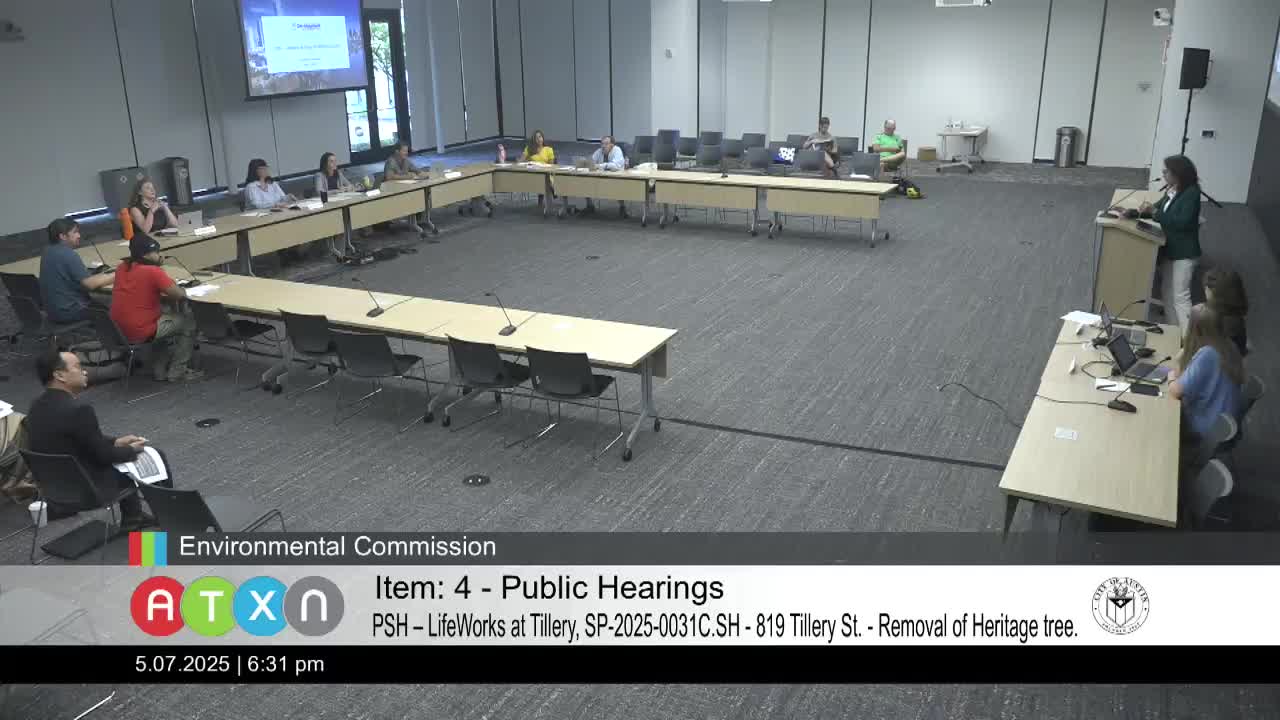
The Environmental Commission voted May 7 to recommend approval of a Land Use Commission variance allowing the removal of a 32-inch-diameter heritage pecan (tree number 3510) on the 1-acre portion of a 13-acre site where LifeWorks plans a 120‑unit permanent supportive housing project at 819 Tillery Street. The recommendation passed on a roll call vote: eight in favor, one opposed and one abstention.
City arborist Naomi Rotramel told commissioners the request is a variance under the city's heritage tree ordinance (transcript citations provided to the commission) and that staff's technical review determined the subject pecan has "poor structural integrity" and documented defects including repeated large limb failures and a cavity beneath a major branch union. Rotramel said staff requested advanced assessments (climbing inspection, resistograph/tomography) and that multiple staff and a board-certified master arborist verified internal structural weakness in the crown above a major load-bearing union. Rotramel said the "variance is recommended."
Rotramel said the applicant provided multiple alternative layouts and design iterations; staff reviewed those options and met with Fire, Transportation and other reviewers. The applicant committed to preserving 34 other heritage trees on the property and to transplanting one heritage tree where feasible. Rotramel described the mitigation standard in the Environmental Criteria Manual as 300% mitigation per inch for a heritage tree; for certified affordable developments the mitigation rate is $75 per inch (the applicant proposed a $7,200 payment), with a preference for on-site replacement plantings where possible.
Connor Kenny, project manager for developer Capital A Housing, and Liz Schoenfeld, chief executive officer of LifeWorks (the nonprofit owner/operator), said the project is a 120-unit, four-story permanent supportive housing building for youth exiting foster care or otherwise experiencing homelessness, coupled with on-site services and proximity to ACC Eastview and LifeWorks's East Campus. Kenny said the project was offered the 1-acre parcel under a below-market lease arrangement that requires a shared site development permit across the larger 13-acre property; he said the developer lacks legal rights to the remainder of the property and that the landowner of the larger site declined to accept the subject pecan if it were transplanted to their portion. Kenny and civil engineer Nat (Civilitudes) described site constraints: a concrete conveyance channel (Boggy Creek), floodplain, fire-lane access and required ADA and water-quality infrastructure that together push building mass into the corner where the pecan stands.
Kenny said moving the subject pecan off-site or raising the building height to preserve it were infeasible under the project's funding constraints. He said the developer is saving more than 97% of the heritage trees on the overall site and has committed to an arborist-backed tree care plan for preserved trees.
Public comment included residents and tree advocates who urged preservation, asked whether mitigation dollars could be used to plant a replacement pecan in a nearby pecan park, and requested an explicit commitment to tree-planting on the East Side. One commenter asked whether mitigation funds would be transparent and used promptly.
After public comment the commission debated the tradeoffs between tree preservation and a deeply affordable, service-integrated housing project. Commissioners pressed staff and proponents on the tree's condition, the feasibility and cost of transplanting (applicants cited prior local moves that cost six figures for paired large trees), and the degree to which the developer had explored alternatives. Naomi Rotramel and staff said eight heritage trees on the site met dead/diseased/imminent-hazard criteria and that several others were in poor condition; two were in fair or good condition but staff and the applicant concluded retention would prevent reasonable use because of the tree's central location within the buildable area.
The commission's recommended approval included multiple conditions added during deliberations and recorded in the motion: submittal and implementation of a tree care plan for the preserved heritage trees for the duration of the lease (as read by staff), annual reporting on tree care activities, adherence to oak-wilt prevention practices, maximization of on-site planting using urban forest replenishment funds (prioritizing native, climate-resilient species), coordination with parks and community organizations on youth-focused tree-planting and education initiatives, and development of on-site interpretive materials to tell the site's pecan grove story. The motion also specified the applicant would pay the required mitigation ($7,200) into the Urban Forestry Replenishment Fund if on-site planting could not satisfy mitigation requirements.
Roll call on the motion read by the commission secretary recorded eight votes in favor (Commissioners Firo, Qureshi, Flurry, Lokey, Ganguly, Secretary Cofer and Chair Bridal among them), one opposed (Commissioner Krueger), and one abstention (Commissioner Breimer). The commission staff will forward the recommendation and the motion language and conditions to the Land Use Commission (Planning Commission) and to Council as part of the public process.
Ending: The developer said it intends to break ground this summer if the variance and other permits proceed; staff and the applicant will return in later permitting stages with landscape and planting plans showing how many replacement trees are planted on-site versus fed to the replenishment fund.