Get Full Government Meeting Transcripts, Videos, & Alerts Forever!
Get email alerts on the Watershed Annual Report topic
No spam. Unsubscribe anytime.
Austin Watershed presents 2024 Annual and State of the Environment reports to Environmental Commission
Summary
Watershed Protection Department staff previewed the department's 2024 annual report and the code-mandated State of the Environment report, highlighting flood-response work, recharge projects and public outreach while commissioners asked for more local watershed detail.
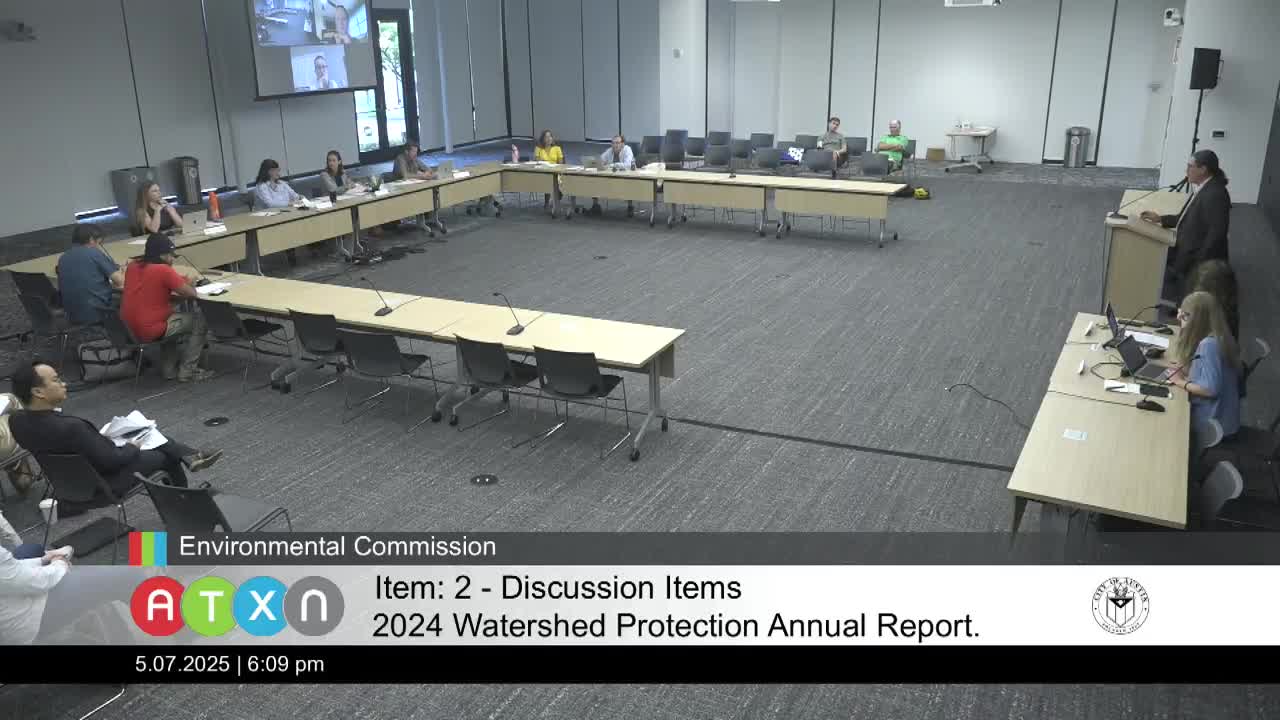
The Environmental Commission heard a presentation May 7 from the City of Austin Watershed Protection Department on its 2024 Annual Report and the forthcoming State of the Environment report.
Jorge Morales, director of the Watershed Protection Department, told commissioners the department began producing annual reports in 2020 to "showcase what we're doing," and walked the commission through major projects and metrics from the fiscal year that runs October 2023 through September 2024.
The presentations summarized recent emergency repairs at Barton Springs Pool, the completion of phase 2 of the Confluence at Waterloo Park, and the Little Bear Recharge Enhancement Project, which diverts water from a relatively clean stream into the aquifer. Morales said the department has "actually created a position for grants" in recent years to diversify funding beyond the drainage utility charge after some federal grant programs paused.
Interim environmental officer Liz Johnston said the State of the Environment report is a "code-mandated requirement" presented to City Council each April and stressed the document draws on data across multiple departments: Watershed Protection (lakes, creeks, aquifers and the salamander program), the Office of Climate and Resiliency (air and climate data), Development Services Community Tree Division (urban forest), Parks (open space), and Austin Water (wildlands). Johnston walked commissioners through the ArcGIS story map format and the report's tabs for trees, water quality, erosion, emergency response and outreach videos.
Commissioners praised the report's accessibility and interactivity, and asked for more localized content for specific watersheds. Commissioner Flurry and others said they found the reports easy to use on mobile devices but had trouble finding detailed references to Onion Creek in the 2024 materials; staff said watershed-specific data are available in an interactive map viewer where users click watershed segments to retrieve data. Commissioners also asked about the department's equity work and its ongoing strategic plan update "Rain to River."
On grants and funding, Morales confirmed some earmarks and federal grant programs paused or were canceled, citing a previously anticipated $50 million grant for Falwell Lane near Onion Creek that was terminated. He said staff will continue to pursue other state and board funding sources for priority projects. On endangered species work, Johnston explained that watershed staff have aquatic specialists (for salamanders and mussels) and that newly considered listings (monarch, a bat species, and some plants) are not yet part of the department's BCC permit and therefore are not fully documented in the watershed tab.
Commissioners asked about community engagement; staff said they run a social media campaign each year, provide council briefings on request, and will attend district events on invitation. Multiple commissioners thanked staff for the report's format and the time invested in producing videos, maps and metrics.
The commission did not take formal action on the reports; staff said the items are informational and will return as needed for Council and community engagement.
A closing note: Morales invited commissioners to suggest additional metrics or topics for next year's report.
Ending: The department emphasized the reports are interactive, meant for public use, and available through the commission's meeting backup materials and the Watershed Protection website. Staff asked commissioners to send suggestions for metrics to include in the 2025 editions.