Get email alerts on the Housing Policy topic
No spam. Unsubscribe anytime.
Board endorses ADU zoning changes plus registration, inspection and amnesty program
Summary
The board recommended approval of a package establishing accessory dwelling unit (ADU) code amendments, a registration and inspection process for rented ADUs, and an amnesty program to legalize existing unpermitted units.
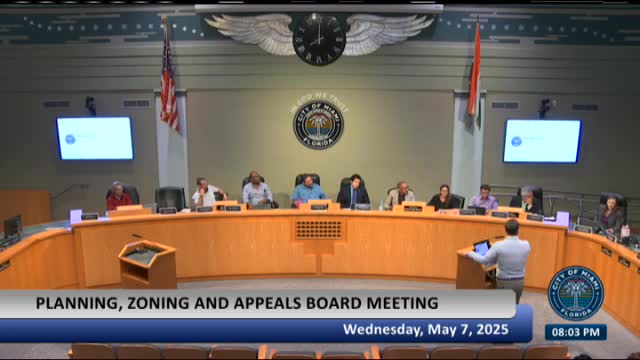
The Planning, Zoning and Appeals Board voted unanimously to recommend a package of measures to implement accessory dwelling units (ADUs) citywide: zoning code amendments (Miami 21), a registration and compliance program administered by the Office of Zoning, and an associated amnesty program that waives double permit fees for qualifying existing units.
Grama Jones, assistant director of planning, described the ADU program as a multi‑element effort that includes zoning amendments, a registration/compliance process and an amnesty track tied to the city’s existing code relief program. Denise Matthews (zoning and information supervisor) presented details: property owners who intend to rent ADUs must register online, provide documentation (certificate of occupancy or building permit, owner disclosure, homestead exemption when applicable), and undergo an initial and annual virtual or in‑person inspection. The registration would issue a renewable ADU registration certificate annually, with renewals due each fiscal year (October 1) and a renewal inspection window.
Key limits and requirements cited in the presentation and packet: internal ADUs will be limited to 500 square feet; detached/external ADUs are limited to 10% of lot area (maximum 800 square feet under the proposed rules); one additional off‑street parking space remains required; rental of an ADU requires the property to have a homestead exemption. Staff said zoning will lead registration and inspections, with coordination from Building and Code Compliance. Tamara Allen Frost (zoning administrator) told the board two zoning inspectors were budgeted to begin work in October; code compliance will assist where broader property violations are identified.
Staff described the amnesty program as piggybacking on the existing code relief program: applicants may attend presubmittal meetings, and after‑the‑fact permit fee waivers are proposed to encourage voluntary legalization. Board members asked about enforcement capacity, tenant protections and potential traffic/parking impacts. Members urged staff to provide in‑person assistance and a dedicated customer window during the initial outreach period; staff agreed to pursue a staffed desk option. Several members requested regular reporting on program take‑up and outcomes; staff said metrics and periodic updates would be prepared.
The board moved, seconded and recommended approval of the package. The item will advance to City Commission for final action.
AI generated
The text on this page is AI generated. Summaries, highlights, analysis, and video transcripts are all produced from the original source material.
AI can make mistakes, so if you spot one, and we will fix it for everyone.
Note: the source content is unaltered by us. Any content source we link to, be it a video, an audio recording, or a document, is presented exactly as its publisher released it. That publisher is usually a government body, sometimes an individual official or another organisation.