Get Full Government Meeting Transcripts, Videos, & Alerts Forever!
Get email alerts on the Composting topic
No spam. Unsubscribe anytime.
Block Island compost pilot reaches about 20 tons; Conservancy urges transfer-station redesign and funding
Summary
A Block Island Conservancy-led pilot using an EcoDrum processed roughly 18–20 tons of food scraps and signed up more than 250 participants. Presenters told New Shoreham officials the program is operational but needs equipment changes, routing solutions for rental properties and restaurants, and space planning tied to a transfer-station redesign.
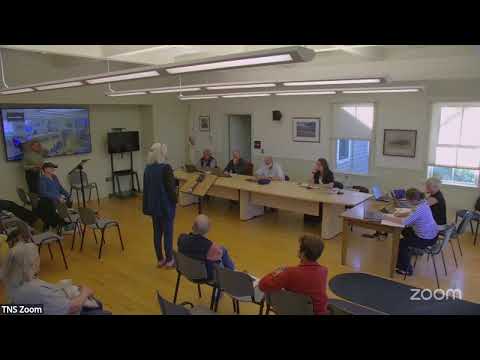
Dory Napoleoni, board president of the Block Island Conservancy, told the Town of New Shoreham work session that a year-long compost pilot has processed roughly 18 to 20 tons of food scraps and enrolled more than 250 households and businesses.
“The program, at least I feel it has been very successful and that is largely due to the collaboration between Block Island Conservancy, Block Island Recycling Management, the town, and the community,” Napoleoni said. She described the pilot’s central piece of equipment — an EcoDrum purchased by the conservancy and delivered to the transfer station — and said food-scrap collection began in early June and ramped through the summer.
Why it matters: Pilot organizers said composting locally reduces the number of food-waste trips off-island to the Johnston landfill, lowers greenhouse-gas emissions from long-haul transport and creates a local soil amendment that would otherwise be imported. Organizers and town staff said the pilot’s successes point to the need for a transfer-station redesign that explicitly plans for an expanded compost facility.
What the pilot did and learned
The conservancy applied to the Rhode Island Department of Environmental Management for a permit sized as a medium compost facility; that application was approved in the first quarter of 2024, Napoleoni said. The EcoDrum, a rotating in-vessel unit the conservancy purchased, can accept mixed food waste — including meat, dairy and seafood — which organizers said simplifies participation for households and businesses.
Organizers recorded every pound that went into the drum, mixed food with carbon sources (wood chips or pine shavings) and sent finished material to an accredited lab. Napoleoni said samples were tested at Woodend Laboratory in Maine and that the conservancy will continue periodic lab testing to confirm the compost is safe for soil use.
Operational constraints and fixes
Presenters listed recurring operational issues and near-term fixes: the self-tipping hoppers used for deposit were prone to overfilling and contributed to complaints about flies and odors; the conservancy purchased standard trash cans with fixed lids and a mechanical ‘‘dumper/tipper’’ to replace hoppers and reduce reliance on transfer-station heavy equipment for daily loading. Napoleoni said a small screening shaker has been ordered to speed manual screening and a biofilter is under consideration to reduce odors inside the building.
“We are going to be replacing the hoppers with trash cans with fixed lids…we recently purchased it just arrived last week,” Napoleoni said of the dumper/tipper device intended to let staff load the drum when the transfer station is open rather than only after closing.
Capacity, product and costs
Presentations cited the on‑site EcoDrum’s indicated throughput at roughly 500–600 pounds of food scraps per day when operating at target temperature ranges. Organizers reported filling the drum over the summer and generating finished compost giveaways to program participants; the conservancy covered drop‑off costs for participants during the pilot. Funding so far has come from Block Island Conservancy resources, small contributions from transfer‑station staff, and a grant from the RUSA Foundation.
Expansion and transfer-station planning
Speakers said scaling beyond the pilot raises logistics questions: how to collect food waste from rental properties and restaurants that do not bring trash to the station, where to site additional drums or buildings, and how to incorporate composting into any larger transfer‑station redevelopment so temporary infrastructure (slabs, quonset huts) would not be wasted if the site is redesigned.
Town staff and conservancy members urged the town to start engineering and site‑planning work so a blueprint exists for future development, noting there is $50,000 identified in the upcoming capital budget cycle to begin planning for transfer‑station redevelopment. Conservancy organizers said they would seek grant opportunities and partnerships but that municipal application requirements for many compost grants mean the town’s involvement will be necessary for larger funding.
Next steps and outstanding questions
Organizers recommended continuing the pilot while implementing the hopper-to-trash-can swap, completing the screening equipment purchase, continuing lab testing, and developing a site plan for an expanded compost facility that could be incorporated into a broader transfer‑station redesign. They also identified the absence of a widespread curbside pickup system for rentals and restaurants as a key logistical gap that would require either a new local business or a municipal service to close.
Ending note: The conservancy framed the pilot as a community-driven start that demonstrates local viability but requires municipal planning and funding to scale and be integrated into long-term transfer‑station improvements.