Get Full Government Meeting Transcripts, Videos, & Alerts Forever!
Get email alerts on the Energy topic
No spam. Unsubscribe anytime.
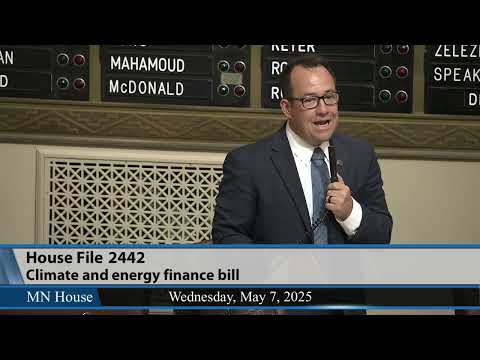
Minnesota House passes energy bill, House File 2442, on 112-21 vote
Summary
The Minnesota House passed House File 2442, a budget and policy package for energy programs and the Renewable Development Account, by a 112-21 roll call after floor debate on energy policy, data centers, nuclear options and solar siting.
The Minnesota House of Representatives passed House File 2442, a bill funding energy programs and continuing work on renewable development accounts, by a roll call of 112 yeas and 21 nays after floor debate.
Representative Acum, cochair of the House Energy Committee, told colleagues she was “honored to be cochair of the House Energy Committee” and said the bill protects recent advances in renewable energy while leaving some policy priorities for later work. “We can all agree that Minnesota needs to provide energy that is safe, reliable, sustainable, and affordable,” Acum said on the House floor.
Lawmakers described the measure as a “lights on” budget for energy. Representative Swazinski said the bill should be advanced to conference committee despite leaving out some reforms he favors, including net‑metering changes and potential shifts on nuclear policy. “This bill is a lights on Bill,” Swazinski said, urging members to vote to send the measure to conference.
Debate touched on several policy areas rather than on a single change. Acum and others raised concerns about new, high‑demand data centers, saying stronger rules were needed to protect natural resources and ratepayers from new transmission and generation costs. Representative Acum said: “The most important of the issues for me has been addressing the new data centers that require large amounts of energy who are knocking on Minnesota's door.”
Energy efficiency and federal programs also featured in the discussion. Representative Jones cited independent and industry data in support of continued efficiency spending: she said state evaluations show “for every $1 spent on energy efficiency programs in here in Minnesota returns 4 dollars to the state's economy” and warned that federal changes to Energy Star would affect Minnesota programs. Jones said the Energy Star program “sets the standard” used by state programs and attributed large annual consumer savings to it.
Representative Hollins outlined the history and local impacts of the Renewable Development Account (RDA), which he said was created as part of a compromise allowing expanded dry‑cast storage of spent nuclear fuel at Prairie Island and is funded by Xcel Energy payments. Hollins said the RDA has directed “over $200,000,000 into projects” and listed examples, including $4,750,000 to the Granite Falls hydroelectric dam, $2,000,000 in community energy transition grants, $10,000,000 to the University of Minnesota Morris for a green ammonia pilot, and $5,500,000 for a Mountain Iron solar manufacturing project. He described the typical residential contribution as “about 80¢ a month” and stated the RDA is funded by a fee of “0.00109¢ per kilowatt hour.”
Representative Murphy warned about siting and environmental risks for large solar projects, citing concerns that panels can break and release toxic materials and reporting research claims that long‑term panel coverage affects soil fertility and water retention. “Solar panels contain toxic substances like cadmium, lead, and selenium,” Murphy said, and argued the Legislature should do “our due diligence.”
Members on both sides called for further work in conference committee to reconcile remaining differences. Representative Acum and Representative Swazinski both said they expect additional negotiation and improvements in conference.
After debate the clerk called the roll; the clerk announced “there being 112 yays and 21 nays, the bill is passed and its title agreed to.” The House record shows one named floor vote during the roll call: Representative Fogelman recorded a “no.” The measure will proceed according to the Legislature’s regular process.