Get Full Government Meeting Transcripts, Videos, & Alerts Forever!
Get email alerts on the Life Insurance Education topic
No spam. Unsubscribe anytime.
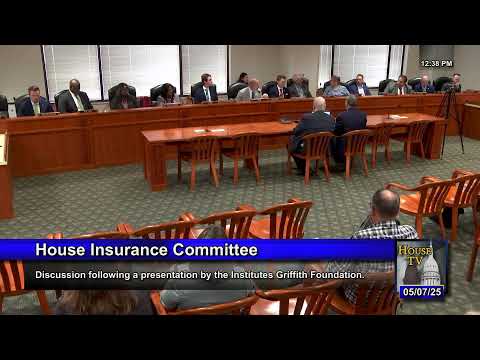
Griffith Foundation and expert brief Michigan House Insurance Committee on life insurance, annuities, AI and financial literacy
Summary
Frank Paul Tomasello of the Griffith Foundation and Dr. Robert Klein of Georgia State University briefed the Michigan House Insurance Committee on life insurance, annuities, regulatory oversight and emerging issues including financial literacy and artificial intelligence.
Frank Paul Tomasello, executive director of the Griffith Foundation, and Dr. Robert Klein, emeritus professor of risk management and insurance at Georgia State University, gave an educational briefing to the Michigan House Insurance Committee on life insurance and annuities and on regulatory and consumer-protection issues.
Dr. Klein began by defining life insurance as a contract that "all life insurance policies provide some form of death benefit," and explained major product families: term life (pure death protection for a specified period), ordinary/whole life (permanent policies with cash-value accumulation), and universal life (a later product offering premium flexibility and variable cash-value performance).
Klein described trade-offs among products and consumer risks. He noted that universal life policies, popular in the 1980s, have produced disputes when interest-rate and crediting-rate assumptions changed, leading to litigation and then to regulatory action at state and NAIC levels. "When interest rates started coming down, the performance of the policies wasn't as good and people were surprised by that," he said, and regulators later implemented disclosure and suitability rules.
Klein also discussed contract provisions typically relevant to consumers: suicide clauses, nonforfeiture options, policy loans and contestability/incontestability periods. On the state-level safety net, he said: "In Michigan for example, the maximum cash value that the guarantee association will cover is a hundred thousand dollars." He urged clearer consumer information and education rather than assuming regulation alone can solve knowledge gaps.
The briefing also covered annuities as a product that pays a stream of income and can replicate a defined-benefit-like payout for retirees. Klein noted annuity expense loads and urged consumers to weigh trade-offs.
Committee members asked about financial literacy and artificial intelligence. A member identified in the record as the vice chair pressed for ways to incorporate financial literacy so young people understand life insurance and annuities when premiums are affordable; Klein recommended broader financial-education requirements in secondary schools. On AI, Tomasello said regulators and industry are seeking an equilibrium between innovation and consumer protection; he noted that the NAIC is studying AI applications and that states are considering guardrails to ensure compliance with existing laws.
Neither Tomasello nor Klein advocated for specific legislation; both characterized the session as educational. The transcript records offers by the presenters to provide additional resources: Griffith Foundation materials and on-demand webinars available at griffithfoundation.org.