Get Full Government Meeting Transcripts, Videos, & Alerts Forever!
Get email alerts on the State Budget topic
No spam. Unsubscribe anytime.
Assembly hearing advances debate on raising California's rainy day fund cap and changing deposit rules
Summary
California lawmakers and fiscal experts on Tuesday heard competing proposals to change the state's Budget Stabilization Account, commonly known as the rainy day fund, as the Legislature prepares for the May revision and a potential voter measure.
SACRAMENTO
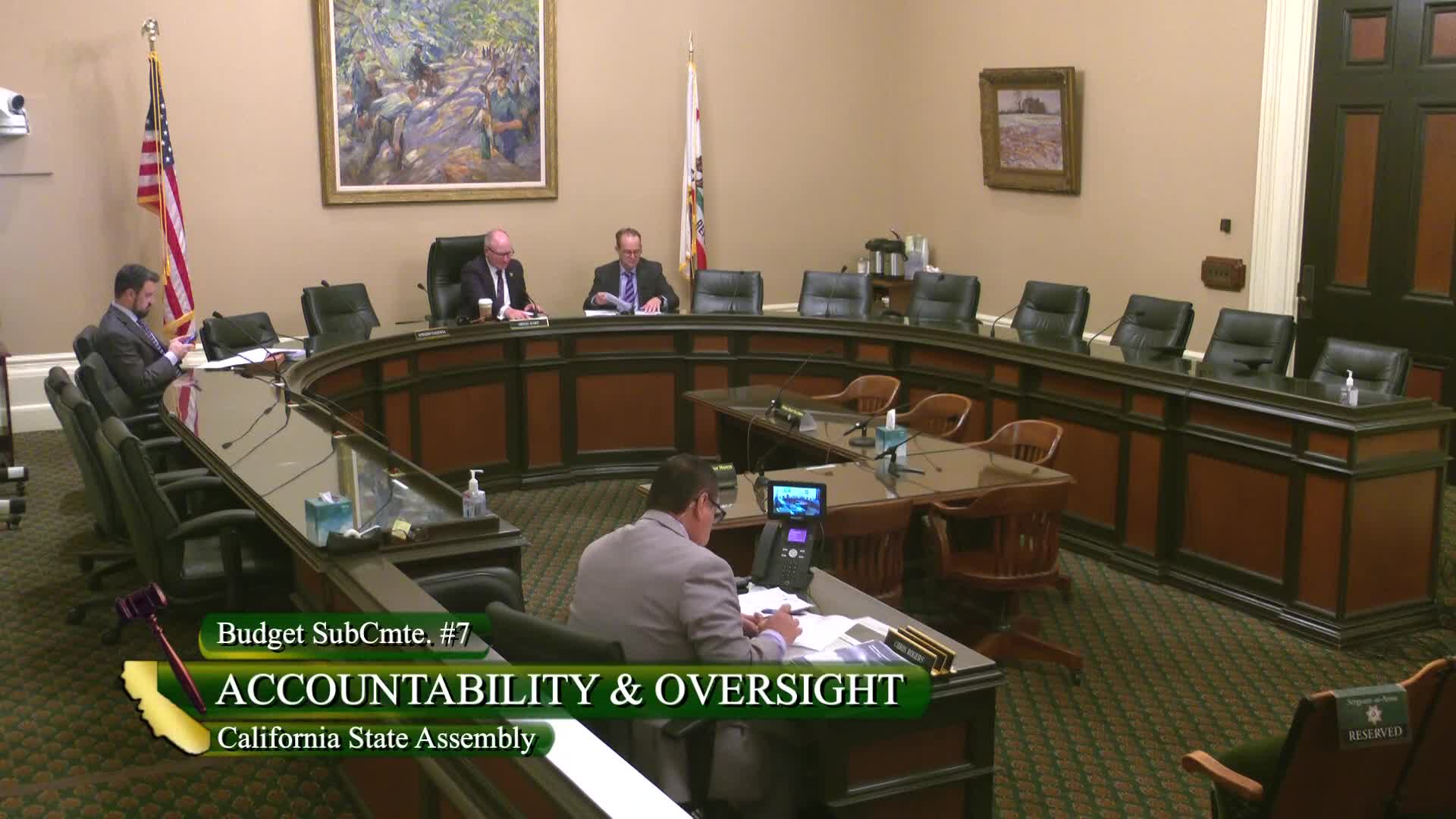
California lawmakers and fiscal experts on Tuesday heard competing proposals to change the state's Budget Stabilization Account, commonly known as the rainy day fund, as the Legislature prepares for the May revision and a potential voter measure. The hearing in the Assembly Budget Committee on Accountability and Oversight included a presentation by the Legislative Analyst's Office and testimony from the Department of Finance, advocates, labor and fiscal-policy groups.
The Legislative Analyst's Office's Anne Hollingshead said Proposition 2 (2014) set the current rules tying annual base deposits and a formula for excess capital gains to the BSA. "The base amount...is 1.5% of general fund tax revenues," Hollingshead said, and that base is split roughly 50/50 between BSA deposits and certain debt payments. She told committee members the current structure means that, "under current policy...reserves could cover about one third of funding shortfalls over 50 years" in the LAO's benchmark model.
Assemblymember Valencia, author of ACA 1, argued the current 10% constitutional cap on the BSA is too low and urged voters be given the chance to raise the cap. "When times are good, we save," Valencia said in opening remarks. ACA 1 would raise the constitutional cap and increase required contributions so the state can save more during revenue upswings.
Department of Finance staff described the governor's parallel proposal. The administration is proposing to increase the cap from 10% to 20% of general fund tax revenues and to exempt deposits to the BSA from counting against the state appropriations limit (the Gann limit). Lisa Brzezinski of the Department of Finance told the committee the proposal is intended to remove the constraint that forced large surpluses to be returned to taxpayers rather than saved.
Outside groups and policy shops offered a range of views on scale and tradeoffs. The Legislative Analyst's Office recommended options that would go farther than the governor's plan, including a model to phase the cap to 50% of general fund tax revenues by 2055 combined with broader deposit rules to capture additional sources of volatility. The LAO and other presenters emphasized that much of the BSA's growth in recent years has come from volatile capital gains taxes: the LAO's modeling finds about 65% of recent growth was from excess capital gains and 35% from the base deposit.
The California Budget & Policy Center and other groups urged balancing larger reserves with current spending priorities, noting that reserves are only one of several budget tools and that California faces important service needs now. The Budget Center's Scott Graves said the governor's approach would make the BSA "significantly more effective" and increase the share of future shortfalls covered from roughly a third to about half, according to LAO estimates.
Public commenters included labor, anti-poverty advocates and taxpayer groups. Several speakers recommended pairing any large new reserve deposits with reforms to other systems, such as unemployment insurance, to avoid using reserve funds without addressing underlying structural problems. One commenter, representing the New California Coalition, urged a larger change that would align with the LAO's more expansive recommendations.
No formal vote occurred at the hearing. Committee members and leadership staff said the proposals will likely be refined ahead of the May revision and any measure placed before voters. Committee members also discussed the trade-offs of embedding detailed formulas in the constitution versus using statutory or discretionary accounts that the Legislature could adjust.
The hearing drew technical questions from members about how Proposition 2 interacts with Proposition 98 school funding rules, the mechanics of the excess capital gains formula, and which debt payments are eligible under the current framework. LAO and Finance staff said the capital gains true-up process and Proposition 98 interactions make the current formulas complex and sometimes unpredictable.
The panelists recommended next steps that included clearer ballot language for any constitutional change, public education to explain complex formulas, and consideration of a mix of mandatory constitutional deposits and statutory reserves to preserve legislative flexibility. Committee members signaled interest in continued hearings before the May revision and in working toward a single legislative proposal that could be placed before voters for consideration in 2026.
Ending: The Assembly hearing provided a technical review of the rainy day fund rules, introduced ACA 1 and the governor's proposal to lift the BSA cap, and framed key trade-offs for lawmakers: how large to make constitutional restraints, whether to expand the types of revenue that feed deposits, and how to protect current program needs while saving for future downturns. Further drafts and public outreach were anticipated before policymakers finalize language for a voter measure.