Get Full Government Meeting Transcripts, Videos, & Alerts Forever!
Get email alerts on the Short Term Rentals Registration topic
No spam. Unsubscribe anytime.
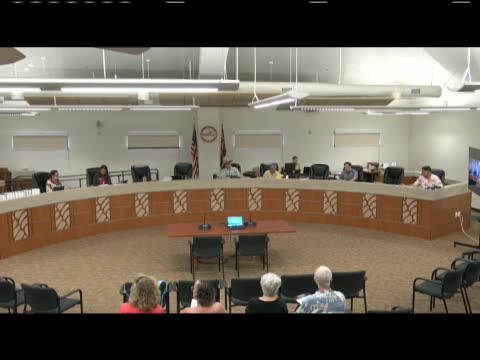
Hawaii County committee forwards Bill 47 to full council to register short‑term rentals after 6‑1 vote
Summary
The Hawaii County Policy Committee on Planning, Land Use and Economic Development voted to forward Bill 47 to the full County Council with a favorable recommendation after debate and public testimony, advancing a measure that would require most transient vacation rentals (TBRs) and hosting platforms to register with the county and pay annual renewal fees.
The Hawaii County Policy Committee on Planning, Land Use and Economic Development voted to forward Bill 47 to the full County Council with a favorable recommendation after debate and public testimony, advancing a measure that would require most transient vacation rentals (TBRs) and hosting platforms to register with the county and pay annual renewal fees.
Bill 47 would add a new article to Chapter 6 of the Hawaii County Code to create a registration process for hosted and unhosted short‑term rentals, require hosting platforms to provide monthly listings, direct the Finance Department to manage registrations and initial tax checks, and preserve planning’s appeals process for land‑use compliance. The measure sets an annual renewal fee (presented in committee as $100 for hosted TBRs and $250 for unhosted TBRs) and a civil penalty for continued operation after final violation findings (listed in the draft as $10,000). Exemptions identified in state law (Hawaii Revised Statutes §237D and related sections) were included in the committee packet.
The bill’s sponsor, Councilmember Kimball, told the committee the measure is “just a registration bill. It is going to help us identify the actual number and locations of TBRs across the county.” She said the Finance Department will issue TBR numbers after owners submit an online affidavit and documents and that planning will review land‑use compliance. Kimball also said the county intends to issue a request for proposals for compliance software after the registration system is in place.
Public testimony at the committee hearing was sharply divided. Several homeowners, hosted operators and small‑farm operators told the committee the item should be deferred until the county’s pending economic impact study is released. Joshua Michalek, a Hilo resident, said, “This bill, HP 47, appears to be just the second attempt to regulate and register TBRs after SB 121 was shelved,” and asked the committee to shelve the bill to allow the study and broader public comment. Multiple testifiers raised similar concerns about timing, enforcement and fines.
Opposition testimony highlighted potential impacts on elderly and low‑income hosts, and the difficulty of resolving unpermitted building work in the county’s permitting process. Several speakers said a county estimate that roughly 40% of island properties include unpermitted improvements meant many long‑running, small‑scale operators could be exposed to enforcement or loss of registration; one speaker cited an estimate of about 2,600 potentially affected households. Testimony described prolonged permitting timelines and urged a grace period for remediation rather than immediate penalties.
Representatives of the visitor and lodging industry offered the opposite take. Stephanie Donahoe of the Kohala Coast Resort Association said the association supported Bill 47 as a way to ensure that all operators are registered, paying Transient Accommodation Tax (TAT) and General Excise Tax (GET), and providing safe accommodations: “...this is a measure to make certain that everyone operating within the short term vacation rental sphere is, registered with Hawaii County, that Hawaii County knows where those short term vacation rentals are located, that they know that they are adequately paying TAT and GET...” She urged consistent enforcement of tax and listing requirements, including holding hosting platforms accountable for listings of allegedly illegal units.
Planning Director Jeff Darrow described how planning currently enforces unhosted short‑term rental rules (a complaint‑driven process that begins with online advertisement checks) and noted that Bill 47 would expand the county’s ability to identify listings proactively by comparing registrations to scraped platform data. Darrow also discussed historic parking complaints in some neighborhoods and reiterated that the bill itself does not change where rentals are permitted under Chapter 25 of the county code.
Deputy Finance Director Malia Keikai told the committee Finance will house the registration process and perform initial checks against TAT/GET and real property tax records; she said Finance was short one staff member at the time of the hearing but expected to fill that vacancy.
After discussion and brief debate among committee members, Councilmember Kimball moved to approve Bill 47 and forward it to the full council with a favorable recommendation. Councilmember Kerkowitz seconded. The committee called the question and, by roll call, approved sending the bill to the full council with a favorable recommendation by a 6‑1 vote; Councilmember Onishi recorded the lone vote against the motion and two members were absent. The committee packet and sponsor’s presentation noted that the county’s economic impact study is expected to deliver preliminary results ahead of the full council process and that any future land‑use amendments would be considered after that study.
Next steps described at the hearing included establishing the online registration and annual renewal workflow under Finance, comparing registrations with hosting‑platform data from a vendor, and potentially pursuing land‑use code changes later in the year based on the economic study and pending litigation. The full County Council will consider the bill on its own schedule.
Votes at a glance
- Motion: Approve Bill 47 and forward to full Council with a favorable recommendation. Mover: Councilmember Kimball. Seconder: Councilmember Kerkowitz. Outcome: forwarded to full council with favorable recommendation. Vote tally reported in committee: 6 in favor, 1 opposed (Councilmember Onishi), 2 absent.