Get Full Government Meeting Transcripts, Videos, & Alerts Forever!
Get email alerts on the Critical Areas Ordinance topic
No spam. Unsubscribe anytime.
Skagit County planning commission hears public concerns on proposed 2025 critical areas ordinance update
Summary
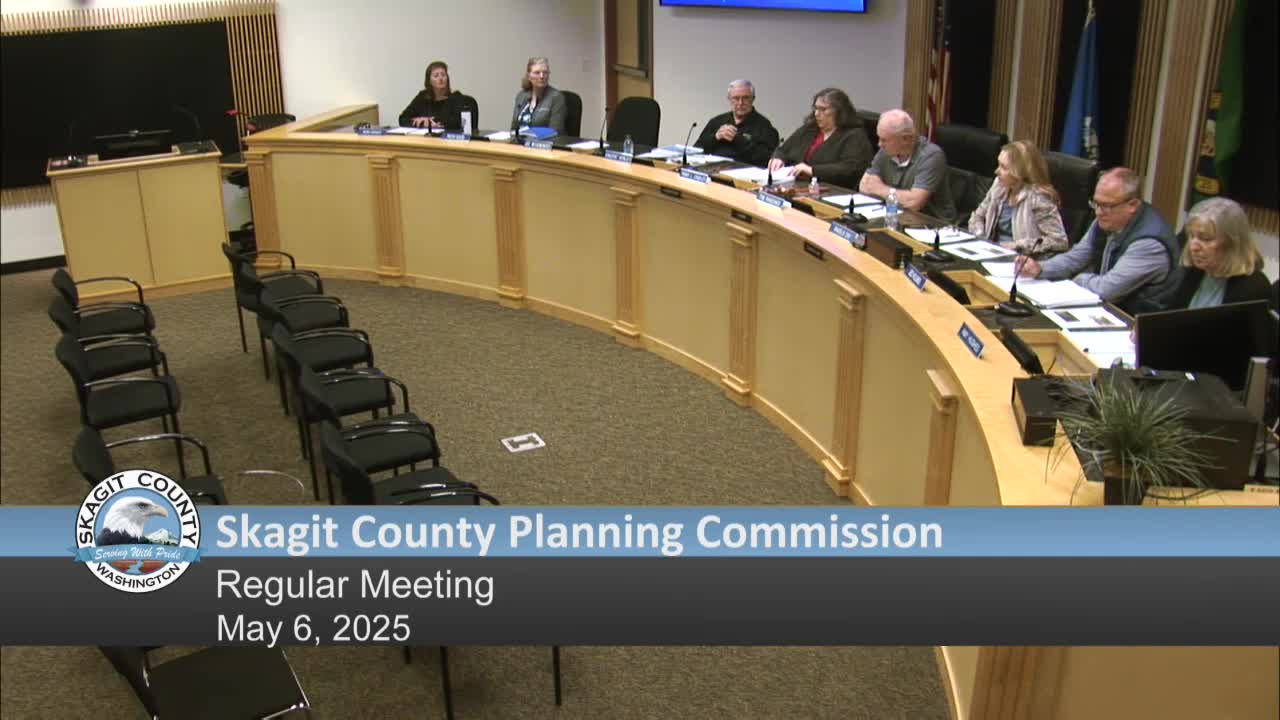
The Skagit County Planning Commission held a public hearing May 6 on the proposed 2025 Critical Areas Ordinance (CAO) and development regulations update, hearing testimony from residents, conservation organizations and staff about stormwater pollution, riparian buffers, wetlands exemptions and where future growth should occur.
The Skagit County Planning Commission held a public hearing May 6 on the proposed 2025 Critical Areas Ordinance (CAO) and development regulations update, hearing testimony from residents, conservation organizations and staff about stormwater pollution, riparian buffers, wetlands exemptions and where future growth should occur.
Speakers at the hearing urged the commission to tighten protections for fish and water quality, to require off‑site impact analyses for projects that could affect downstream critical areas, and to direct new housing toward existing urban areas rather than expanding rural villages.
Jan Edelstein, a Big Lake resident, told the commission she has compiled 25 years of local water‑quality data and cited a county chart showing that total phosphorus measured at the lake outlet has risen from below the 20 µg/L standard in 1999 to “50 to 60 µg per liter in phosphorus.” "It's up 300%," she said, and argued county rules that examine impacts only on site or within a fixed short buffer fail to account for pollutant loading that reaches downstream waters. Edelstein said a long‑running development project with about 18 acres of new impervious area was permitted with multiple SEPA reviews without any critical‑area site assessment for off‑site stormwater impacts because the project boundary was 800 feet from the lake rather than within the county's shorter review distance. She asked the commission to require a critical‑area site assessment when off‑site impacts to critical areas are possible. "I urge you to correct this deficiency," Edelstein said.
Marlene Finley, president of Evergreen Islands (Anacortes), said her organization will submit written comments but highlighted several recommendations: extend the county's distance of consideration to 300 feet when determining potential impacts to critical areas; deny new wells where chloride levels indicate saltwater intrusion risk; adopt riparian management zone guidance from the Washington Department of Fish and Wildlife (WDFW); and oppose exemptions that would remove buffers from small wetlands (those under 1,000 square feet) and allow Category 4 wetlands under 4,000 square feet to bypass mitigation sequencing. Finley also opposed allowing timber harvest within riparian buffers and asked the CAO to include performance standards that reconcile riparian protection with defensible‑space needs for wildland fire protection.
Molly Doran of Skagit Land Trust (Mount Vernon) urged the county to direct new residential growth to urban areas where infrastructure and services exist, and to avoid adding capacity that would extend development into rural villages. "These goals can and must be achieved together," she said, and recommended more emphasis on natural hazard avoidance, water availability, sea level rise, wildfire and landslides when planning growth. Doran also supported stronger habitat connectivity language in the CAO and requested that the county specify alluvial fans as known or suspected landslide hazards.
Planning and Development Services (PDS) staff described how project review typically proceeds: an initial office review using maps, aerial imagery and existing datasets; a site visit if indicators of critical areas appear; and, where warranted, staff or consultant preparation of a site assessment or a requirement that applicants provide a critical‑areas report (which may be a wetland report, geotechnical report or fish and wildlife habitat assessment). Jack (Natural Resources Planner, PDS staff) summarized that process and said staff will follow up with the commission after the written comment period closes. Dan Nicholl (consultant on the technical team) explained that jurisdictions must translate best available science into local code and that WDFW's riparian recommendations can produce buffer values larger than the county's current buffer chart in some settings.
The planning commission opened the hearing, accepted public testimony and closed the hearing after hearing from those on the sign‑in sheet and remote participants; staff and consultants will prepare written responses to written and oral comments received. The written comment period remains open until Thursday, May 8 at 4:30 p.m. The commission is scheduled to deliberate May 20 and forward a recommendation to the Board of County Commissioners.
The commission approved the April 22 meeting minutes at the start of the session by voice vote.
Next steps: staff and the consulting team will compile written responses to comments, provide the commission with a comment packet shortly after May 8, and prepare summary materials for the commission's May 20 deliberation.