Get Full Government Meeting Transcripts, Videos, & Alerts Forever!
Get email alerts on the Ceasefire Resolution topic
No spam. Unsubscribe anytime.
San Marcos council rejects ceasefire resolution after hours of public comment and threats from governor
Summary
After more than 150 people spoke during a nearly eight-hour meeting, the San Marcos City Council failed to adopt a resolution calling for an immediate, permanent and sustained ceasefire in occupied Palestine. The measure was sponsored by two council members, amended during the meeting and ultimately failed 5–2.
The San Marcos City Council on May 6 rejected a nonbinding resolution calling for an immediate, permanent and sustained ceasefire in occupied Palestine, arms restrictions and recognition of Palestinian sovereignty after more than 150 people testified during a marathon public‑comment session and an intense council debate.
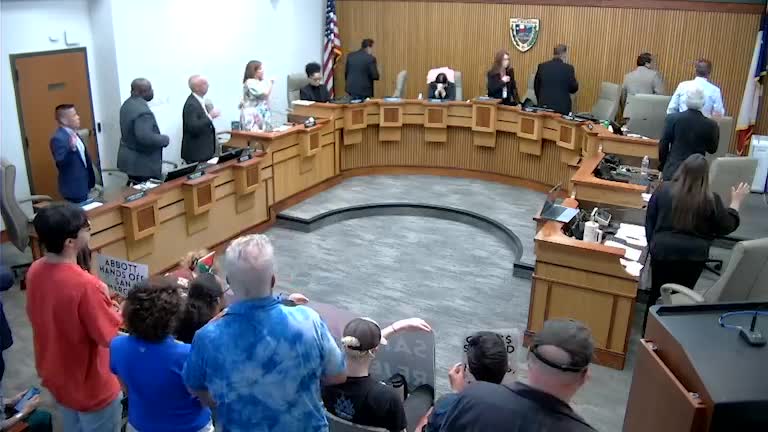
Supporters and opponents filled the council chamber and lined up at the podium for hours, with dozens of speakers urging the council either to press the city’s moral authority and ask that U.S. and state officials stop aiding the violence or to avoid taking an official position on a foreign conflict. The council first voted to accept an amendment to the proposed resolution but voted down the full motion as amended, 5–2.
The vote, which failed after the council adopted amended language earlier in the night, followed repeated warnings from Gov. Greg Abbott’s office that state grants could be withdrawn if the city took steps interpreted as a boycott of Israel. The governor’s letter was referenced repeatedly by speakers on both sides of the issue and by council members considering the potential fiscal impact on the city.
The amendment that councilmembers adopted and sent back for a final vote explicitly said the resolution did not call for the city to violate state law and included language condemning violence against civilians. Still, the council voted the final motion down, with the clerk announcing a 5–2 defeat. (The motion to adopt the resolution was made by Councilmember Amanda Rodriguez and seconded by Councilmember Alyssa Garza; the final tally was announced by the clerk but individual roll‑call record for each vote was not read into the public record.)
Why it mattered: supporters argued the measure would let San Marcos formally oppose a humanitarian crisis and pressure higher levels of government; opponents said the city should not weigh in on foreign policy and warned of legal and financial consequences. The public comment period stretched past midnight; the meeting convened at 6:01 p.m. on May 6 and adjourned at 1:56 a.m. on May 7.
Voices from the chamber
Supporters described the resolution as a moral imperative. “Vote for this ceasefire resolution. Stand up for us against the state. Don’t let them bully us,” Amanda Smith, a San Marcos resident, told the council during public comment as she urged members to resist threats from the governor.
Opponents said the proposal was one‑sided and inappropriate for a municipal governing body. “The proposed resolution…is deeply hurtful and profoundly one‑sided,” Rabbi Ari Weingarten told the council, arguing the measure failed to condemn atrocities committed by Hamas on Oct. 7, 2023.
What the council did
- Motion introduced: Councilmember Amanda Rodriguez moved to adopt the resolution; Councilmember Alyssa Garza seconded. - Amendment: Councilmember Rodriguez moved to amend the draft with language posted on the council’s message board, adding explicit text that the resolution would not require the city to violate state law and condemning violence against civilians. The amendment passed on a council vote (announced in the meeting as 5 to 2). - Final vote: After more public comment and deliberation, the council voted on the resolution as amended; the motion failed 5–2.
Public testimony and turnout
City staff said more than 150 speakers had signed up for citizen comment; the council allowed three minutes per speaker. Supporters and opponents frequently clashed in tone and content; speakers cited international bodies, casualty counts and U.S. foreign‑assistance laws and described personal ties to the region. Several speakers asked one councilmember to recuse because of employment at an Israeli company, a request repeated multiple times during the evening.
Financial and legal context
Speakers on multiple sides of the issue referenced state and federal statutes and courts. The governor’s letter warned that state agencies could review or terminate grant agreements if the city adopted measures seen as supporting a boycott of Israel; speakers cited statutes and international instruments in arguing whether the measure would expose the city to legal or financial risk. Council members said they had discussed the legal issues in executive session earlier in the evening.
Council reaction and next steps
Councilmembers split along lines that did not map cleanly to the sponsors. Several councilmembers said they feared the potential loss of state funding; others said the legal threats were political intimidation and that passing the resolution would be an exercise of the council’s free‑speech authority.
The meeting’s outcome does not legally bar councilmembers from reintroducing the resolution at a later date. Multiple legal and policy questions raised in public comment were referred to staff for follow‑up; a number of residents requested written responses to factual questions asked during the Q&A portion of the meeting.
What to watch
- Whether the governor’s office or other state agencies take action on grants referenced in the letter. Council members said staff will monitor any state action and report back. - Any renewed attempt by the sponsors to bring a revised resolution back to the council; sponsors said after the vote they remained engaged with residents and legal counsel.
Ending note
After nearly eight hours of public testimony and council debate, the City Council left the formal policy position unchanged. For now, San Marcos’s elected body opted not to adopt a local expression calling for a ceasefire, while many residents signaled they will keep advocating for their preferred outcome at local, state and national levels.