Get Full Government Meeting Transcripts, Videos, & Alerts Forever!
Get email alerts on the Floodplain Management topic
No spam. Unsubscribe anytime.
State auditor briefs Grimes County on NFIP audit, permit rules and penalties for noncompliance
Summary
A Texas Water Development Board official told Grimes County commissioners that a state audit of the county's floodplain program is under way, outlining permit requirements, potential penalties for noncompliance and options including corrective action plans and interlocal administration.
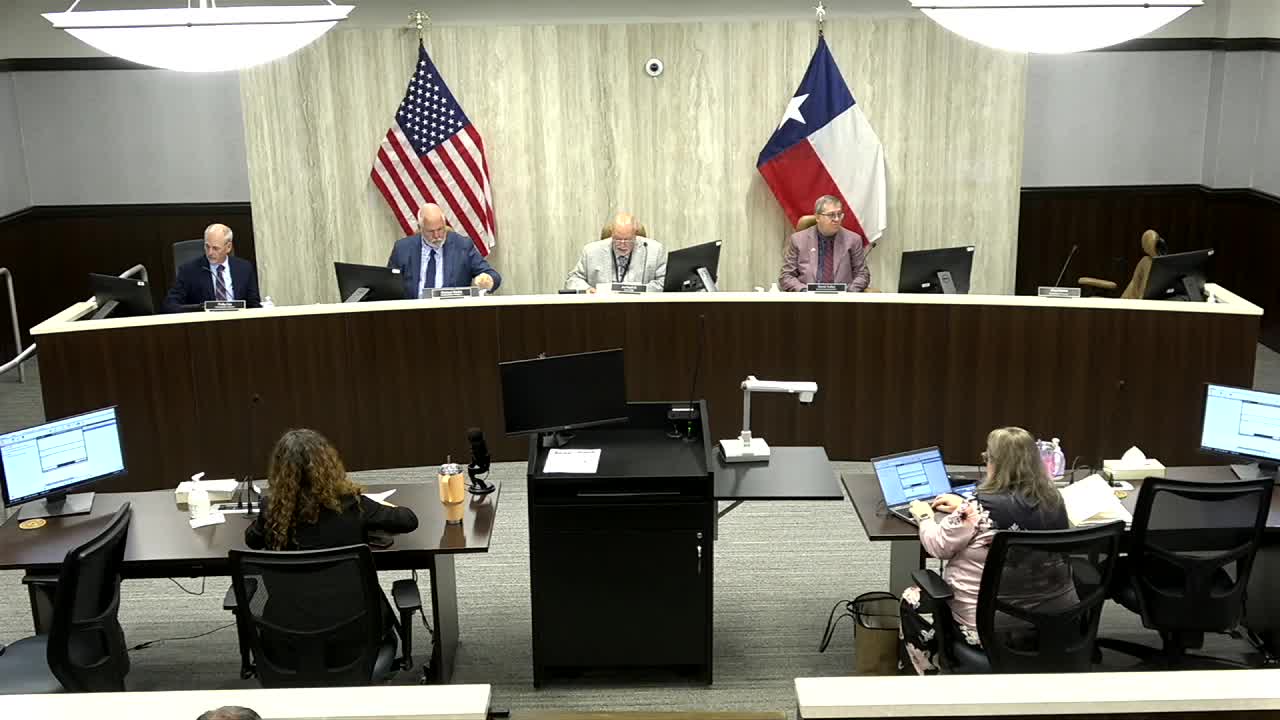
Belle Gonzales, a flood outreach specialist with the National Flood Insurance Program (NFIP) state coordinating office at the Texas Water Development Board, told the Grimes County Commissioners Court in a May 2025 special meeting that the agency has begun an audit of the county’s floodplain management program and reviewed minimum federal and state requirements for participation in the NFIP.
Gonzales said participation in the NFIP is voluntary but carries consequences for noncompliance, including denial of federally backed flood insurance, ineligibility for certain federal grants or loans and limits on federal disaster assistance for structures in identified Special Flood Hazard Areas. She said the state’s review looks at permit records, inspections and enforcement dating back five years and that a finding of noncompliance can lead to probation or suspension from the program.
The presentation matters because federal regulations and state law set minimum local standards for regulating development in flood-prone areas, and noncompliance can affect homeowners’ access to insurance and federal aid. "Texas Water Code chapter 16.314 is what grants cities and counties the ability to... enforce ordinances or court orders that help them participate in [the NFIP]," Gonzales told the court, and she cited 44 CFR section 60.3 as the federal minimum standard the county must meet.
Gonzales summarized the county’s duties under the NFIP: adopt and enforce a flood damage prevention ordinance or court order; issue or deny floodplain development permits; inspect projects for compliance; keep permitting and elevation records in perpetuity; and assess substantial improvement and substantial damage when applicable. She said Grimes County currently falls under a level D classification — meaning the county has Flood Insurance Rate Maps with designated floodways and base flood elevations — which carries more stringent riverine-area requirements than communities with no mapped flood zones.
County Engineer John Stiber confirmed that the county’s floodplain administrator role is assigned by the flood damage prevention court order to the county engineer, a responsibility he and David Lilly currently share. Stiber told the court that the county is already working with the Texas Water Development Board on grants and plan updates, and that the county’s soon-to-be-updated floodplain regulations will adopt the state’s base-level engineering data as regulatory for Grimes County.
Gonzales said she performed a floodplain tour and flagged some properties that may lack sufficient documentation; she has not yet received a permit list for the past five years and said the audit will review those records. She told commissioners the state tries to open and close audits within six months but said the timetable depends on how quickly the community provides documentation and on the number and complexity of corrective actions needed. "We try to open and close it within 6 months," she said, adding that longer audits are possible and the state’s goal is to close in good standing if the county commits to compliance.
Gonzales described remedies the state and FEMA may pursue for noncompliant properties: retroactive permits if structures meet current standards, corrective action measures, stop-work orders, fees and fines, and placement on the national violation tracker; she warned those measures can raise insurance premiums and, in extreme cases, lead to a permanent ban on flood insurance for a property — she referenced a "section 13 16" step described in the court process. She also explained corrective action plans and a possible county resolution to "recommit" to NFIP compliance that can persuade FEMA to allow phased remedies for past violations rather than immediate penalties on homeowners.
Commissioners asked about impacts and costs. Gonzales said some buyouts have already occurred: "we had 5 buyouts under this... the government bought them out," and those parcels are currently county-owned green space. She confirmed the county may charge a $50 floodplain permit fee (which the county can choose to waive retroactively) and that counties frequently provide floodplain administration to small municipalities under interlocal agreements; she said Grimes County provides that service to Todd Mission and that municipalities retain responsibility for permitting inside city limits.
Gonzales emphasized outreach and practicality: the state is nonregulatory in approach and aims to work with resource-limited communities to bring records and permitting into compliance without imposing unrealistic immediate burdens on homeowners. "If... renovations and or damage exceeds that 50% mark, that's when the homeowners are now responsible," she said, describing the substantial improvement/damage threshold.
The special meeting closed with a routine adjournment motion from Commissioner Michael Raskin that County Judge Joe Fouth seconded; the motion carried 4-0.
The county plans a follow-up meeting later the same day — not open to the public because it may include address-level and homeowner information — to discuss flagged properties and corrective actions. The Water Development Board official left business cards and offered further technical and grant assistance to county staff.