Get Full Government Meeting Transcripts, Videos, & Alerts Forever!
Get email alerts on the Criminal Justice topic
No spam. Unsubscribe anytime.
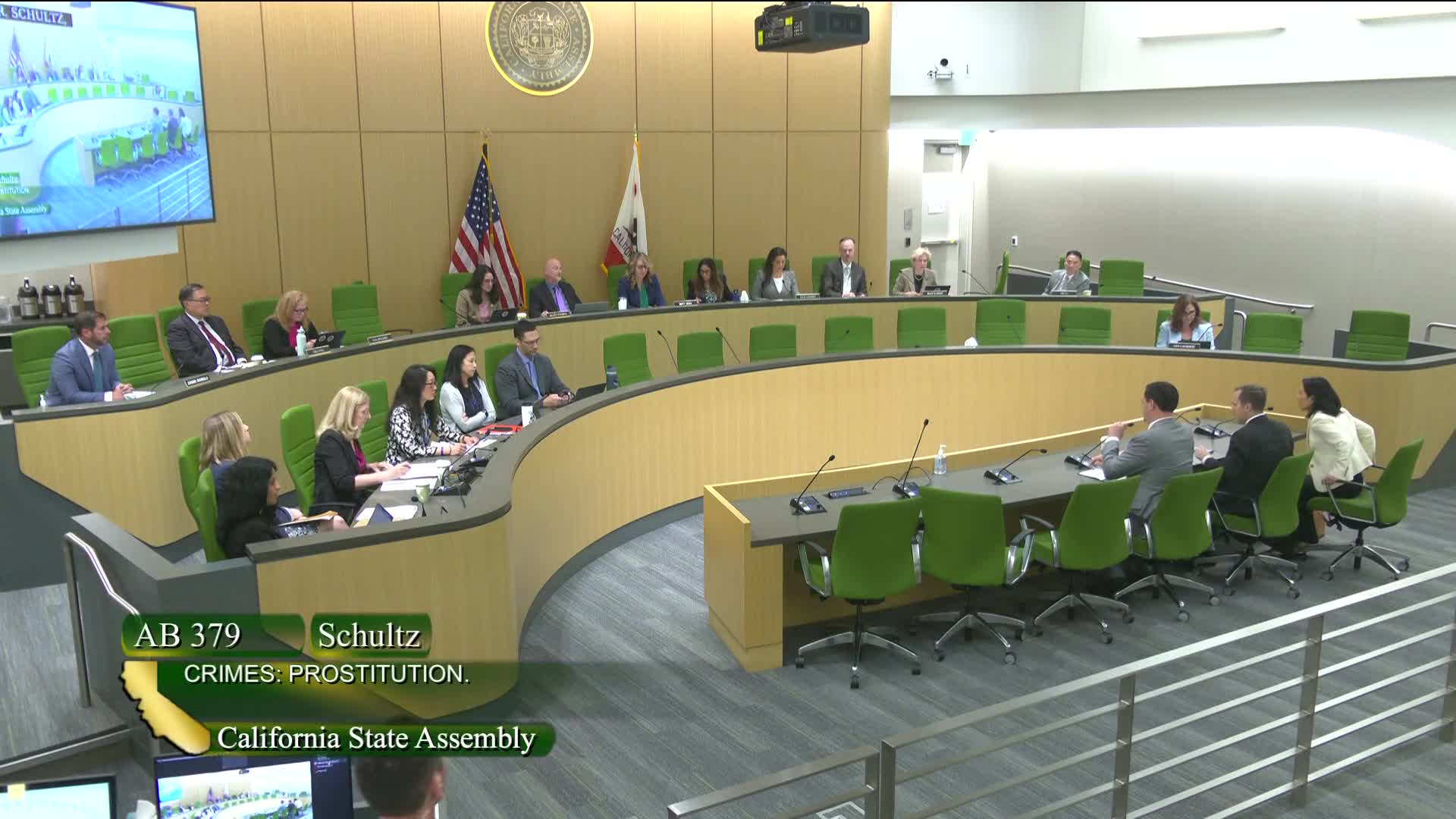
Assembly committee advances AB 379 after extended debate and public testimony on trafficking penalties and survivor support
Summary
AB 379, a human‑trafficking bill putting new and enhanced penalties and funding mechanisms in place, was presented to the Assembly Appropriations Committee on May 7 and advanced after extensive testimony and debate.
Assemblymember Schultz presented AB 379 on May 7, describing a package of amendments that broaden criminal penalties tied to solicitation of minors, increase civil penalties for businesses that facilitate commercial sex trafficking, and create survivor-support and vertical-prosecution grant programs.
Schultz said the bill authorizes felony punishment as a wobbler for an adult who solicits a minor more than three years younger and creates a misdemeanor for loitering with intent to purchase commercial sexual services. The bill would require persons convicted of solicitation of a minor granted probation to participate in an educational program addressing human trafficking. Schultz said those changes mirror certain existing age-differential approaches in California law and aim to support prosecutorial discretion where appropriate.
On financial enforcement, the author told the committee the bill clarifies enforcement authority for human-trafficking notice requirements currently in the civil code, gives the California Attorney General and Department of Justice the authority to pursue civil penalties against hotels and other establishments, and raises penalty ranges (for specified institutions from $1,000–$10,000 to $3,000–$25,000; posting failures from $500–$1,000 to $1,000–$2,000). Schultz said revenues would be deposited into a Survivor Support Fund to finance community-based services and a vertical prosecution grant program.
The hearing included extended public testimony. Opponents included current and former sex workers and advocacy groups such as the Sidewalk Project and the Sex Workers Outreach Project, who argued the bill would criminalize people of color and low-income communities, replicate failures of prior measures (including Prop 35), and divert resources from housing and harm‑reduction services. A Sidewalk Project speaker recounted a local case of a survivor who died after law enforcement used force; speakers urged a public-health, housing-first approach and criticized enforcement-based responses.
Supporters and some committee members praised the bill’s vertical prosecution component; committee discussion repeatedly returned to balancing enforcement with investments in housing and survivor services. Multiple members said they would work with budget leaders to seek funding for vertical-prosecution grants.
After questioning and extended comment, the committee moved AB 379 out on a roll call; the transcript records some members initially not voting and later vote adjustments. Members said they expect continued amendment and stakeholder engagement as the bill moves forward.