Get Full Government Meeting Transcripts, Videos, & Alerts Forever!
Get email alerts on the Public Safety Fire topic
No spam. Unsubscribe anytime.
Brawley fire chief warns of overlapping calls, seeks deputy chief and station upgrades
Summary
Fire Chief Mike York told the Brawley City Council that the department now runs about 2,900 incidents a year, 73% of which are medical calls, and that roughly 35% of incidents overlap. He asked council to consider an additional deputy chief for operations and training, replacement apparatus, and eventual station improvements or a new station.
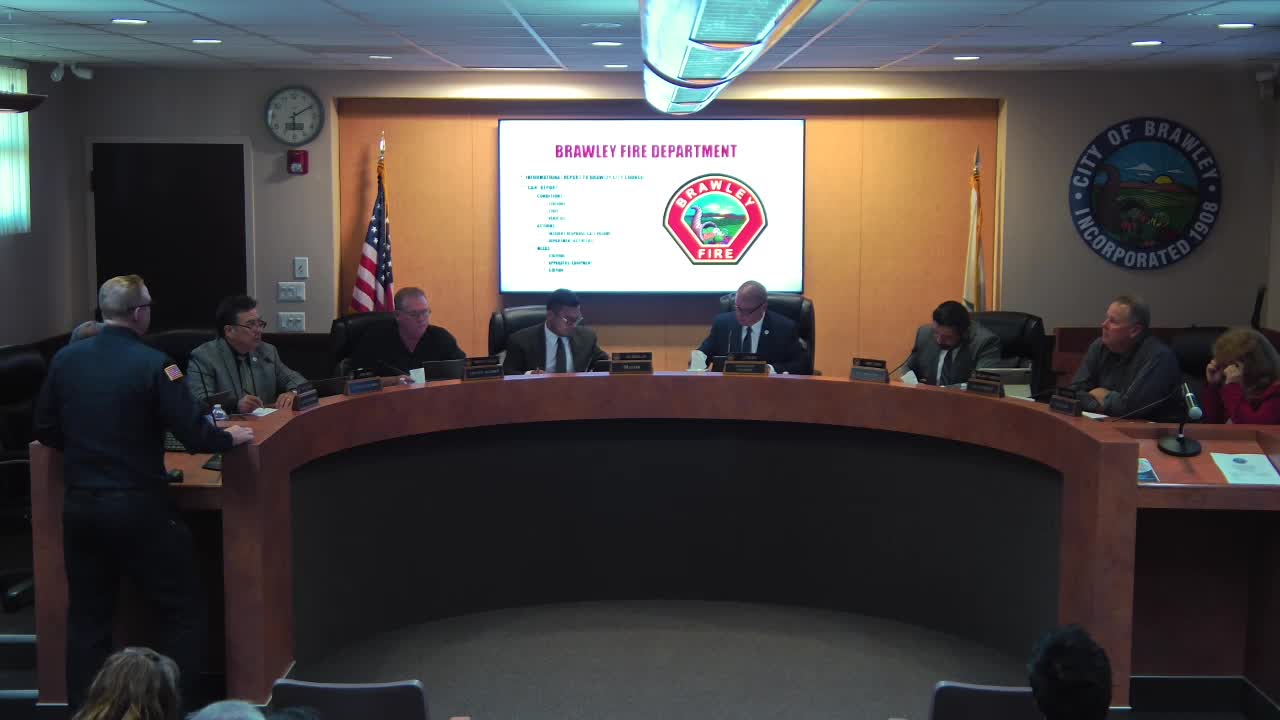
Fire Chief Mike York told the Brawley City Council on May 6 that the Brawley Fire Department now responds to about 2,900 incidents a year — roughly eight calls per day — and that roughly 73% of those calls are medical aids. “This is an all hazards department,” York said, summarizing the department’s workload and capacity.
York told the council the department operates two stations with 24 total staff, 22 assigned to shifts, a fleet of 12 units and an average of four firefighters assigned to Station 1 and three to Station 2 on daily shifts. He said the department moved to an all-career staff after operating with part‑time personnel for decades and described investments in personal protective equipment, hoses and new apparatus in recent fiscal years.
The chief emphasized a staffing and response problem he said is his biggest concern: overlapping incidents. “About 35% of our incidents overlap,” York said, meaning a call comes in while crews are already assigned elsewhere. He said that condition either depletes available staff, creates delayed responses or forces reliance on mutual aid. York said the department has so far been able to defer some calls to AMR for transports, and that the city has not suffered a “significant loss of property or life” attributable to the overlap, but that it remains a pressing operational risk.
To address capacity and training, York asked the council to approve a fiscal‑year staffing request that includes a deputy chief of operations and training. “That individual will be in charge of ensuring that all training requirements are met as well as overseeing operations such as fleet and vehicle maintenance and oversight of the department captains,” York said, describing duties currently split between himself and his deputy.
York also outlined major equipment and facilities needs: replacement of the department’s ladder truck (a 2009 Pierce estimated at $1.5 million to replace with a 36–40 month build time), additional cardiac monitors and automated CPR devices, more cordless hydraulic rescue tools (jaws of life) and upgrades to Station 1 — including raising the apparatus door height, flooring work and parking‑lot resurfacing. He said Station 1’s age and the city’s geography have contributed to slow response times to the southwest part of Brawley and that a long‑term solution could include an additional station at a site discussed with Rancho Los Lagos as part of possible annexation.
York said the department has pursued FEMA’s SAFER grant program for staffing in prior cycles but that the federal grant program’s availability remains uncertain. He outlined a multi‑year plan that added one firefighter last year and asked council to weigh the tradeoffs between pay increases and adding staff, telling council, “Do we need to pay our people more? Yes. Do we need to add staff? Yes. Do we have the funds to do both? I don't know.”
Council members asked about training incentives and how reimbursements work; York explained a mix of pay‑period stipends and percentage incentives tied to education and certifications. He also thanked the council for recent budget increases that he said have allowed the department to bring equipment procurement up to date.
York closed by thanking staff and saying he would welcome follow‑up questions; councilmembers followed with clarifying questions about certification pay, timelines for apparatus replacement and grant prospects.