
San Gabriel approves $28,108 purchase to start police drone program
Get AI-powered insights, summaries, and transcripts
Sign Up Free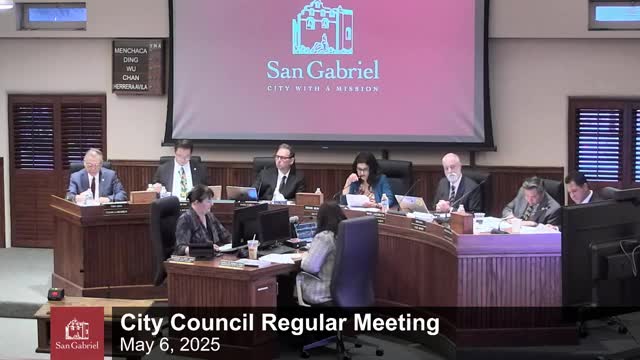
Summary
The City Council voted 5-0 to authorize a police unmanned aerial vehicle (UAV) program, approving a $28,108 purchase, training for eight officers and ongoing annual costs estimated at about $10,000.
The San Gabriel City Council on May 13 approved a resolution authorizing the purchase of unmanned aerial vehicle (UAV) equipment and related training and software for a total first-year cost of $28,108, aimed at expanding police aerial surveillance and incident response capabilities. The measure passed 5-0.
City officials said the program is intended to improve officer safety, speed response to active incidents and provide real-time situational awareness at large public events. The council’s vote authorizes purchase of two drones (a Matrice 4 configuration) along with operator training, licensing and software, and funds the initial warranty and parts coverage included in the vendor package.
San Gabriel Police staff and officers described use cases for the technology in patrol and investigations. Detective Chris Laffey said a UAV “reduces risk by providing aerial surveillance in high-risk situations, such as barricaded subjects, burglaries, or armed confrontations.” Officer Tushar Giuliani described past delays when the department had to wait for neighboring agencies’ drones and said timely local access helped resolve calls more quickly and safely. Officer Andrea Fuentes presented the fiscal breakdown, saying the first year’s total is about $28,107.40 because it includes equipment, eight operators’ Part 107 certification, software and a two-year parts warranty; recurring annual costs were estimated at roughly $10,000 thereafter for software renewals, insurance and training.
Councilmembers raised privacy and oversight questions. Councilmember Herrera Avila asked what protocols would prevent misuse and how the public would be informed; staff said the department will adopt a publicly available policy and use drone software that records deployments and provides supervisory visibility. Vice Mayor Chan and other councilmembers urged a public outreach plan; Herrera Avila and others suggested demonstrations and community education, with speakers suggesting a demonstration at a July 4 event if the equipment is available.
Staff described operational limits and program administration: pilots will be selected by the police administration; the drone operators will perform the duty as collateral assignments rather than as new paid positions; batteries yield roughly 40 minutes of flight time under typical conditions with additional batteries supplied in the package; the vendor warranty/parts coverage in the quote covers the first two years. Staff said the department will reassess equipment and program needs after year three, given rapid changes in drone hardware.
The council approved Resolution No. 25-14 to fund the purchase. Staff said $5,900 would be transferred from an internal account ending in 172, with the remaining $22,208 appropriated from the general fund for fiscal year 2024–25 and paid to the account ending in 2701. Councilmember Ding moved the staff recommendation; Councilmember Wu seconded. The motion passed by a vote of 5-0.
The decision was accompanied by direction to finalize a public-facing policy, pursue grant opportunities to offset operating costs and schedule community education about the program’s uses and safeguards. Councilmembers requested periodic reports on deployment, community outreach and program costs.
The UAV program approval places San Gabriel’s police department in line with neighboring agencies that already deploy drones, while committing the city to annual maintenance and oversight costs and to a public transparency plan.