Get Full Government Meeting Transcripts, Videos, & Alerts Forever!
Get email alerts on the Children And Families topic
No spam. Unsubscribe anytime.
Tulsa launches childrens cabinet plan; tribal leaders outline services and gaps
Summary
City Deputy Mayor Crystal Reyes described a new Office of Children, Youth and Families and a Tulsa Childrens Cabinet; representatives from the Muscogee (Creek), Osage and Cherokee nations summarized tribal programs, service capacity and needs including summer EBT, WIC, childcare and elder supports.
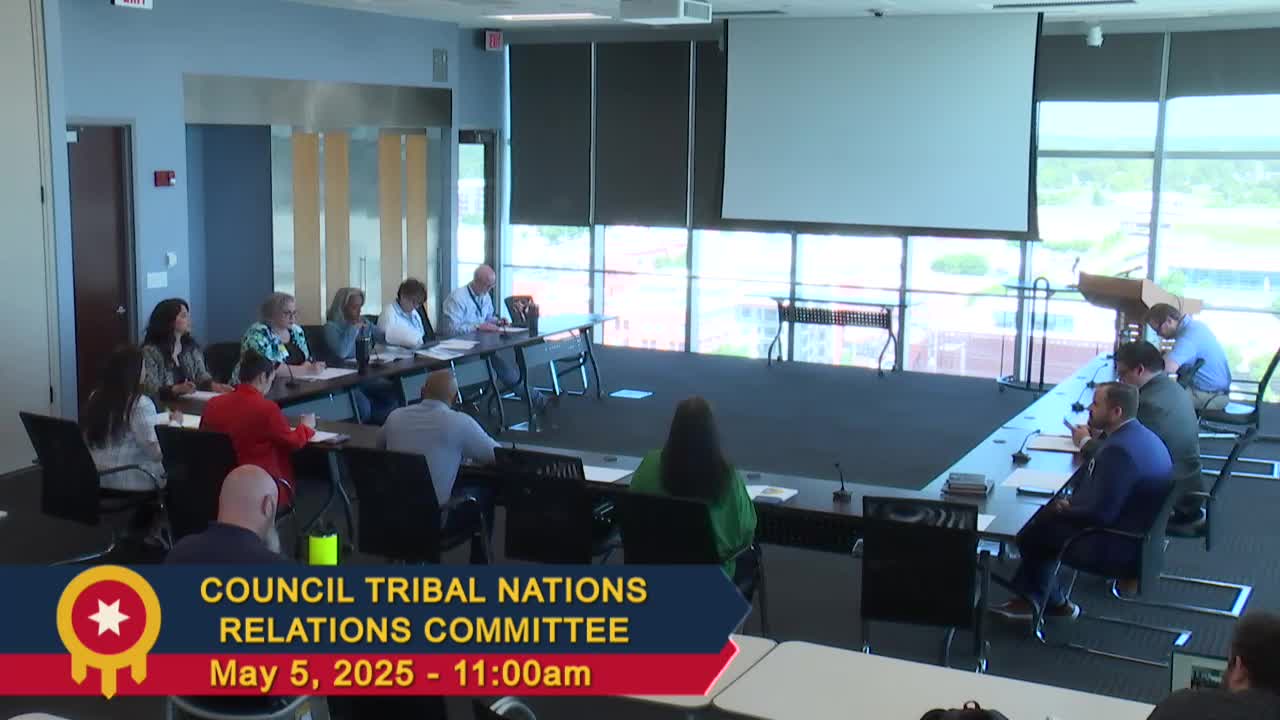
Tulsa Deputy Mayor Crystal Reyes told the Tulsa City Council Tribal Nations Relations Committee on May 5, 2025, that the city has established a mayoral Office of Children, Youth and Families and will contract with local nonprofit ImpactTulsa to run operations and begin creating a strategic plan and a childrens cabinet to align city and community efforts.
The childrens cabinet will convene cross-sector partners, Reyes said, and include "about 30 kind of representatives of institutions of systems that impact children" and focused action alliances for early childhood, career pathways and family stability. Reyes said Ashley Phillipson of ImpactTulsa will serve as director of the new office and that the mayors goal for the initiative is "to put an additional 15,000 youth on a path to economic mobility by 2030." She described the cabinet and action alliances as a structure to reduce silos and coordinate resources across city and tribal systems.
Tribal officials attending the committee described a broad set of child- and family-focused programs available through their nations and flagged gaps that affect service delivery in Tulsa and surrounding areas. Carmen Tecumseh Williams, secretary for community and human services for the Muscogee (Creek) Nation, summarized 12 programs, most providing direct services, and described child welfare, childcare, elder services and other supports the nation operates for citizens.
Williams said the Muscogee (Creek) Nations Children and Family Service Administration provides prevention services and child-protective investigations, and that the nations tribal court and attorney generals office participate in child-welfare cases. "We currently have 10 children in tribal custody," Williams said.
She described 10 childcare centers, three newly completed facilities that will double local capacity, certification of home providers, and a range of elder supports including an adult protective-services unit, an ombudsman program, food distribution sites and an elder nutrition program. Williams said the tribe provides a $7,500 funeral benefit for enrolled citizens, a $300 school-clothing stipend per calendar year for students from pre-K through college, and up to $10,000 lifetime medical-travel reimbursement for eligible tribal citizens.
Osage Nation social-services official Teresa (last name not specified in the record) described early-learning and education programs the Osage Nation operates. She said the nation runs WELA early-learning centers in Pawhuska, Albany, Fairfax and Skiatook and is integrating Osage language and culture into daily programming. "WELA is a comprehensive child development program for children ages 6 weeks through 12 years of age," she said.
The Osage representative said the Osage Nation funds college tuition assistance (quoting $172 per credit hour for community-college-level courses and up to $412 per credit hour for research university courses), assisted about 1,748 students this past academic year with nearly $7 million in tuition benefits, and runs a WIC program serving about 3,000 participants per month. She also said the nation is opening a new health clinic expected to be occupied by July 1, 2025, and plans additional behavioral-health residential and transitional facilities by 2026.
Representatives from the Cherokee Nation described using existing public-health infrastructure to operate last years Summer EBT program after the state did not administer it. A speaker for the Cherokee Nation said tribal partners collectively supported summer feeding; one speaker said tribes fed "around about 91,000" children through tribal-operated summer EBT last year and that this year tribal operations will be able to process benefits themselves.
Committee members and tribal officials discussed practical steps to connect Tulsa residents to tribal services. Cherokee Nation and Muscogee (Creek) Nation speakers suggested cross-linking tribal portals to the citys 3-1-1 page and training 3-1-1 and other call-center staff to refer callers who identify as tribal citizens to the appropriate tribal portal or contact. Reyes said the city can follow up to ensure tribal appointment invitations and contact lists are processed.
Several tribal presenters and council members raised federal funding vulnerability as a continuing concern. Speakers noted that tribes have sometimes had to "gap fill" services when federal or state funding decreased, and that tribal delivery of programs such as Summer EBT or utility assistance can require substantial administrative and IT capacity.
Votes at a glance The committee approved the minutes from the Feb. 3, 2025, meeting by voice vote. Motion recorded as "Move to approve the minutes as submitted." Outcome: approved.
Sources: Presentations and remarks at the Tulsa City Council Tribal Nations Relations Committee meeting, May 5, 2025. The meeting included city staff and representatives from the Muscogee (Creek) Nation, Osage Nation and Cherokee Nation. The committee scheduled its next meeting for Aug. 4, 2025.