DeKalb County procurement staff outline process, timelines and steps to reduce subjectivity
Loading...
Summary
Purchasing and Contracting staff presented an overview of DeKalb County’s procurement process, citing a typical solicitation timeline of about 120–150 days, ongoing work to reduce subjectivity in evaluations, implementation of an e-procurement system and remaining gaps from prior audits cited by commissioners.
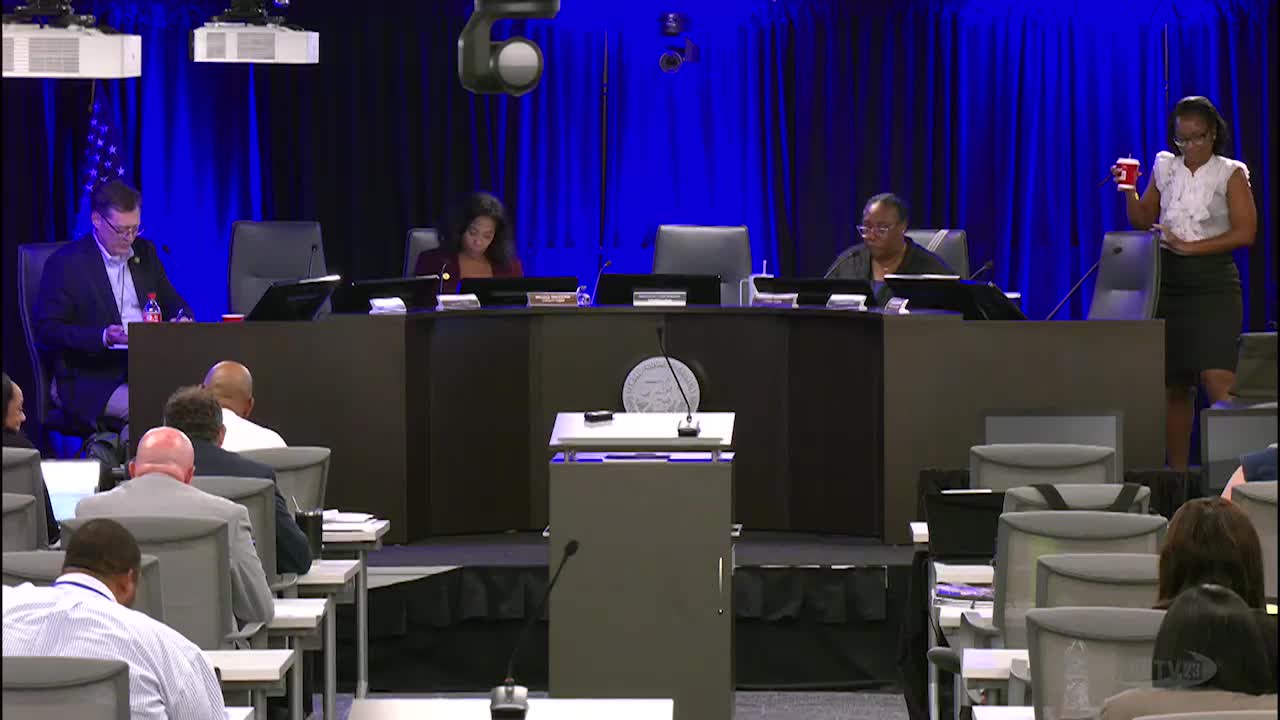
Commissioner Robert Patrick, chair of the Public Works and Infrastructure Committee, opened a discussion on the county’s procurement process and invited Attorney Butler of Purchasing and Contracting to present an overview.
Attorney Butler said the department supports more than 40 user departments and described a centralized, collaborative process that staff view as aligned with federal, state and local rules. "We have been averaging about 120 to 150 days," Attorney Butler said of the typical procurement timeline, "and that's assuming nothing goes wrong and we don't have a lot of questions and there are no issues." She said the timeline varies with complexity and that Purchasing and Contracting is benchmarking to identify efficiencies.
The presentation described seven commonly used procurement methods (sole source, emergencies, request for proposals, request for qualifications, requests for quotes, invitations to bid and others), seven stages of work from needs assessment through contract management, and a dedicated local small business enterprise (LSBE) team to support ordinance compliance. Crystal Creekmore was named as the procurement manager assigned to the commissioners' procurement team.
Butler outlined a seven-step flow: planning, procurement request development (via the Procurement Request Submittal Solution, PRSS), advertisement, opening/closing, evaluation, award and contract management. She said the evaluation phase can include performance and financial reviews, reference checks and, for watershed consent-decree work, a further multi‑stakeholder review that began after issues surfaced in 2021.
Several commissioners asked for clarifications. Commissioner Terry said he was concerned that many findings from prior audits remained unaddressed. "There is no protest provision," Terry said, referring to what he described as a gap in the county's current policy that he said forces a vendor to sue if they want to challenge an award. He cited a 2018 Office of Internal Auditor report and a longstanding question about whether DeKalb County can adopt a purchasing ordinance without a change to the county's organizational act. County counsel confirmed that legal questions about the organizational act have complicated efforts to change buying authority.
Butler said Purchasing and Contracting is moving toward more objective scoring, including developing scoring matrices and standard templates, and that an e-procurement system began phased implementation on Feb. 24, 2025. She said the e-procurement system should reduce manual document preparation and streamline template use and automations.
The presentation also clarified common misconceptions: Purchasing and Contracting does not pay vendors (Accounts Payable does); Purchasing and Contracting does not single-handedly select vendors (the governing authority or board makes award decisions); and purchasing staff do not typically write scopes of work for user departments but will assist in scope development.
Commissioners asked about frequent change orders and vendor performance. Butler said change orders are requested by user departments and reviewed collaboratively; there is no fixed numeric cutoff for allowed modifications, and each request is considered on its facts. She said the county is trying to reduce repeat change orders by better scoping solicitations and by maintaining contracts where practical (for example through treatment after clearing rights-of-way).
Attorney Butler and Purchasing and Contracting staff acknowledged they are using prior audit material and are in regular contact with the Office of Internal Audit to implement improvements. Commissioners encouraged continuing the work through the Finance, Audit and Budget (FAB) Committee and requested follow-up on outstanding audit recommendations and on the status of the organizational-act question.
Ending: Committee members thanked staff for the overview, and Commissioners Terry and others indicated they will pursue follow-up through FAB and direct communications with Purchasing and Contracting.