Get Full Government Meeting Transcripts, Videos, & Alerts Forever!
Get email alerts on the County Budget topic
No spam. Unsubscribe anytime.
Cherokee County CFO outlines 2026 budget assumptions, warns digest delay will complicate planning
Summary
CFO Marcus briefed the Board on preliminary 2026 budget assumptions, the impact of HB5891 on the digest timetable, flat non-property revenue, proposed use of fund balance and spending cuts, and key calendar dates for hearings.
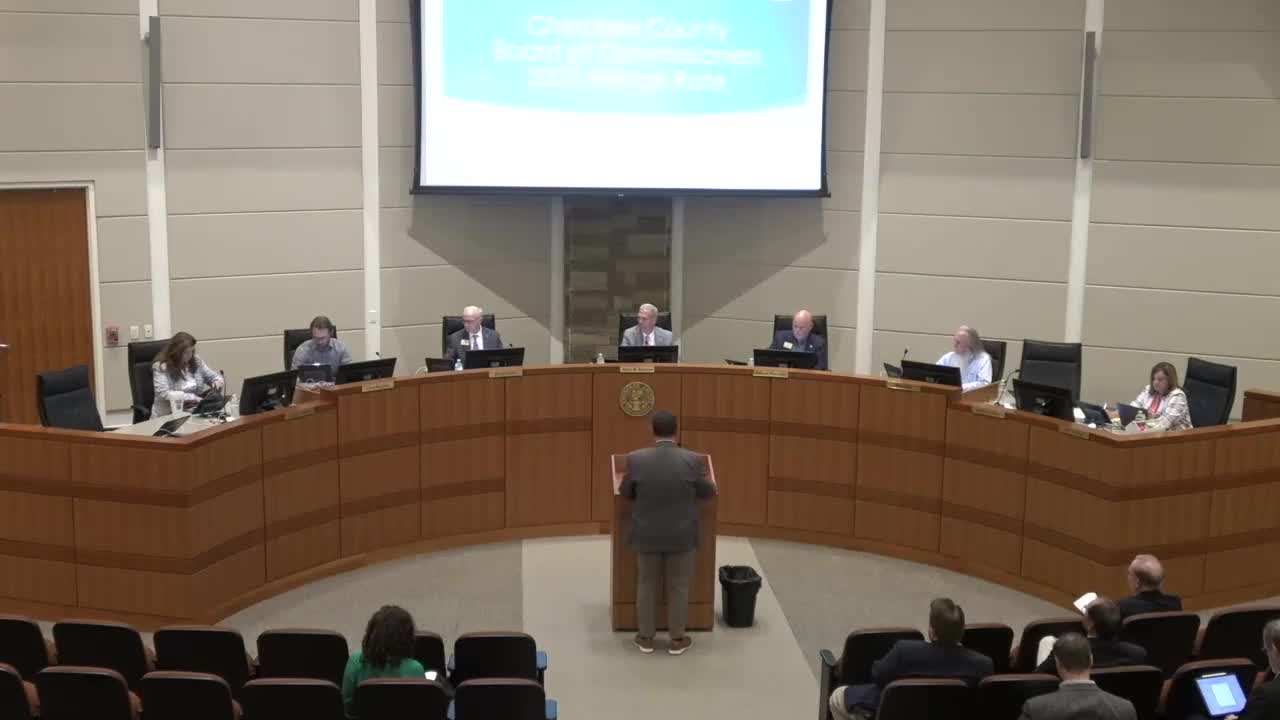
Marcus, Cherokee County chief financial officer, told the Board of Commissioners on May 6 that the passage of HB5891 delayed the digest and shifted the county’s budget timetable.
He said the delay means the county will not have finalized digest numbers until June and that the budget team is presenting assumptions and proposed cuts now so the Board can react once the digest arrives.
Marcus said continuing national and local indicators complicate planning because non-property revenues have slowed. “Property taxes are making up a greater percentage of our total revenues,” he said, adding that many other revenue categories are flat in 2025 after several years of modest growth.
Marcus summarized the county’s key assumptions for the preliminary 2026 budget: hold new positions and vehicle purchases until the digest is known, include a 3% cost-of-living adjustment (COLA), and keep the millage rate constant. He told the Board departments were instructed to limit requests and that budget staff cut roughly 55% of department asks, reducing the departments’ requested increase of about $19.4 million down to a proposed total budget increase of about $10.7 million.
Why this matters: with other revenues flat, Marcus said the county will rely more heavily on digest growth to cover cost increases. He and commissioners discussed the county’s existing reserve use — Marcus said the draft budget would again use about $7 million in fund balance, and that continued use at that level over multiple years would require policy choices later.
Key budget details and drivers
- Revenue drivers: Marcus said the county’s SPLOST receipts and other non-property revenues have slowed; fiscal-year SPLOST growth was 4.17% for FY24 and 0.66% so far in FY25, with April up 3% but overall “very flat.” - Other revenues: Ten major non-property revenue categories grew 5.8% in 2024 but show zero growth in 2025 in the county’s forecast; building inspections and intangibles are down and interest income is lower. Marcus said commission on tax collections rose because property taxes are a larger share of receipts. - Cost drivers: Personnel and COLA account for a large portion of the proposed increase — Marcus identified $3.6 million attributed to COLA and about $1.8 million to operating increases. The sheriff’s office noncompetitive pay and added positions together accounted for roughly $3.4 million in the draft (the sheriff “add back” of positions was $1.6 million and noncompetitive pay $1.8 million, Marcus said). - Capital and transfers: Capital decreased about $608,000 (fewer vehicle purchases in operating), while transfers and payments to other agencies rose (the library increase was about $458,000; EMS transfers rose about $648,000). Marcus said some vehicle purchases will be funded from SPLOST rather than operating.
E‑911 staffing and fund balance
Marcus outlined a pending decision about E‑911 staffing: the E‑911 fund could support three new positions now, drawing on its fund balance, but if E‑911 rates do not increase in coming years the general fund could be required to subsidize E‑911 for a few hundred thousand dollars annually by 2027–2028. Marcus said the E‑911 fund currently has a balance that can cover near‑term additions but that legislative changes to the per‑line fee could relieve that pressure.
Calendar and next steps
Marcus gave the Board the schedule he will follow: the tax assessor will present on June 17; Marcus will present millage-rate options immediately after the digest is known; the county’s first public hearing on millage will be July 15; the Board plans two public hearings and the millage‑rate adoption on Aug. 5 to allow the tax commissioner time to prepare bills.
Board reaction and follow-up
Commissioners asked for follow-up detail on the E‑911 fund balance and for a clearer read on how much digest growth would be needed to cover the $10.7 million increase. Marcus said roughly 5%–6% net growth in the digest would cover the current draft, but that uncertainty about new exemptions tied to HB5891 makes any early estimate imprecise.
The county will use the June digest to revise the numbers and return to the Board with millage options and a final proposed budget schedule.
Ending
Marcus and staff will provide more detailed figures after the assessor’s June 17 presentation. The Board received the preliminary presentation and directed staff to return with the digest‑based calculations and the millage options.