Get Full Government Meeting Transcripts, Videos, & Alerts Forever!
Get email alerts on the Parking And Transportation topic
No spam. Unsubscribe anytime.
Tigard releases multi‑week parking study; council to review in June before full enforcement
Summary
City staff reported results of an expanded parking study in downtown Tigard and the Tigard Triangle showing moderate on‑street utilization and pockets of overstays; council asked for more zone‑level breakdowns and scheduled a June follow‑up before moving to full enforcement.
City staff reported results from an expanded parking study covering downtown Tigard and the Tigard Triangle and outlined a phased approach of additional outreach, a June forum and a staged enforcement timeline that the council will revisit in mid‑June.
Redevelopment Manager Sean Fairley and Community Development Director Kirkman described a 40‑day data collection effort that divided the study area into more than 30 collection zones. Parking ambassadors collected counts Monday–Friday and on alternating Tuesday–Saturday schedules that included evening hours. Highlights from March–April data: downtown on‑street peak utilization reached about 64% overall (Main Street south often up to 80%), public parking lots were often at roughly 80% utilization at peak times, and the Triangle area (Dartmouth/72nd) recorded peak utilization up to 86% on Saturday evenings. Staff reported an average daily overstay (parking beyond posted time limits) rate of about 10% in downtown and about 33% in the Triangle; a majority of overstay incidents were long‑duration (four hours or more).
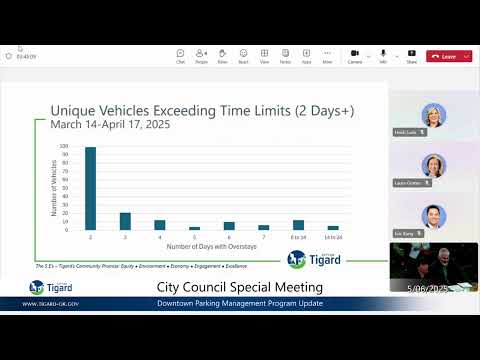
Staff also presented analysis of repeat overstays (unique vehicles with multiple overstay events) and said a notable share were vehicles observed overstaying multiple days, which likely reflects employees or nearby residents. Councilmembers requested clearer charts breaking out overstays by number of days and asked staff to produce zone‑level breakdowns; Councilor Schack asked for access to the raw data. Councilors also discussed safety for employees who may park farther from workplaces, the cost of enforcement (staff cited roughly $110,000 per year for a private enforcement contractor plus potential internal overhead) and options to survey customers about parking behavior (staff proposed a short, business‑distributed four‑question survey and agreed to keep it brief).
Next steps outlined by staff: continue notification and education through May–June (including mailers to adjacent residents and outreach via business partners), host a broader parking forum in June, return to council June 17 with an update, run a warning‑citation phase in July–August and begin time‑restricted enforcement on a scheduled date (targeted for Sept. 1) if council confirms. Several councilors requested the June follow‑up; a number also asked that staff ensure survey questions are short and that charting be clarified before the next meeting.