Get Full Government Meeting Transcripts, Videos, & Alerts Forever!
Get email alerts on the Budget topic
No spam. Unsubscribe anytime.
Wake County Board of Education adopts budget plan that uses reserve funds, draws 6-3 vote
Summary
After hours of public comment and debate, the Wake County Board of Education approved a modified 2025–26 proposed budget that uses more than half of the district's unassigned fund balance and trims a proposed teacher supplement increase; the vote followed board changes restoring dental premiums, restart-school funding and maintenance support.
The Wake County Board of Education on May 5 approved a modified 2025–26 operating budget that relies on $21.4 million of the district's unassigned fund balance and passed 6-3 after several hours of public comment and board debate.
The board's action came after the board first voted to waive Board Policy 81.01 so it could use more than 50% of its unassigned fund balance to balance next year's budget. Finance presenter David Nieder told the board that the $21.4 million draw represents about 54% of the district's unassigned fund balance as of June 2024. "That investment of $21,400,000.0 ... represents 54%," Nieder said during his presentation.
Why it matters: Board members and dozens of public speakers framed the vote as a choice between making near-term restorations to staffing and services in schools and preserving reserves for future uncertainty. Speakers repeatedly cited threats to counselors, digital learning coordinators, librarians and other school-based roles; several parents and staff urged the board to request the full additional local funding needed to avoid cuts.
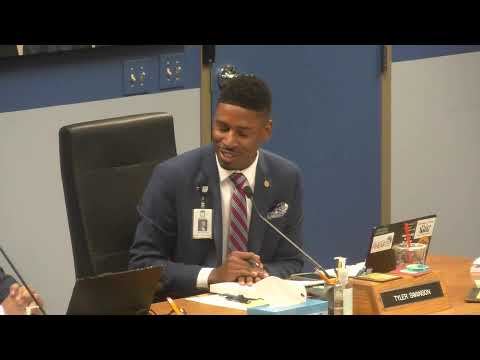
Board changes and tradeoffs: The version the board approved restored several items the superintendent initially proposed cutting. Vice Chair Swanson summarized key modifications when moving the motion: the budget keeps employer premium contributions for dental coverage (leaving employees paying $6 per month for self-only dental), restores about $6 million earmarked for "restart" schools, and removes a proposed maintenance reduction of just over $600,000. To offset those restorations, the board reduced the proposed district teacher supplement increase from 3% to 1.5%, agreed to a 1-degree change to building temperature setbacks (estimated to save $500,000), and authorized using $1 million in community-use funds on a recurring basis to offset utility and volunteer background-check costs.
Public comment: More than 40 public presenters addressed the board during a lengthy comment period. Students, teachers, librarians, parents and advocacy groups urged the board to avoid cuts to school-based positions and library collections. "Every student deserves to feel safe at school," student speaker Brandon Estevez said during the public-comment period; several librarians described fundraising and out-of-pocket spending to keep collections current. Librarian Christine Jensen said the district's 20 digital learning coordinators support 10,840 teachers and warned that proposed reductions would have systemwide effects. Multiple speakers pressed the board to seek fuller local funding from Wake County commissioners.
Board discussion and vote: Board members debated the trade-offs. Vice Chair Swanson, who chaired the budget committee, argued that the board had to present a balanced budget that both restored some district services and reflected the uncertainty of county, state and federal funding. "Our fund balance is only available for rainy days, and it's enough in there to keep the district afloat for roughly five days," Swanson said during debate. Board members who voted against the budget said they could not support cuts that directly affect classrooms or that were adopted without an independent organizational study of central-office staffing.
Roll-call result: The modified budget passed by roll call 6-3. In the recorded vote, Miss Gordon voted nay; Mr. Hershey voted aye; Dr. Ingram voted nay; Miss Edmonds voted aye; the chair voted aye; Vice Chair Swanson voted aye; Miss Mahaffey voted aye; Miss Caulfield voted nay; Miss Rice voted aye.
What remains uncertain: District staff told the board the county manager had proposed a smaller increase in county appropriation to the county commissioners (roughly $35 million) than the $40.3 million the board requested. Staff also noted uncertainty in forthcoming state and federal budgets; federal grants currently represent about 8% of the district's revenues (roughly $175 million, per staff remarks). Board members said further work with county commissioners and state legislators will continue.
Votes at a glance: the board also took these formal actions during the meeting: it waived Board Policy 81.01 to allow use of more than 50% of unassigned fund balance (motion by Vice Chair Swanson; second by Miss Edmonds; passed), approved administrative appointments and recommendations for employment that had been reviewed in closed session (motion by Mr. Hershey; second by Vice Chair Swanson; passed by voice vote), adopted two payroll-related policies (Board Policies 75.60 and 76.20) on first reading (motion carried on first reading 7-1 with one member temporarily absent), adopted the consent agenda (voice vote), and voted to return to closed session at meeting end.
Closing: Board members said they will continue advocacy at the county and state level and revisit budget choices as county and state revenues become clearer. Superintendent Robert Taylor said staff will proceed with the actions the board approved and begin follow-up work, including moving forward with an organizational study requested by some board members.