Get Full Government Meeting Transcripts, Videos, & Alerts Forever!
Get email alerts on the Agritourism topic
No spam. Unsubscribe anytime.
Planning Commission reviews agritourism rules for A‑1 properties; suggests major conditional‑use framework and safety conditions
Summary
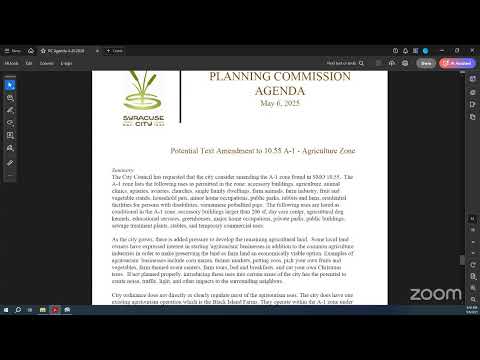
The Syracuse Planning Commission reviewed draft rules to allow agritourism activities in the A‑1 zone under a major conditional‑use process, with proposed conditions on minimum acreage, life‑safety inspections and a ban on overnight stays.
The Syracuse Planning Commission spent its work session reviewing draft language to allow agritourism activities in the A‑1 (agricultural) zone under a major conditional‑use framework.
Staff framed agritourism as activities that invite the public to working farms — examples include corn mazes, pick‑your‑own operations, petting zoos, farm tours, farmers markets, small farm stores selling Utah local products, and farm‑themed event centers such as wedding barns. Staff said one existing local example, Black Island Farms, operates under a temporary commercial conditional use and noted a major conditional use would require public notice and a public hearing and allow the planning authority to impose and later revoke conditions if the operation created unacceptable impacts.
Commission discussion focused on public‑safety and operational items: staff proposed requiring a minimum parcel size (a 5‑acre floor was suggested by commissioners), prohibiting overnight stays and short‑term rentals, requiring structural review and compliance with life‑safety codes (NFPA 101 and current International Fire Code requirements), and ensuring adequate fire apparatus access and parking. Commissioners emphasized that older barns and other existing structures intended for public gatherings must be evaluated for structural safety and that fire department access may require specific surfacing or access lanes (IFC Appendix D was discussed). ADA accessibility, stormwater/parking impacts, and visuals such as lighting and noise were raised as conditions the city should be able to address through the conditional‑use process.
Staff said the draft list of permitted agritourism activities could be made explicit (for example, farm stores selling Utah local meat, eggs, honey, produce, jams, cheese, and similar items) while also allowing the land‑use authority to impose additional, site‑specific conditions. Commissioners asked staff to refine the draft language to add express references to new structures, inspections for existing structures used for public gatherings, life‑safety compliance, and a mechanism to allow exceptions if warranted by the land‑use authority. Staff will revise the proposed language and return the item to a future meeting for additional discussion and possible referral to City Council.