Get Full Government Meeting Transcripts, Videos, & Alerts Forever!
Get email alerts on the Property Tax Reassessment topic
No spam. Unsubscribe anytime.
Prince George supervisors review reassessment results; extend BOE application deadline and authorize attorney to probe vendor contract
Summary
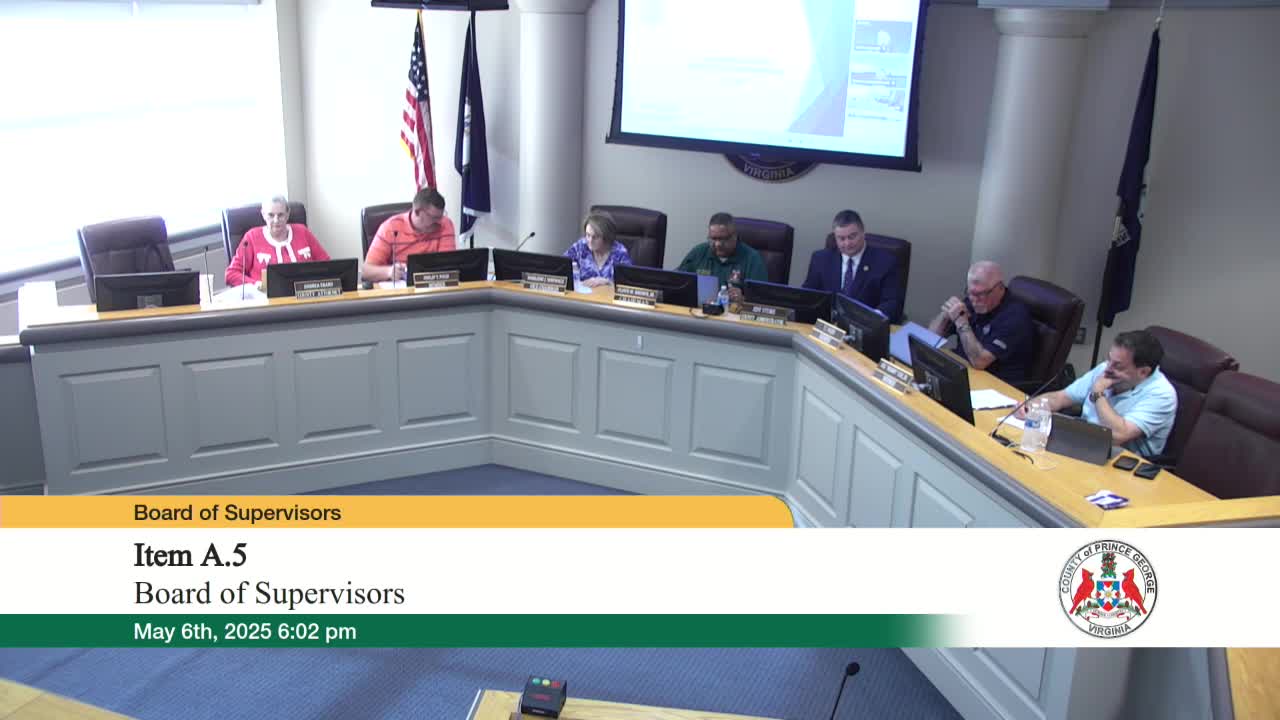
Prince George County Board of Supervisors members on May 6 heard a detailed fiscal 2026 reassessment update from Vision Government Solutions and discussed its implications for the county budget, then approved procedural steps to give residents more time to appeal and authorized the county attorney to investigate potential contract deficiencies with the vendor.
Prince George County Board of Supervisors members on May 6 heard a detailed fiscal 2026 reassessment update from Vision Government Solutions and discussed its implications for the county budget, then approved procedural steps to give residents more time to appeal and authorized the county attorney to investigate potential contract deficiencies with the vendor.
Vision consultant Brian Cunningham presented the reassessment work, saying the firm inspected every property using aerial imagery, qualified and reviewed sales, and created valuation models before informal reviews. "We reviewed every sale, either qualified or unqualified them," Cunningham said. He told the board his team reconfigured the county into 92 appraisal neighborhoods and completed three iterations of land and building valuation models.
Why it matters: the reassessment changes feed directly into the county’s fiscal 2026 revenue estimate and the value of a penny of tax revenue. County staff told the board that updated assessment numbers received May 1 reduced the growth used in the introduced budget, lowering the increase in projected real estate tax revenue by about $585,000 from the introduced budget figures and raising the equalization rate one penny to $0.74. Staff said keeping the tax rate at the advertised $0.82 would still yield an increase in real estate tax revenue for FY 2026, but smaller than earlier estimated.
Key presentation points and figures
- Vision reported it posted nightly updates to the public-facing system and planned to mail change-of-assessment notices to 3,221 parcels; of those, Vision said 45 notices reflected increases while 3,176 reflected decreases. Cunningham said the firm and county staff had completed informal reviews and office reviews with property owners.
- The firm said it established 92 appraisal neighborhoods for more granular, table-driven mass appraisal modeling; its largest two neighborhoods contain about 1,100 and 900 parcels respectively.
- Vision said roughly 4.4% of parcels (the firm cited the number as the percent represented by parcels reviewed informally) were the subject of informal hearings during the reassessment process. Cunningham called a 4.4% informal rate “very good” compared with typical reassessment projects.
- Cunningham told the board the informal reviews and adjustments reduced appraisal totals by roughly $91 million, or about 1.9% of the pre-informal total, and that residential values showed the largest relative increase (about 14% in one cited measure) while commercial/industrial/multifamily declined roughly 2.5%.
Board members pressed Vision and county staff on process and transparency
Supervisors repeatedly questioned the clarity of notices and how residents could obtain working papers and supporting data. Supervisor Pugh said many residents read the preliminary notice as a final assessment and that confusion drove public concern. "This isn't right or they're charging me for something I didn't have or vice versa," Pugh said, arguing that some residents perceived the preliminary notice as the final value.
Vision's presenters said they had begun sending more complete working papers and sales files to property owners who requested them; they described the working-paper packet as a manual with tables and cost ladders (the presenter said the manual was about 60 pages and cost-letter pages averaged about two pages per property). Vision said it provided property record cards, a complete sales file (qualified and unqualified sales), and the procedures guide and that a limited set of final working papers had been distributed to property owners who continued to request them.
Supervisors and staff also discussed customer service. Several supervisors said residents reported delays or no return calls from Vision; Vision acknowledged capacity limits and said staff attempted to return calls and to direct residents to the informal and office-review processes. County staff said they had asked Randy Horn’s assessor staff to step in to help resolve inquiries.
Budget implications discussed
County finance staff updated the board on how the May assessment figures affect the FY 2026 introduced budget. The county’s projected real estate tax revenue growth used in the introduced budget was reduced by about $585,000 in the May 1 update; combined with a $350,000 decline in public service corporation tax assessments, staff reported a combined revenue decrease of roughly $935,000 compared with introduced estimates, before other adjustments. The presentation noted the introduced budget had kept the real estate tax rate at $0.82; with the revised values the value of a penny of tax revenue dropped slightly (staff estimated about $416,000 per penny after the update).
Finance staff outlined options to cover the reduced revenue, including trimming the increase to the school transfer (staff estimated a proportional reduction would lower the required cuts by about $167,000), scaling back some new county positions or reclassifications included in the introduced budget, trimming non–public-safety pay adjustments, or lowering contingency. Staff said they would circulate a spreadsheet of budget choices to supervisors by Friday and asked the board to consider tradeoffs before adoption later in May.
Board actions taken
After discussion the Board took three formal actions related to the reassessment and budget schedule:
- The supervisors set an additional budget work session in May at 6 p.m. (motion moved by Mr. Cox; second by Mr. Pugh; roll call: Wymack—Yes; Cox—Yes; Pugh—Yes; Webb—Yes; Brown—Yes). The motion carried.
- The board approved a resolution extending the Board of Equalization application deadline from May 30 to June 30 to give residents and staff additional time to resolve issues before formal BOE hearings (motion moved by Mr. Webb; second by Mr. Pugh; roll call: Pugh—Yes; Webb—Yes; Brown—Yes; Wymack—Yes; Cox—Yes). The motion carried.
- The board approved a resolution authorizing the county attorney to investigate potential contractual deficiencies with Vision Government Solutions and, if appropriate, send a 30-day notice allowing the vendor to cure any deficiencies under the contract (motion moved by Mr. Webb; second by Mr. Cox; roll call: Webb—Yes; Brown—Yes; Wymack—Yes; Cox—Yes; Pugh—Yes). The motion carried.
What the BOE extension and attorney action mean
County staff and the county attorney told the board the BOE extension would give residents and staff more time to file BOE applications and for assessor-staff and Vision to attempt to resolve cases administratively before formal BOE hearings. The county attorney explained that the contract with Vision may require the county to notify the vendor in writing of specific deficiencies and give the vendor 30 days to cure them; the board authorized her to take those steps if warranted.
Next steps and timeline
Staff said change-of-assessment notices would be mailed imminently (Vision stated notices went to the printer and should reach mailboxes within days). County finance staff will circulate an updated budget-choice spreadsheet by Friday and the board scheduled the May budget work session to finalize reductions and choices ahead of the May budget adoption timeline. The BOE application deadline is now June 30.
The board did not adopt any tax-rate change at the May 6 meeting; staff said a public hearing on the real estate and manufactured-home tax rates will be held the following week as previously scheduled.