Get Full Government Meeting Transcripts, Videos, & Alerts Forever!
Get email alerts on the Broadband topic
No spam. Unsubscribe anytime.
Harney County Court backs partners to pursue BEAD broadband funding, agrees to provide letters of support
Summary
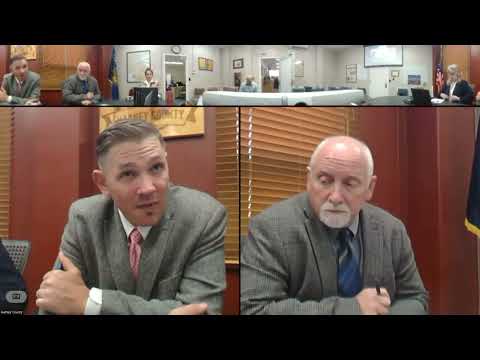
Harney County Court voted unanimously May 6 to authorize Rural Prosperity Partners to develop a BEAD application and to provide county letters of support if a provider-led project is identified. Commissioners stressed guardrails to avoid duplicating local provider plans.
Harney County Court on May 6 voted to support Rural Prosperity Partners’ effort to develop a Broadband Equity, Access, and Deployment (BEAD) grant application and to provide county letters of support if a qualified internet service provider (ISP) proposes a project serving parts of the county.
The action followed a lengthy briefing by Commissioner Dorough and outside consultants from Rural Prosperity Partners, who said the Oregon Broadband Office opened the BEAD application window and that Harney County has been prequalified. Commissioner Dorough said the federal BEAD allocation to Oregon totals about $688.9 million and that the BEAD application window closes May 22. “The BEAD application window is now open and it closes on May 22,” Dorough said.
Rural Prosperity Partners staff said they are in early discussions with potential providers, including Warm Springs Telecom and Link Oregon, about a joint application that could target one school district as the service area. Rachel Maddock Hughes of Rural Prosperity Partners told the court “there is no cost to you guys to help with applications,” and said the county’s main role would be to provide timely letters of support and certain approvals at later stages if an application proceeds.
Why it matters: BEAD is the largest federal broadband program for states, with rules that require applicants to demonstrate coverage, affordability and local support. A county letter carries points in the application scoring; Rural Prosperity Partners’ presenters said lacking those letters could reduce an application’s competitiveness.
What the county discussed and decided - Scope and partners: Presenters described pursuing a hybrid solution (fiber where feasible, fixed wireless for outlying locations) focused on a school-district footprint rather than attempting to cover the entire county. Joe (last name not provided), a technical lead with Rural Prosperity Partners, explained that some portions of the targeted districts could receive fiber while outlying households would likely receive fixed wireless, but any non-fiber solutions would still have to meet minimum BEAD speeds (at least 100 Mbps down / 20 Mbps up in the state scoring guidance).
- Duplication concerns: Commissioners repeatedly raised concern about duplicating local private investment, specifically referencing MiWayve — a local ISP that has an independent fiber project under way. Commissioners asked presenters to consider targeting Crane (Harney School District 4/Crane School District) or other areas where MiWayve is not planning service so federal funds would not simply duplicate private builds.
- Letters of support and guardrails: Presenters asked the court to pre-authorize letters of support so Rural Prosperity Partners would not have to wait for the next meeting if an application needed county backing before the state deadline. Commissioners approved that request with the caveat that letters be specific to a defined project and that the county can set guardrails (for example, target Crane School District instead of areas already served). The motion passed by voice vote; commissioners signaled unanimous approval.
- Match and costs: Presenters said BEAD applications require matching funds and that Rural Prosperity Partners is exploring matching options with potential ISPs. Presenters and commissioners noted engineering and design work would be needed to estimate build costs; no county financial commitment to match was made at this time.
Quotes - Commissioner Dorough: “Harney County went through an extensive application process to get prequalified for BEAD…we were really encouraged by the Oregon Broadband Office to get prequalified even though we didn't feel we had the capacity ourselves.” - Rachel Maddock Hughes, Rural Prosperity Partners: “There is no cost to you guys to help with applications.” - Joe (Rural Prosperity Partners): “When we talk about anything other than fiber, it still has to provide at least a hundred megabits per second download and 20 megabits upload.”
What happens next: Rural Prosperity Partners will continue negotiations with potential ISPs and return to the county with project specifics. The court authorized county staff (Holly York, executive assistant) to serve as the county point of contact and to provide letters of support for an identified applicant and project, with guardrails the court requested.
Context and background: BEAD (Broadband Equity, Access, and Deployment) is a federal program administered in Oregon by the Oregon Broadband Office. States must prioritize unserved and underserved locations, and applications are evaluated on technical feasibility, affordability commitments and local support. Harney County officials and Rural Prosperity Partners said the county has little or no local matching funds and is relying on partners and other matching sources if an application proceeds.
Funding and scale: Presenters identified one likely target — a school district with roughly 700 fundable locations (about 601 unserved and 99 underserved based on state mapping) — but said final scope and costs will be set by engineering work and the chosen provider’s proposal.
The court’s vote was procedural approval to allow Rural Prosperity Partners to prepare an application and for the county to provide project-specific letters of support when requested. No county financial commitment was authorized at this meeting.
Ending: Rural Prosperity Partners and county staff said they expect to have clearer information later in the week and will alert the court once a potential applicant and target district are identified.